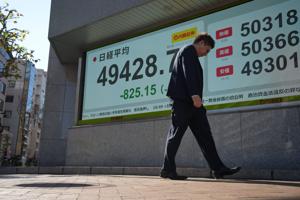
World shares and U.S. futures experienced a noticeable decline on Monday, as Tokyo’s benchmark index fell nearly 2%. This drop followed remarks from Bank of Japan Governor Kazuo Ueda, who indicated a potential interest rate hike could be discussed at the central bank’s upcoming meeting on December 19. Oil prices surged by more than $1 per barrel, adding to the market’s volatility.
In early trading, futures for the S&P 500 were down by 0.6%, while the Dow Jones Industrial Average showed a decrease of 0.5%. Major European indices also reported losses, with Germany’s DAX declining 1% to 23,589.90, and the French CAC 40 falling 0.5% to 8,079.94. The UK’s FTSE 100 edged down 0.1% to 9,707.68. In Japan, the Nikkei 225 declined 1.9% to 49,303.28, reflecting investor concerns over rising interest rates.
The Bank of Japan has maintained a benchmark interest rate of 0.5% for years, struggling to stimulate economic growth and combat deflation. With inflation stabilizing above the target of 2%, the central bank faces a challenging decision: raise rates to counter inflation and support a weaker currency, or maintain easy credit to encourage borrowing and consumer spending.
Economic reports on manufacturing activity are under scrutiny, particularly regarding the impact of heightened tariffs imposed by the U.S. on Asian economies. A recent survey of Japanese factory managers revealed a slowdown in manufacturing activity, with the S&P Global Japan Manufacturing Purchasing Managers Index (PMI) registering at 48.7 for November. Although this represents a slight improvement from October’s 48.2, it remains below the critical threshold of 50, indicating ongoing contraction.
“The latest PMI data showed that Japan’s manufacturing sector continued to struggle with weak demand conditions,”
stated Annabel Fiddes, economics associate director at S&P Global Market Intelligence. The survey highlighted a solid decline in overall new business, emphasizing the struggles faced by manufacturers.
In China, factory activity has contracted for the eighth consecutive month, as indicated by an official survey released on Sunday. This trend underscores the challenges faced by the Chinese economy, even as a trade truce with the U.S. remains in effect. Conversely, Hong Kong’s Hang Seng index rose by 0.7% to 26,033.26, while the Shanghai Composite also gained 0.7%, reaching 3,914.01. In South Korea, the Kospi dipped 0.2% to 3,920.37, while Australia’s S&P/ASX 200 fell 0.6% to 8,565.20. Taiwan’s Taiex lost 1%, and India’s Sensex decreased by 0.1%.
Despite the weak manufacturing data, consumer spending during the Black Friday and Cyber Monday shopping events is projected to exceed expectations. During the abbreviated trading session following Thanksgiving, the S&P 500 rose 0.5%, the Dow increased by 0.6%, and the Nasdaq gained 0.7%. Trading was temporarily halted for all three indices due to a technical issue at the Chicago Mercantile Exchange, linked to an outage at a CyrusOne data center.
Last week, stocks rallied on hopes for another rate cut from the U.S. Federal Reserve, following a mid-November decline triggered by concerns about the sustainability of the artificial intelligence market boom. Notably, Nvidia saw a drop of 1.8% on Friday, concluding the month with a double-digit loss. Oracle experienced a 23% decline in November, while Palantir Technologies fell by 16%. Conversely, some technology stocks, including Alphabet, enjoyed gains, with a nearly 14% increase attributed to excitement surrounding its recently launched Gemini AI model.
The U.S. Federal Reserve is facing complex decisions regarding interest rates as inflation continues to rise while the job market shows signs of weakening. Although further rate cuts could provide economic support, they may also exacerbate inflation. Minutes from the Fed’s October meeting indicated potential divisions among policymakers regarding future decisions.
In commodity markets, U.S. benchmark crude oil rose $1.14 to $59.69 per barrel, while Brent crude achieved a similar increase, reaching $63.52 per barrel. The U.S. dollar weakened against the Japanese yen, falling to 155.25 yen from 156.14 yen. The euro strengthened against the dollar, rising to $1.1622 from $1.1596. Additionally, Bitcoin’s value dropped by 4.3%, trading at $87,115.
As the week unfolds, investors will continue to monitor economic indicators and central bank decisions that could significantly influence market trends across the globe.