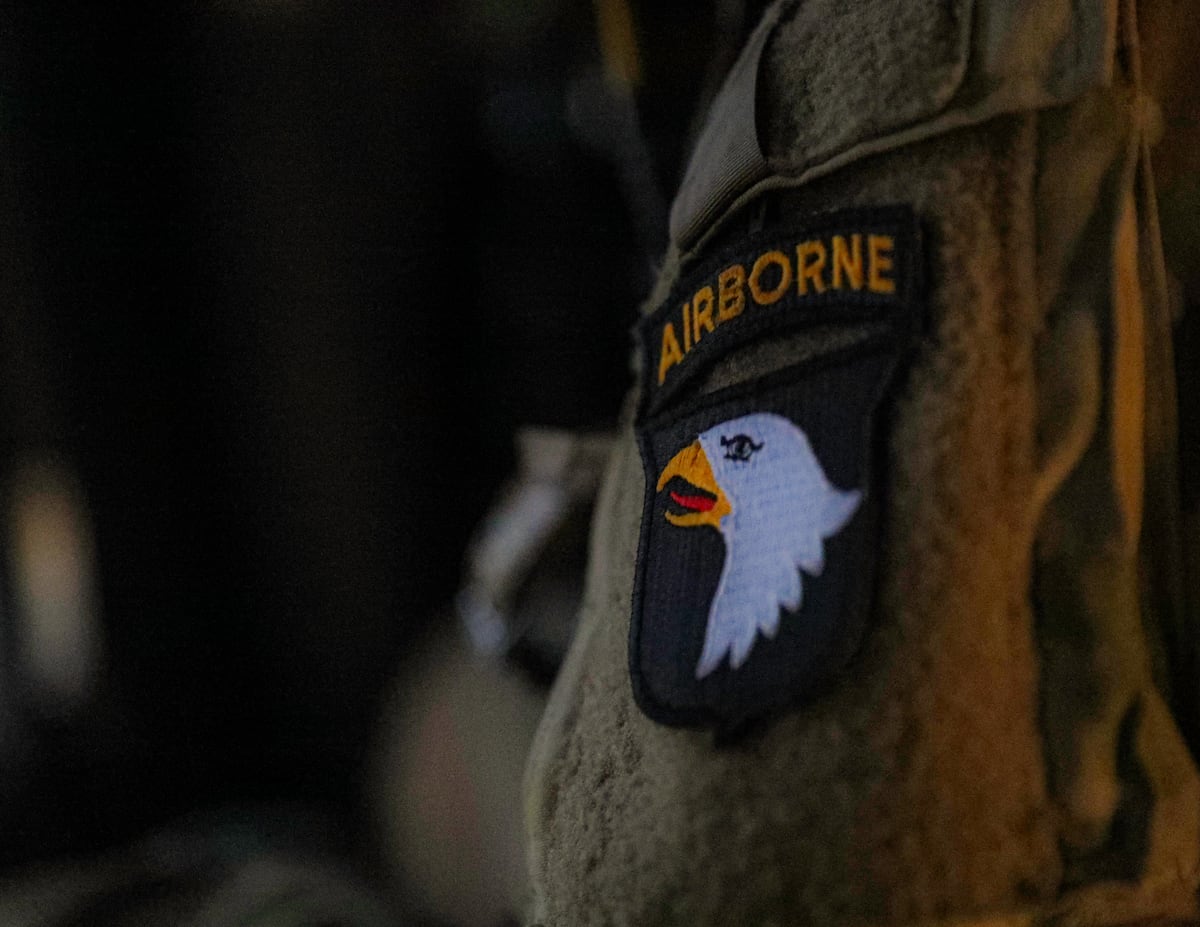
The 101st Airborne Division, renowned for its storied history and highlighted in Stephen Ambrose’s “Band of Brothers,” has played a pivotal role in American military history. From its daring parachute landings on D-Day to engagements in Vietnam, Iraq, and Afghanistan, this division is synonymous with courage and resilience. However, the intriguing origins of its distinctive insignia, the screaming eagle, trace back to a remarkable war bird from the Civil War era.
The eagle, known as Old Abe, was captured as a chick in 1861 by Ahgamahwegezhig, also known as Chief Big Sky, from the Lac du Flambeau Band of the Lake Superior Ojibwe. Sold for a bushel of corn to Daniel McCann in Chippewa County, Wisconsin, Old Abe initially served as a family pet. As he grew larger and more expensive to maintain, McCann sought a buyer among the troops gathering for deployment at Camp Randall in Madison.
Eventually, Old Abe was sold for $2.50 to Captain John E. Perkins, leader of the militia company known as the Eau Claire Badgers. This marked the beginning of a legendary partnership as Old Abe became an official mascot for the 8th Wisconsin Infantry, which was later re-designated as Company C, 8th Wisconsin Volunteer Infantry Regiment. The unit quickly adopted the nickname “Eagle Regiment,” a fitting tribute to their feathery companion.
Old Abe traveled into battle with the 8th Wisconsin, perched on a black shield affixed to a wooden pole. He witnessed 37 battles and skirmishes, including significant engagements at Vicksburg and Corinth. His original owner, Captain Perkins, succumbed to wounds sustained in battle on May 11, 1862, yet Old Abe continued to serve as a source of inspiration and entertainment, often performing tricks for the troops.
The eagle’s presence was so impactful that Confederate soldiers often expressed a greater desire to capture Old Abe than to take an entire brigade. Colonel Rufus Dawes of the 8th Wisconsin recalled how prisoners remarked they would trade more to seize the eagle than to capture a whole unit. Confederate General Sterling Price famously declared during the Battle of Corinth that capturing Old Abe was a priority, stating, “that bird must be captured or killed at all hazards.”
Despite the attempts to capture him, Old Abe remained with his unit until it mustered out in 1864. The men of the 8th Wisconsin donated the eagle to the state of Wisconsin, where he became a symbol at various political, social, and cultural events. Unfortunately, his living conditions deteriorated over time, leading to bouts of malnutrition and exposure.
In 1881, a fire broke out in the Wisconsin State Capitol building. Old Abe survived the blaze but succumbed to smoke inhalation shortly thereafter. His death marked the end of an era, yet his legacy as an emblem of valor endures. The 101st Airborne Division adopted the screaming eagle insignia in 1921, ensuring that Old Abe’s spirit continues to inspire generations of soldiers.
Today, the 101st Airborne Division stands as a testament to the bravery and tenacity of its members, with the iconic eagle emblem serving as a reminder of the sacrifices made by those who wore the uniform. The story of Old Abe is not just a chapter in military history; it encapsulates the enduring spirit of the troops who have fought under the banner of the screaming eagle.