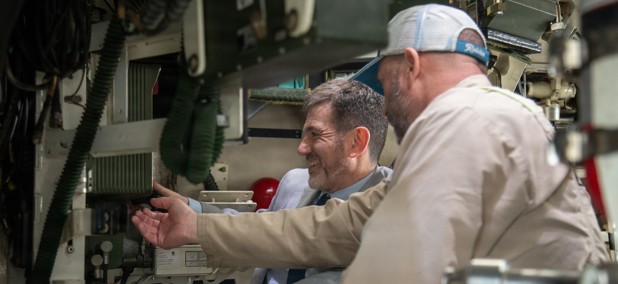
General Dynamics is reshaping its approach to technology development by uniting competitors in a collaborative environment. Two of its divisions are establishing creative spaces and events aimed at fostering cooperation among companies, with a focus on accelerating the development and delivery of military technology. This week, General Dynamics Information Technology (GDIT) inaugurated a new **5,200 square-foot** digital lab named the **Mission Emerge Center** just outside **Fort Belvoir, Virginia**.
The center’s primary objective is to collaborate with various companies, including cloud service providers, to develop military technology and showcase its capabilities to Pentagon officials. As GDIT President **Amy Gilliland** articulated on **December 2, 2023**, this dedicated space allows for a more effective demonstration of new technologies than is typically possible within the confines of the Pentagon. “We can create solutions that we showcase here that are attached to a sandbox environment that we’re building where the customer can actually see things,” she said.
The initiative comes in response to the Pentagon’s increasing demand for defense contractors to assume greater risks in technological advancements. **Defense Secretary Pete Hegseth** emphasized this need during a speech on **November 7, 2023**, where he highlighted the urgent pace at which adversaries are developing new capabilities. He stated, “If we are going to prevent and avoid war, which is what we all want, we must prepare now.”
GDIT’s strategy reflects a significant shift from its previous model, which focused primarily on executing enterprise IT solutions. The company is now investing in the creation of products and establishing strategic collaborations with other tech firms. Gilliland noted that the new directive for leaders within GDIT’s emerging tech sector is to identify and collaborate with companies that possess promising technologies. “Those partnerships can ultimately end up being a teaming arrangement. They could be an acquisition in the future,” she explained.
Significantly, GDIT does not charge companies for access to the Mission Emerge Center, emphasizing a commitment to fostering innovation. Dale Hogan, GDIT’s senior director of information systems, noted that companies voluntarily contribute their research and development efforts alongside GDIT, enhancing the potential for impactful technology solutions.
In addition to the Mission Emerge Center, **General Dynamics Land Systems**, which specializes in combat vehicle manufacturing, is also adapting its strategy. The division plans to join **Newlab**, a coworking space in downtown **Detroit**, to collaborate with startups and investors. Business development leader **Scott Taylor** confirmed that this arrangement aims to overcome the limitations imposed by stringent security protocols at their current facility.
Last week, General Dynamics Land Systems utilized Newlab to host the **Maneuver Warfighter Industry Symposium**, where military leaders, investors, and drone technology companies convened to address challenges faced by ground troops. Taylor emphasized the military’s encouragement for industry stakeholders to organize collaboratively to solve critical issues, stating, “Senior leaders in the Army—from the secretary to the chief—have been encouraging industry to start self-organizing.”
The inaugural symposium featured a range of defense tech companies, including **Anduril**, **Palantir**, and **Autonodyne**. Taylor expressed optimism about future collaborations, stating, “We all have a very similar common goal: We want to support the U.S. military and our allies’ needs.”
While the initiative to foster collaboration among competitors is promising, challenges remain. The competitive environment within the defense sector can complicate open communication and collaboration. Taylor acknowledged this, noting the potential risks of working alongside competitors, stating, “You fill a room with 24 companies, and some of them are competitors with each other. They’re not always forthright in being very open.”
As General Dynamics moves forward with these initiatives, the formation of effective partnerships and collaborations will be crucial. Taylor acknowledged, “Do we have the right team put together? Not yet. It’s still in development right now.” The ongoing evolution of these projects will ultimately determine their success in meeting the Pentagon’s needs for advanced military technology.