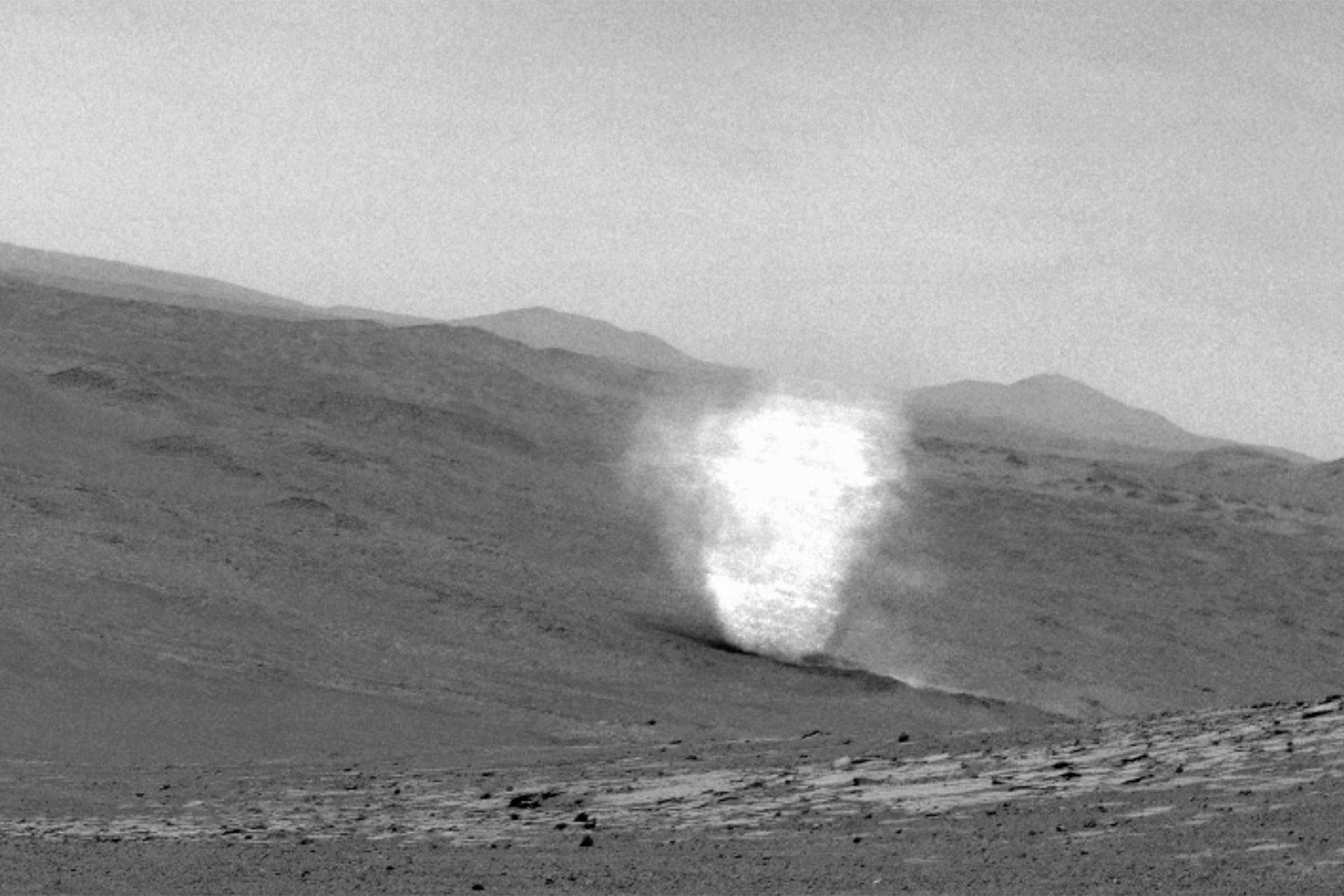
NASA’s Perseverance rover has made a groundbreaking discovery on Mars by capturing evidence of electrical discharges associated with dust devils. This weather phenomenon, long theorized but never directly observed, confirms that lightning occurs in the Martian atmosphere, as detailed in a recent study published in the journal Nature.
Dust devils are whirlwinds formed by rapidly rising columns of warm air, similar to those on Earth. They are a common feature of the Martian landscape, created when warm air near the surface rises through cooler air above. It was suspected that the dust caught within these whirlwinds generates a static charge through friction, a process known as the triboelectric effect. This is akin to the spark produced when one shuffles across a carpet and touches a metal object.
According to Baptiste Chide, the lead author and planetary scientist at L’Institut de Recherche en Astrophysique et Planétologie in France, “Triboelectric charging of sand and snow particles is well documented on Earth, particularly in desert regions, but it rarely results in actual electrical discharges.” He further explained that the thin atmosphere of Mars makes it easier for electrical sparks to form, as the threshold for discharges is significantly lower compared to Earth.
Despite the increasing understanding of atmospheric phenomena on planets like Saturn and Jupiter, the absence of confirmed lightning on Mars had frustrated scientists for years. The breakthrough came unexpectedly as a result of the Perseverance rover’s SuperCam instrument, which is primarily designed to analyze the acoustics of Martian rocks.
Since its mission commenced in 2021, the SuperCam has recorded a total of 55 electrical disturbances. Notably, 16 of these occurred when a dust devil passed directly over the rover. The researchers deduced that these discharges were not linked to the planet’s frequent dust storms, suggesting they originate from the dust devils instead. This fortunate occurrence allowed scientists to confirm their long-held suspicions.
The implications of this discovery are significant. Lightning has the potential to induce unique chemical reactions that could alter the chemical balance of the Martian surface. This might increase the likelihood of forming complex compounds and possibly even organic molecules, raising further questions about the planet’s capacity to harbor life.
As research on Mars continues, this finding opens new avenues for understanding the planet’s weather systems and their potential impacts on its geology and chemistry. The Perseverance rover, with its innovative instruments, remains at the forefront of this exploration, providing insights that could reshape our understanding of the Red Planet.