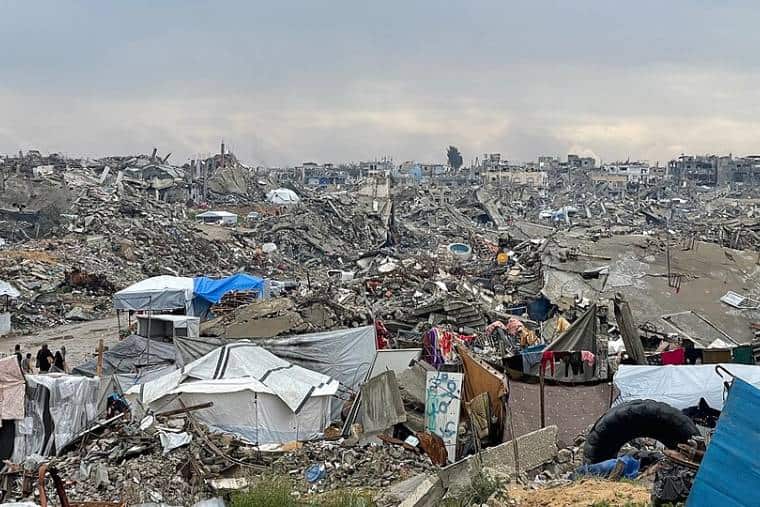
Israel has escalated its military operations in the Gaza Strip, continuing what officials have described as a “war of extermination” against Palestinians. On a recent day, Israeli forces killed Raed Saad, a senior figure in Hamas, along with four others during an airstrike in southern Gaza. This incident underscores a shift in tactics as Israel aims to tighten its control in the region, now occupying approximately 58 percent of Gaza.
The conflict persists amid severe humanitarian conditions exacerbated by recent events. The region was struck by Storm Byron, which has claimed at least 14 lives and left thousands without essential shelter. While the storm wreaked havoc, Israeli authorities have been accused of withholding vital aid, including tents and blankets, necessary for those affected by the harsh weather. Reports reveal that over 27,000 tents were destroyed, with an additional 53,000 damaged. Tragically, two individuals died when a wall collapsed onto tents in Gaza City’s Remal neighbourhood, and a child lost their life in the al-Mawasi camp due to freezing temperatures.
Hamas spokesperson Hazem Qassem condemned the ongoing violence, stating that the “war of extermination continues, albeit with different tactics.” He highlighted the dire humanitarian situation, noting the “successive collapses of homes” as evidence of the extensive devastation inflicted by Israeli military actions.
As discussions regarding a potential ceasefire progress, plans are underway for the deployment of the International Stabilisation Force (ISF) in Gaza, anticipated to begin in early 2024. Meetings in Doha, Qatar, are scheduled for Tuesday to further address this initiative. The United Nations Security Council has endorsed the ISF’s authority to demilitarise Gaza, a move that raises concerns about its implications for the local population.
Israeli Prime Minister Binyamin Netanyahu has stated that while the ISF may undertake certain tasks, there are limitations to its capabilities, hinting at ongoing military operations. He mentioned, “We know there are certain tasks that this force can perform… but we will see about that,” indicating a relentless approach towards disarmament in Gaza.
The violence is not confined to Gaza. Reports indicate a surge in attacks by Israeli settlers in the West Bank. A resident named Mahmoud, from Masafer Yatta in Hebron, detailed over 264 attacks in October 2023 alone, targeting villages and Bedouin areas. He expressed concern over the systematic displacement of Bedouin communities, particularly in regions like the Jordan Valley and Ramallah countryside.
In a recent incident, settlers attacked a Palestinian olive harvest in Mukhmas, north of occupied Jerusalem, resulting in the destruction of numerous trees. Similar acts of aggression were reported in Ein El-Duyuk, near Jericho, where settler militias instilled fear in the local Bedouin population.
The ongoing situation reflects a broader geopolitical context, where Western support has been seen as enabling Israeli policies that many critics label as colonial and expansionist. Activists in the UK are calling for divestment from Israel by institutions and companies, urging the government to reconsider its ties with the Israeli state in light of the escalating violence.
As the conflict continues, the humanitarian impact remains severe, with civilians bearing the brunt of military actions and natural disasters alike. The international community is urged to address the urgent needs of the affected populations while navigating the complex political landscape surrounding the Israeli-Palestinian conflict.