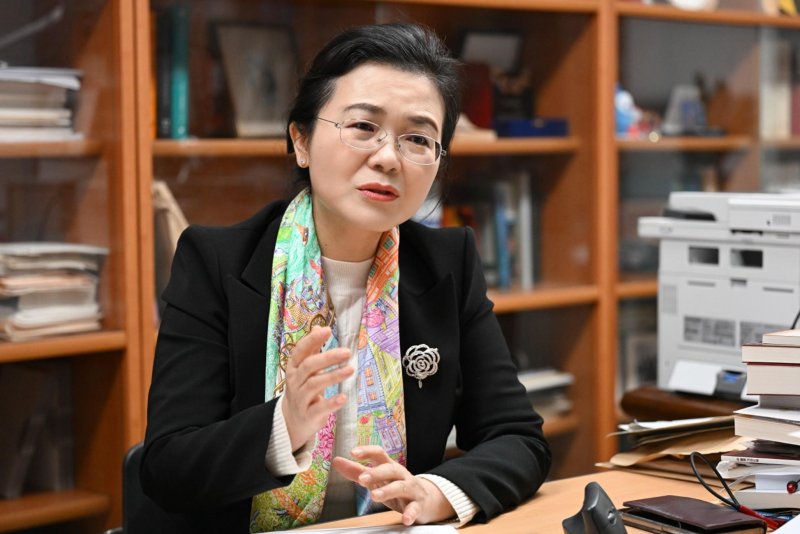
URGENT UPDATE: A prominent law professor from Korea University has raised alarms over a controversial package of judicial reform bills proposed by South Korea’s ruling party. Cha Jin-ah, a specialist in constitutional law, warned that these reforms could significantly weaken judicial independence and threaten the separation of powers.
In a statement made earlier today, Cha emphasized that “unchecked power leads to dictatorship,” highlighting the potential dangers of fast-tracked legislation aimed at expanding the number of justices in the Supreme Court and establishing new courts. These reforms could drastically reshape the judicial landscape in South Korea.
The proposed changes include increasing the number of Supreme Court justices, setting up a special court for treason, and introducing a controversial crime of “distorting the law.” Cha expressed concern that the ruling party’s push to process multiple bills simultaneously raises questions about political motives and consolidation of power.
Cha’s critique comes as the National Assembly prepares to deliberate on these reforms. She supports certain measures, such as a modest increase in Supreme Court justices, but insists that the proposed expansion by 12 justices would lead to blatant political appointments.
“The motives behind expanding the Supreme Court and expanding review powers look suspicious. The Constitutional Court should speak out when judicial independence is threatened.”
In her interview, conducted Tuesday, Cha described the proposed special court for treason as unconstitutional. She warned that such a tribunal could lead to unfair trials and predetermined outcomes. “Fair trials become meaningless,” she stated, cautioning against the dangers of politicized judicial processes.
The introduction of a law against “distorting the law” has also been labeled as problematic. Cha pointed out that while similar laws exist in Germany, they were created as a response to historical atrocities and have largely become obsolete. She cautioned that if adopted in South Korea, this law could be weaponized against judges and prosecutors, leading to a chilling effect on judicial independence.
Cha further criticized the plans to abolish the court administration office, asserting that it would strip away essential judicial authority. “Judicial power belongs to the courts,” she declared, emphasizing that this includes administrative functions crucial for maintaining a fair legal system.
As the ruling party holds a majority in the National Assembly, experts like Cha are urging the public to engage and voice their concerns. “Only public opinion can stop a legislative rampage,” she stated, insisting that democracy requires ongoing citizen oversight beyond election day.
With the potential for these reforms to reshape the judicial system in South Korea, the coming days will be critical. Observers are urged to monitor the National Assembly’s actions closely, as further developments are expected. The debate over judicial reform is not just a political issue; it holds profound implications for the future of democracy in South Korea.
As this situation unfolds, citizens and legal experts alike are called to action. The integrity of judicial independence hangs in the balance, and the call for a transparent and fair legal system has never been more urgent.