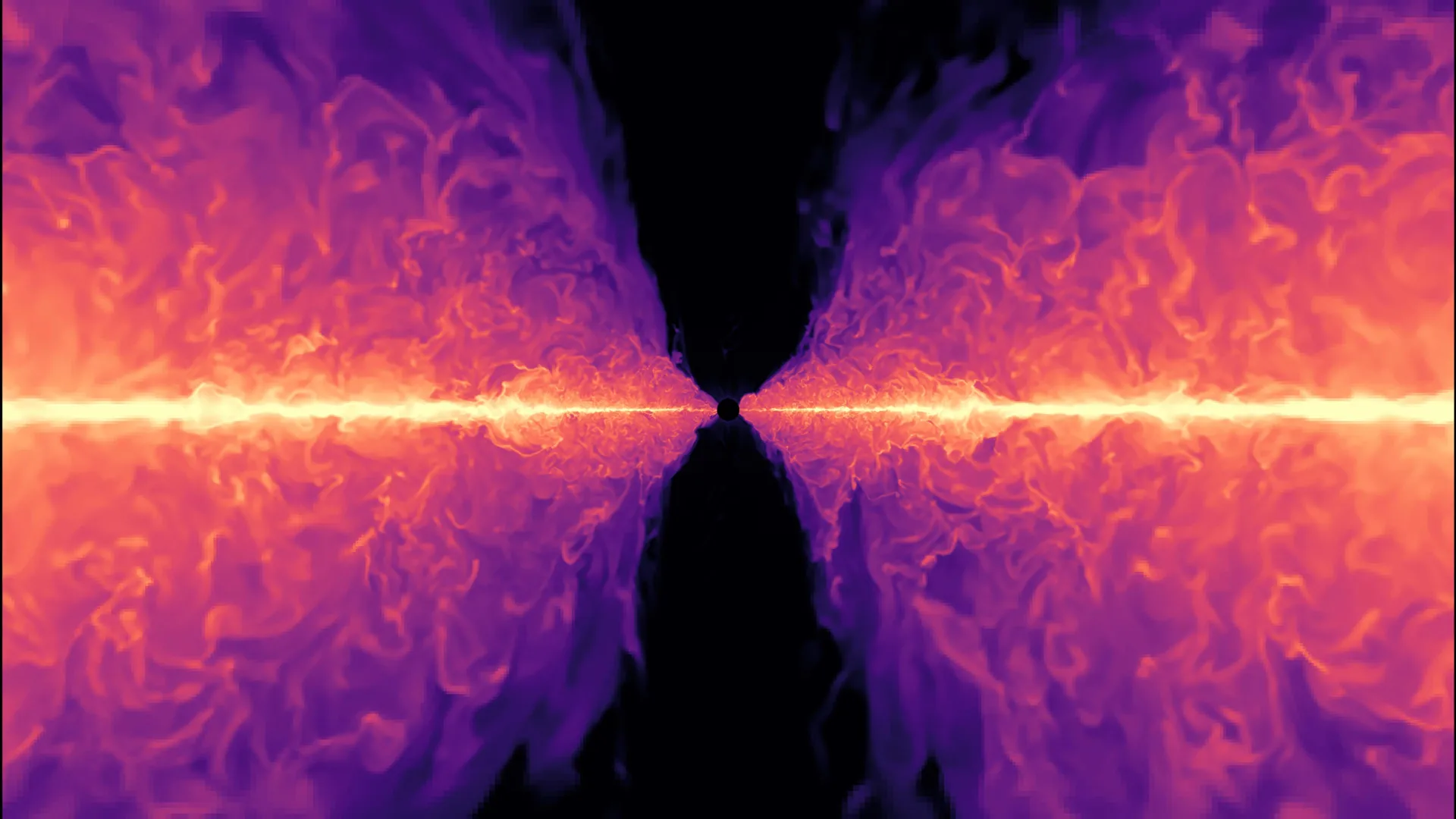
Researchers have developed groundbreaking simulations that provide unprecedented insight into the behavior of black holes. By integrating the principles of Einstein’s theory of gravity with the complex interactions of light and matter, scientists have created models that closely align with actual astronomical observations. These advancements reveal how matter forms chaotic, luminous disks and generates powerful outflows as it approaches black holes, marking a significant milestone in our understanding of these enigmatic cosmic entities.
This innovative study was published in The Astrophysical Journal on December 22, 2025, spearheaded by a team from the Institute for Advanced Study and the Flatiron Institute’s Center for Computational Astrophysics. It introduces the most detailed model of black hole accretion to date, a process through which black holes draw in surrounding matter and emit intense radiation. Utilizing some of the world’s most advanced supercomputers, the researchers conducted simulations that fully account for both Einstein’s relativity and the critical role of radiation, avoiding the oversimplifications that have hindered previous models.
Lizhong Zhang, the lead author of the study and a postdoctoral research fellow at both the Institute for Advanced Study and the Flatiron Institute, emphasized the significance of this research. “This is the first time we’ve been able to see what happens when the most important physical processes in black hole accretion are included accurately,” he stated. Zhang noted that the systems under study are highly nonlinear, meaning that any simplifications could drastically alter the outcomes. The team’s simulations successfully reproduced behaviors consistent with various black hole systems observed in the universe, including ultraluminous X-ray sources and X-ray binaries.
Understanding black holes requires a comprehensive approach that incorporates general relativity due to their powerful gravitational effects, which warp spacetime. However, this alone is insufficient. The immense energy released as matter falls towards a black hole manifests as radiation, which must be accurately modeled to reflect its interactions with nearby gas. Previous simulations often treated radiation simplistically, failing to capture its true behavior. Zhang explained that the earlier methods used approximations that inadequately represented the complexities of radiation dynamics.
The new research overcomes these limitations by employing advanced algorithms capable of solving the intricate equations governing black holes without shortcuts. “Ours is the only algorithm that exists at the moment that provides a solution by treating radiation as it really is in general relativity,” Zhang remarked. This breakthrough allows for a level of realism in simulations that was previously unattainable.
The study primarily focuses on stellar mass black holes, which typically possess around ten times the mass of the Sun. While these black holes are smaller than supermassive ones like Sgr A*, located at the center of the Milky Way, they offer unique research opportunities. Astronomers have captured detailed images of supermassive black holes, while stellar mass black holes often appear as small points of light. By analyzing their emitted light through spectral analysis, scientists can gain insights into how energy is distributed around these black holes. The rapid evolution of stellar mass black holes, occurring over minutes to hours, allows researchers to observe immediate changes.
Using their newly developed model, the researchers tracked how matter spirals inward, forming turbulent disks around these black holes, and observed strong winds and the potential formation of powerful jets. Notably, the light spectra produced in the simulations closely matched real observations, enhancing scientists’ capacity to draw conclusions from limited data and enriching their understanding of these distant cosmic phenomena.
The computational prowess behind this research was made possible by access to two of the world’s leading supercomputers: Frontier at Oak Ridge National Laboratory and Aurora at Argonne National Laboratory. These exascale computers can perform quintillions of calculations per second, reflecting the monumental scale of early computing devices. The project required sophisticated algorithms and software specifically designed for this complex modeling.
Looking ahead, the research team aims to apply their approach to all types of black holes, including supermassive black holes that play a vital role in shaping galaxies. Future studies will refine the interaction between radiation and matter across various temperatures and densities. Co-author James Stone, a professor at the Institute for Advanced Study, highlighted the significance of the project, stating, “What makes this project unique is the time and effort it has taken to develop the applied mathematics and software capable of modeling these complex systems.” He concluded that the next challenge is to comprehend all the scientific insights emerging from this research.