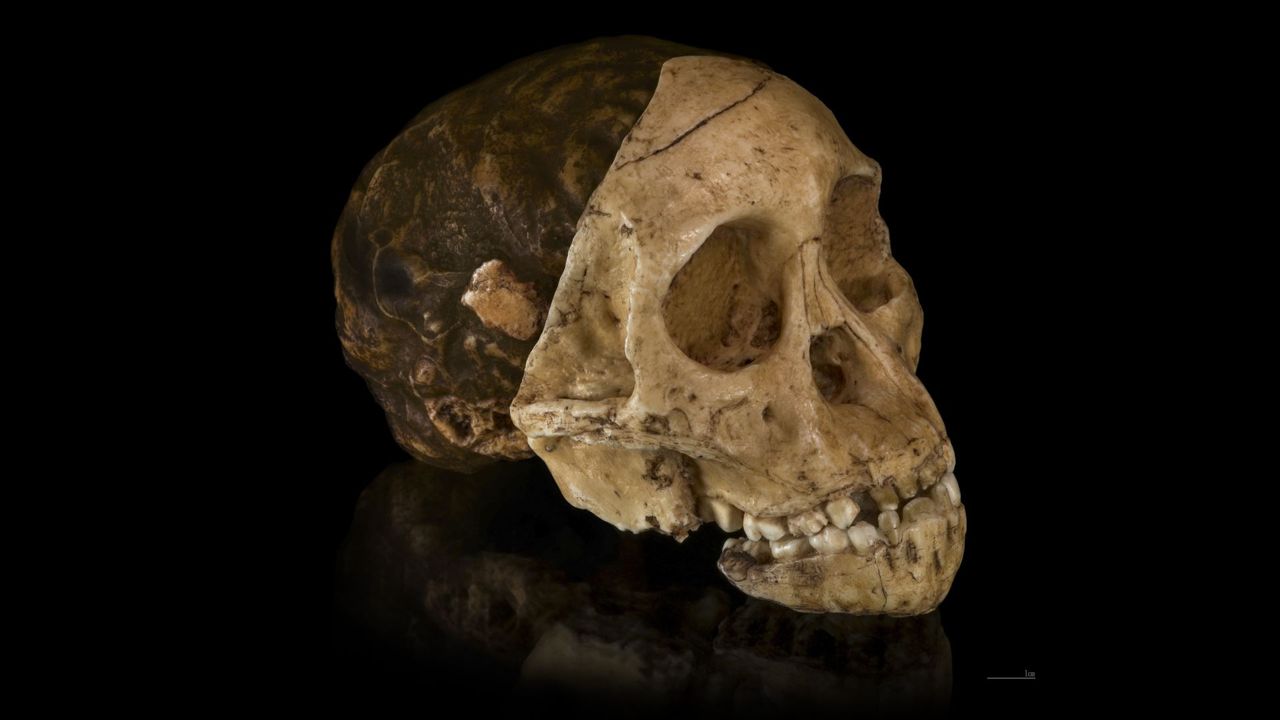
At the end of 1924, an extraordinary discovery occurred in Taung, South Africa, when anthropologist Raymond Dart began examining a primate skull that would change our understanding of human evolution. This small skull, about the size of a coffee mug, belonged to a creature that was unlike any other known species, marking a significant milestone in the study of human ancestry.
The skull, later named the Taung Child, was not excavated by Dart himself. Instead, it came to his attention through a student, Josephine Salmons, who had received it from local workers at the Buxton Limeworks. They had discovered a baboon skull in the quarry, which led Salmons to recognize the potential significance of the find and present it to Dart.
Dart, a professor of anatomy and anthropology at the University of Witwatersrand in Johannesburg, was intrigued by the possibility of more fossils being hidden in the same sediment. He enlisted the help of his colleague, geologist Robert Young, who contacted the quarryman, Mr. de Bruyn. In late November 1924, de Bruyn found a brain cast embedded in a rock and set it aside for Young, who then delivered the cranium to Dart.
In his memoir, “Adventures with the Missing Link,” published in 1959, Dart portrayed the discovery as a moment of immediate recognition and excitement. He claimed to have found the skull among rubble, emphasizing a sense of possession over the significant artifact. On December 23, 1924, Dart was able to view the skull’s face, although part of it remained encased in rock. Over the next 40 days, he meticulously analyzed the specimen.
Dart published his findings in the journal Nature on February 7, 1925, introducing Australopithecus africanus, or “The Man-Ape of South Africa.” This groundbreaking identification would propel Dart to fame and lend credence to Charles Darwin‘s theory that humans and nonhuman apes shared a common ancestor that evolved in Africa.
The Taung Child represented the first near-complete fossil skull of an early human relative ever discovered. Dart noted that the skull was longer than those of other primates and suggested it anatomically resembled that of a six-year-old human child. Subsequent research, however, estimated that the child likely died at the age of three or four. While the sex of the Taung Child remains uncertain, many researchers lean toward the belief that it was female.
Determining the skull’s age has proven challenging due to its removal from its original context. Initial estimates suggested it was approximately 3.7 million years old, but newer studies indicate it is closer to 2.58 million years. For nearly five decades, A. africanus was considered a direct ancestor of modern humans.
The narrative took a turn in 1974 when the discovery of the fossil known as Lucy in Afar, Ethiopia, shed new light on human ancestry. This 3.2-million-year-old specimen belonged to a different species, Australopithecus afarensis, which subsequently replaced the Taung Child in the evolutionary lineage as our direct ancestor.
Recent findings, however, have sparked renewed discussions about the lineage. Researchers have uncovered fossil fragments suggesting that Lucy’s species may not be our direct ancestor after all. Some even propose that A. africanus could reassert its position in the evolutionary narrative, highlighting the ongoing complexity of human ancestry.
The discovery of the Taung Child not only reshaped the understanding of human evolution but also underscored Africa’s pivotal role in the story of humanity. As research continues to evolve, the implications of Dart’s initial findings remain significant, inviting further exploration into our ancient past.