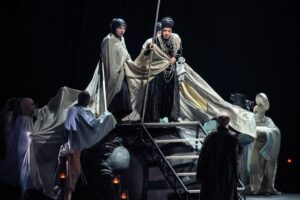
Richard Strauss’s opera “Elektra,” composed in 1909 with a libretto by Hugo von Hofmannsthal, has returned to the Wiener Staatsoper for its 2025-26 season. This one-act opera is a bold reinterpretation of Sophocles’ tragedy, immersing audiences in the tortured mind of Elektra as she seeks vengeance for her father Agamemnon’s murder. The score is a complex tapestry of sound that captures themes of violence, despair, and the dark allure of revenge.
Revival of a Classic Production
The Wiener Staatsoper has revived the renowned production by Harry Kupfer, first staged in 1989. This version retains its power, featuring a stark black set dominated by a fragmented statue of Agamemnon. The visual representation of the statue, partially toppled, evokes a sense of loss and despair, amplifying the opera’s themes.
Conductor Alexander Soddy led the Vienna State Opera Orchestra with a palpable sense of tension from the very first notes. The orchestra’s lush sound, marked by shimmering strings and precise woodwinds, created an exhilarating atmosphere that shifted seamlessly from violent outbursts to moments of haunting beauty.
Ausrine Stundyte’s Commanding Performance
In the role of Elektra, Ausrine Stundyte delivered a gripping performance that captured the character’s obsessive quest for revenge. The structure of the opera centers on Elektra’s intense interactions with her mother Klytämnestra, her sister Chrysothemis, and her brother Orest. Stundyte’s portrayal reflected the character’s psychological torment, though her vocal performance occasionally struggled with the role’s demands. While her middle register resonated with strength and beauty, her higher notes sometimes lacked the intensity expected in a role defined by raw emotion.
Legendary soprano Nina Stemme, making her role debut as Klytämnestra, showcased her dramatic range. Stemme’s powerful soprano articulated the complexity of Klytämnestra, a character driven by guilt and desperation. Her entrance, adorned in lavish jewels and a dramatic cape, was both visually stunning and symbolically rich, encapsulating her dual role as a powerful queen and a vulnerable mother.
Camilla Nylund portrayed Chrysothemis, Elektra’s younger sister, with a voice that expressed both vulnerability and strength. Nylund’s portrayal highlighted Chrysothemis as a voice of reason amidst chaos, perfectly capturing her desire to escape the madness surrounding her. This role allowed Nylund to demonstrate her vocal versatility, shifting from powerful passages to softer, more delicate moments.
Supporting Cast and Overall Impact
Derek Welton, as Orest, added depth to the production with his commanding bass-baritone voice. His presence during the pivotal reunion with Elektra was a highlight of the evening, showcasing the emotional stakes of their family’s tragic narrative.
The performance was enriched by a competent ensemble of supporting characters, including the Fifth Maid, portrayed by Jenni Hietala, who impressed with a sweet soprano sound. The opera’s finale, viewed through Elektra’s perspective, culminated in a powerful visual and emotional climax as she succumbed to the chaos of her own making.
The revival of “Elektra” at the Wiener Staatsoper not only honors Strauss’s legacy but also showcases the exceptional talents of its cast and creative team. The production stands as a testament to the opera’s enduring power to evoke profound human emotions, making the evening a resounding success.