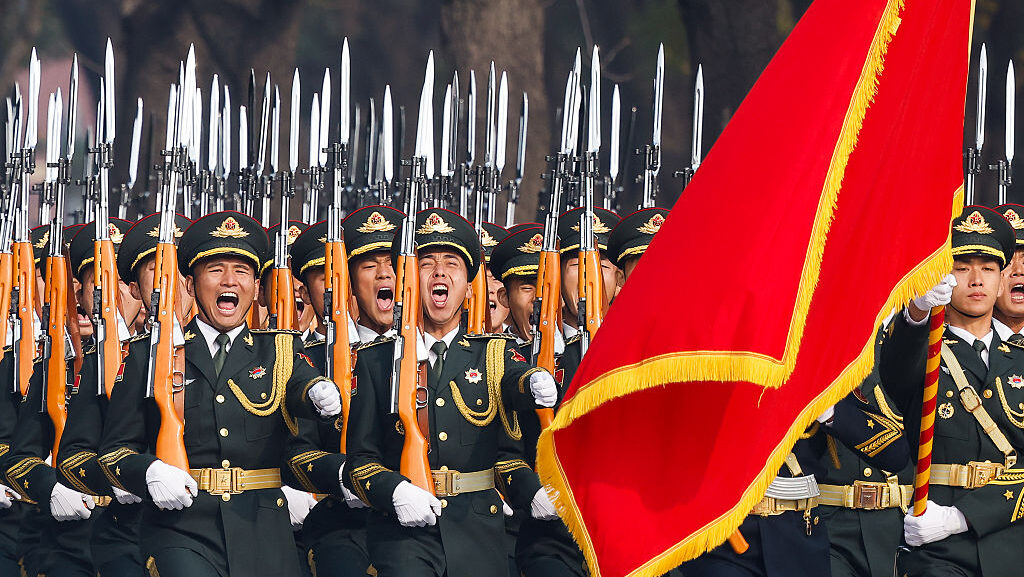
A recent report from the Pentagon indicates that China’s ongoing military buildup poses a growing threat to the security of the United States. This assessment, which spans 100 pages, was mandated by Congress and published on March 5, 2024. It highlights that while the Trump administration aims for friendlier relations with Beijing, China is actively expanding its military capabilities across critical domains, including cyber, space, and nuclear sectors.
The report underscores a directive from Chinese leader Xi Jinping for the People’s Liberation Army (PLA) to prepare for a potential “strategic decisive victory” over Taiwan by 2027. The assessment states, “In other words, China expects to be able to fight and win a war on Taiwan by the end of 2027.” This declaration raises significant concerns regarding regional stability and U.S. interests in the Indo-Pacific.
Key findings from the report reveal various aspects of China’s military advancements. By January 2024, China had tripled its intelligence, surveillance, and reconnaissance (ISR) satellite platforms in orbit since 2018. This expansion has significantly enhanced China’s capacity to monitor U.S. and allied forces on land and in space.
In terms of nuclear capabilities, the report notes that China’s stockpile of nuclear weapons remained in the low 600s through 2024, reflecting a slower production rate than in previous years. Nevertheless, a substantial expansion is anticipated, with the PLA projected to exceed 1,000 warheads by 2030. For context, the United States currently possesses around 3,700 nuclear warheads, while Russia has approximately 4,300, according to the Federation of American Scientists.
The report also highlights the deployment of over 100 solid-propellant intercontinental ballistic missile (ICBM) silos, which are likely intended to bolster China’s early warning counterstrike capability. Additionally, China launched an unarmed ICBM into the Pacific Ocean in September 2024, marking the first such test since 1980, likely to simulate a wartime nuclear deterrence operation.
Cybersecurity remains a significant concern, as the report reveals that Chinese cyber actors have continued extensive cyberespionage efforts and pre-positioned cyberattack capabilities against the U.S. and its allies. Notable operations include the widespread Salt Typhoon and Volt Typhoon infections, which align with Beijing’s goal of establishing dominance in the information domain.
The report also touches on the evolving relationship between China and Russia. In July 2024, the two nations conducted a combined bomber patrol into the U.S. Alaska Air Defense Identification Zone (ADIZ), the first of its kind. This cooperation reflects a deepening strategic partnership, although both countries have not formalized a defense alliance.
As the Trump administration continues to advocate for improved relations with China, the report aims to balance diplomatic optimism with military realism. It states, “Under President Trump’s leadership, relations between the United States and China are stronger than they have been in many years.” However, it emphasizes the necessity of maintaining a capable Joint Force to defend U.S. interests in the Indo-Pacific.
The assessment concludes with a reminder that U.S. interests in the region are fundamental yet reasonable, asserting, “We do not seek to strangle, dominate, or humiliate China.” This nuanced approach reflects the complex dynamics of international relations as the U.S. navigates its response to China’s military advancements and strategic intentions.