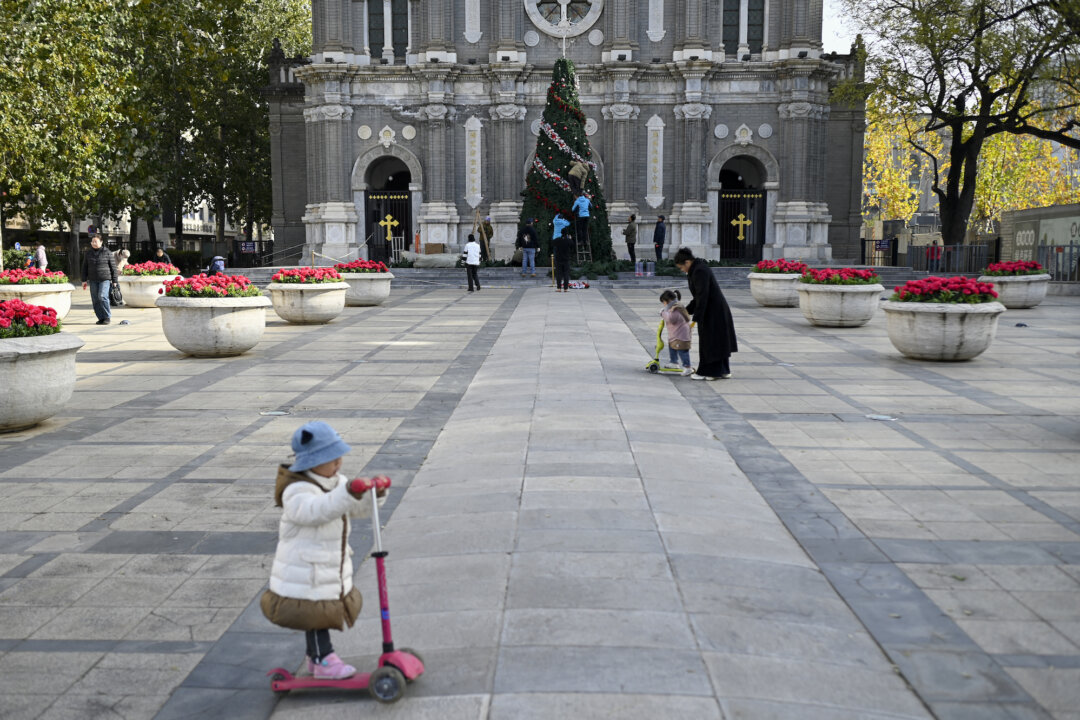
Christmas celebrations across China were significantly muted this year as the Chinese Communist Party (CCP) enforced stricter regulations on religious gatherings and public festivities. Reports from various regions indicate that planned Christmas services were curtailed, public displays were limited, and even the atmosphere typically associated with the holiday was notably absent.
In provinces such as Shandong, Zhejiang, and Sichuan, Christians associated with underground house churches reported that state security officials blocked their attempts to hold Christmas Eve services. Pastor Huang from Qingdao, Shandong, shared that authorities explicitly informed congregants they could not gather for worship. Instead, he and his family opted for a small private gathering at home. He remarked, “All collective gatherings here are banned. Shopping malls are also not allowed to put up Christmas trees or decorations. There’s no Christmas atmosphere at all this year.”
In Wenzhou, a city recognized for its substantial Christian community, Pastor Wang noted that only state-sanctioned churches were permitted to conduct Christmas activities. He commented on the discouragement felt among believers, particularly after several congregants were detained earlier in December. “So now, many [Christians] here are discouraged from attending group events,” he explained.
The CCP maintains strict control over religious practices, allowing only state-sanctioned denominations that adhere to the party’s directives. These churches are compelled to remove Christian symbols, such as crosses, and replace them with images of CCP leaders, underscoring the party’s influence over religious expression.
University Restrictions and Public Order Measures
Several universities in China issued directives limiting student participation in Christmas-related activities. Dezhou University in Shandong instructed students not to post anything related to Christmas on social media, emphasizing that such activities could be monitored. Similarly, Northwest University in Shaanxi Province required students to remain on campus during the Christmas period, implementing nightly roll calls to ensure compliance.
Students at universities in Zhejiang reported being advised to remove Christmas-themed profile pictures and refrain from online discussions of the holiday. The tightening grip on public expression reflects a broader trend where educational institutions are aligning with state policies to suppress unregulated celebrations.
In Shanghai, police took action against individuals attempting to celebrate publicly. A woman dressed as Santa Claus was detained while distributing apples to passersby, and several others in festive attire were questioned at a police station. One local Christian reported that commercial Christmas decorations were restricted to specific areas and noted that many displays were dismantled by December 22. “Christmas can now only exist within clearly defined boundaries,” said another Shanghai resident, pointing out the government’s preference for economic activity without the promotion of the holiday.
Widespread Impact and Official Policies
Reports from across the country suggest that public Christmas events outside of state-sanctioned churches have largely vanished in recent years. A Christian in Fujian Province remarked on the lack of festive activities, while a student in Shenyang indicated that schools discouraged students from wearing Christmas hats. Local officials even visited families to advise against church participation.
In Chengdu, Mr. Yang, a local Christian, indicated that authorities had warned churches not to hold gatherings ahead of Christmas Eve. “There’s almost no Christmas atmosphere anymore,” he stated, noting that while some large shopping malls still had decorations, the vibrant street displays of previous years were noticeably absent. Christians were instructed to confine their holiday observances to state-sanctioned venues or private gatherings with immediate family.
The CCP’s regulations mandate that religious activities occur only within approved venues, significantly restricting the public expression of religious festivities. Local governments have reiterated that Christmas celebrations should “not expand outward, not be amplified, and not be promoted.” Many underground churches have reported receiving notices barring public or collective celebrations, with some cities requiring churches to submit attendance lists for inspection.
On December 23, the U.S. Embassy in China shared a holiday video wishing viewers a “joyful, peaceful holiday season.” The video garnered attention on Chinese social media platforms, highlighting the contrast between the embassy’s message and the restrictions imposed by the Chinese government on Christmas celebrations.
As the holiday season concludes, the tighter restrictions signal a continued effort by the CCP to control religious practices and public expressions of faith in China, reflecting an ongoing tension between state authority and individual beliefs.