A groundbreaking study reveals that vast amounts of water may have been securely stored deep within Earth’s mantle during its formative years, countering previous beliefs that water was lost to space. Research conducted by a team led by Prof. Zhixue Du from the Guangzhou Institute of Geochemistry of the Chinese Academy of Sciences suggests that the mineral bridgmanite can trap significantly more water at high temperatures than once thought. Their findings, published in the journal Science on December 11, 2025, provide new insights into the geological processes that shaped our planet.
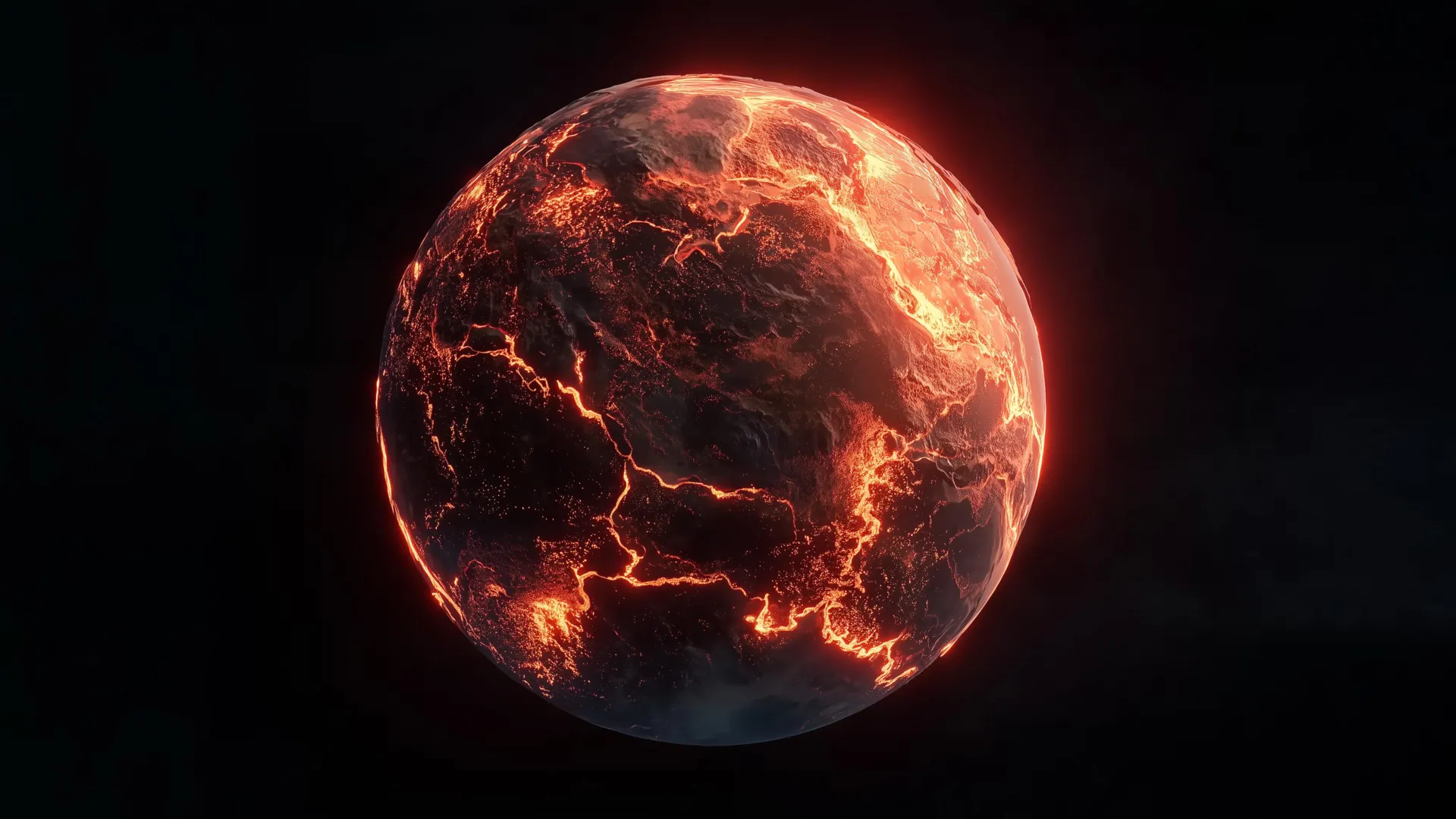
Around 4.6 billion years ago, Earth was a tumultuous, molten mass, frequently bombarded by space debris. During this period, the surface was dominated by a relentless ocean of magma, rendering it inhospitable for liquid water. Today’s oceans, covering about 70% of the planet’s surface, raise an important question: how did water survive this transformative phase?
The recent research sheds light on this mystery. The team discovered that as Earth cooled and solidified, bridgmanite acted as a microscopic “water container.” This mineral, the most abundant in the mantle, may have allowed significant water storage beneath the surface, contributing to the planet’s evolution from a fiery world into one capable of supporting life.
To investigate the water retention capabilities of bridgmanite, researchers faced the challenge of replicating the extreme conditions found over 660 kilometers beneath Earth’s surface. Previous experiments indicated limited water storage, but they were conducted at lower temperatures. This time, the team built a diamond anvil cell combined with laser heating to reach temperatures near 4,100 °C. This setup enabled them to accurately measure how minerals absorb water under high-pressure conditions.
Using advanced techniques, including cryogenic three-dimensional electron diffraction and NanoSIMS, the researchers mapped the water distribution in their samples. Collaborating with Prof. LONG Tao from the Institute of Geology of the Chinese Academy of Geological Sciences, they employed atom probe tomography (APT) to confirm that water is structurally dissolved within bridgmanite itself.
The results were startling: the ability of bridgmanite to trap water increases significantly at higher temperatures. This suggests that during the early stages of Earth’s development, the mineral could have sequestered far more water than previously estimated. The findings imply that the lower mantle may host a water reservoir five to 100 times larger than earlier projections, potentially holding between 0.08 to 1 times the volume of today’s oceans.
This stored water played a pivotal role in Earth’s geological history. It functioned as a “lubricant” for the planet’s internal processes, lowering the melting point and viscosity of mantle rocks. This facilitated internal circulation and plate motion, generating long-term geological activity. Over millions of years, some of this water resurfaced through volcanic activity, aiding in the formation of Earth’s early atmosphere and oceans.
The implications of this research are profound. The study suggests that this hidden reservoir of water was essential in transitioning Earth from a molten inferno to the vibrant, blue planet we know today. As scientists continue to explore the depths of our planet, the findings from this research open new avenues for understanding Earth’s history and the fundamental processes that sustain life.