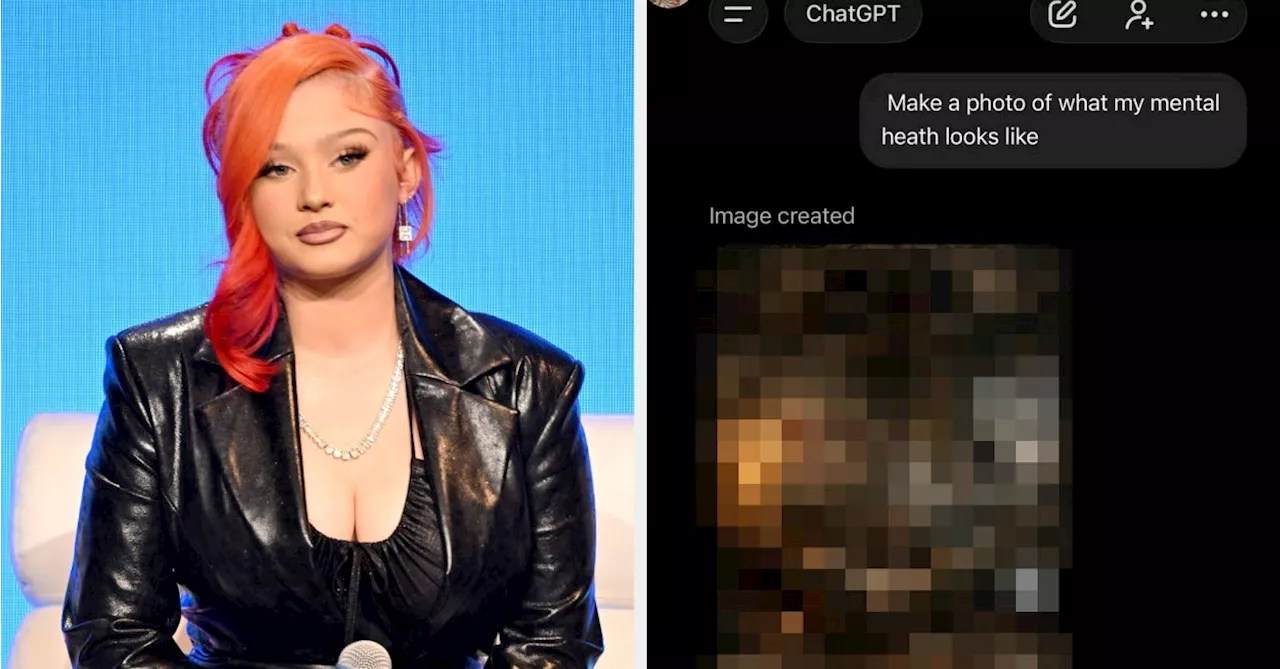
Alabama Barker, the daughter of musician Travis Barker, sparked discussions about mental health after sharing her experience with ChatGPT on TikTok. In a now-viral post from December 2023, she attempted to engage with a trending challenge that asked the AI to generate an image representing her mental state. The outcome, however, left her unsettled and raised questions about the implications of AI in sensitive contexts.
Barker had anticipated a lighthearted image reflecting her anxiety but was confronted with a disturbing visualization. The AI-generated image depicted a dilapidated room, littered with trash and featuring a large hole in the ceiling. A dirty sofa and several alcohol bottles were visible, while the words “HELP ME” appeared on the walls in a reddish hue resembling blood. A noose dangled ominously nearby. Barker commented on this unsettling result, saying, “Never once have I mentioned any conversation of self-hurt. Just panic attacks about throw up lol.”
In her TikTok, she humorously questioned the appropriateness of the content, stating, “Isn’t this like completely against terms of service? Why did it add a rope? And why are there bottles on the floor? I’m suing.” Although her remarks about pursuing legal action were likely made in jest, they highlight a significant concern regarding the AI’s responses to user inputs.
After posting her experience, Barker followed up with ChatGPT to discuss the generated image. A screenshot of their exchange revealed the AI’s apology for producing content deemed inappropriate, stating that it “should not have been shown.” The AI acknowledged Barker’s feelings and informed her that she was justified in calling out the troubling depiction. It even suggested that she could choose to stop using the application if she wished.
Barker indicated that she was not alone in her distressing experience. She mentioned that a friend who participated in the same trend received a similarly alarming image, which also featured a noose. This raised broader concerns about the potential risks associated with using AI technologies in contexts related to mental health.
The responses from users varied widely, with some reporting that they received “beautiful” and artistic images, while others experienced results that mirrored Barker’s unsettling depiction. This disparity underscores the unpredictable nature of AI-generated content, particularly when it intersects with sensitive topics such as mental health.
As discussions surrounding the responsible use of AI continue, mental health professionals emphasize the importance of approaching such technologies with caution. The 988 Lifeline is available for individuals seeking support, offering confidential conversations around the clock. For those in need, it serves as a vital resource to address mental health concerns.
ChatGPT has not publicly addressed the controversy stemming from Barker’s experience, and a request for comment remains unanswered. As users navigate this new digital landscape, the implications of AI’s role in mental health representation warrant careful consideration and dialogue.