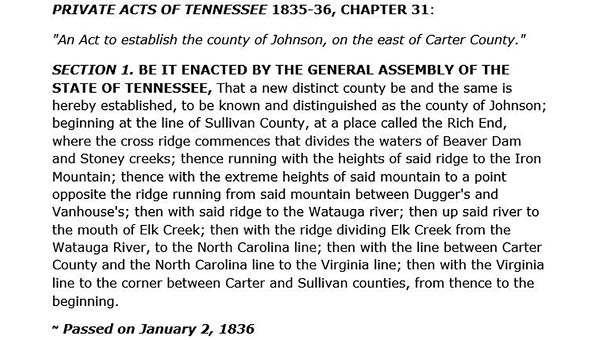
Significant events have shaped the history of Elizabethton and Carter County, Tennessee. This month, we spotlight crucial legislative actions and a notable teachers’ strike that reflect the region’s past. These events are documented at the Archives of the City of Elizabethton, located at the Elizabethton-Carter County Public Library.
Key Legislative Developments
On January 2, 1836, the Tennessee State Assembly officially established the “county of Johnson,” located to the east of Carter County. This county was named in honor of early pioneer Thomas Johnson. At the time, the county seat was undecided, but it was suggested that it be called Taylorsville, named after Colonel James P. Taylor. This name was later changed to Mountain City in 1885.
More than sixty years later, on January 22 and 23, 1903, state officials H.P. Richardson and William H. Nelson introduced a bill in the state legislature. The proposed legislation sought to allocate $2,000 for the creation of a monument dedicated to the patriots who convened at Sycamore Shoals along the Watauga River prior to the Battle of King’s Mountain. This battle played a significant role in the American Revolutionary War.
Teachers’ Strike of 1979
Fast forward to more recent history, the teachers’ strike in Carter County, which lasted for 43 days, serves as a stark reminder of the challenges faced by educators. On January 28, 1979, Chancellor Jerry Scott jailed six teachers union officials for what he termed “willful participation in an illegal strike.” He threatened to imprison all county teachers if they did not return to their classrooms. The strike concluded the following day, on January 29, marking a pivotal moment in local labor relations.
For those interested in further exploring Carter County’s rich history, the archives provide resources and information. To learn more, individuals can reach out to the archives at 423-547-6360 or via email at [email protected]. Each inquiry offers an opportunity to uncover new facets of the area’s past.