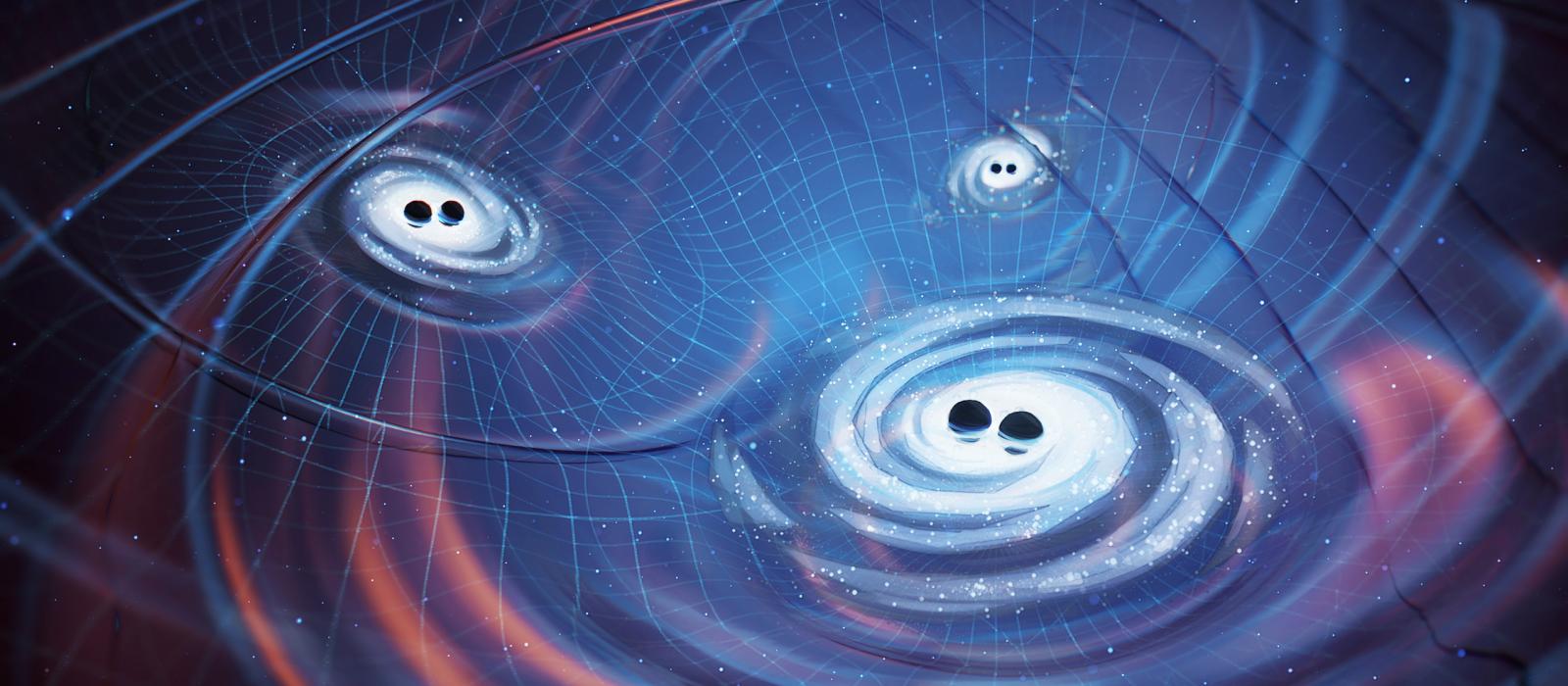
In a breakthrough study, researchers from the University of Amsterdam (UvA) have proposed a novel method to utilize gravitational waves (GWs) for investigating dark matter. Their findings, detailed in the journal Physical Review Letters, suggest that GWs, generated by the merging of black holes and neutron stars, could provide insights into this elusive component of the universe.
Innovative Approach to Dark Matter Exploration
Since the detection of gravitational waves in 2015, which validated a key prediction of Einstein’s Theory of General Relativity, the field of astronomy has undergone significant transformation. Gravitational waves are ripples in spacetime created by the collision of massive celestial bodies and can be observed from vast distances. The recent research from UvA’s Institute of Physics and the Gravitation & Astroparticle Physics Amsterdam (GRAPPA) focuses on how these waves can inform scientists about the existence and distribution of dark matter, which constitutes approximately 65% of the universe’s mass.
Led by researchers Rodrigo Vicente, Theophanes K. Karydas, and Gianfranco Bertone, the study introduces a comprehensive framework that models the interaction between gravitational waves and dark matter. The team examined how extreme mass-ratio inspirals (EMRIs) occur as black holes or neutron stars spiral inward, eventually merging to form more massive black holes.
Utilizing advanced methods of general relativity, the researchers expanded prior models that often simplified the gravitational effects on EMRIs. By taking into account a broader range of environmental factors, they illustrate how the presence of dark matter “spikes” around black holes would produce identifiable signatures in gravitational wave signals.
Future Implications for Astrophysics
The implications of this research are significant. As the European Space Agency plans to launch the Laser Interferometer Space Antenna (LISA) around 2030, this space-based observatory aims to detect over 10,000 gravitational wave signals during its mission. Such advancements in technology will allow scientists to access unprecedented data on black hole mergers and their environments.
“This research not only offers insights into what we can expect from LISA but also lays the groundwork for a burgeoning field that seeks to map dark matter throughout the cosmos,” said Vicente from UvA.
As gravitational wave detectors like the Laser Interferometer Gravitational Wave Observatory (LIGO) and the Virgo Collaboration continue to advance, the potential to unveil the mysteries surrounding dark matter could reshape our understanding of the universe. This study reinforces the critical role that gravitational waves will play in future cosmological research, potentially illuminating the nature and composition of dark matter itself.
For further reading, access the full research published in Physical Review Letters and explore ongoing developments from UVA.