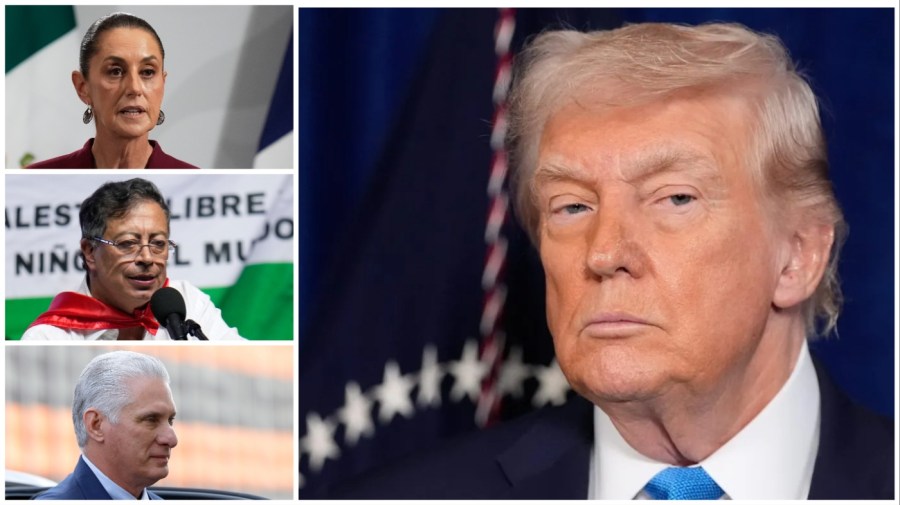
President Donald Trump has intensified pressure on Latin American leaders following the recent ousting of Venezuelan leader Nicolás Maduro. This strategic maneuver has raised concerns about the stability of the region as Trump declared the United States would take a dominant role regarding Venezuela’s future. The developments unfolded after a military operation on the morning of March 15, 2024, which resulted in Maduro’s capture.
In a series of pointed statements over the weekend, Trump warned other leaders in the region not to support Maduro’s regime. He emphasized that the U.S. would not hesitate to act against those who challenge its interests in Latin America. This rhetoric signals a significant shift in U.S. foreign policy, aiming to reshape the political landscape of a region long influenced by American intervention.
The operation that led to Maduro’s arrest involved a coordinated effort by the Venezuelan military, which has seen a split in loyalty in recent months. Reports suggest that a faction within the military facilitated the raid, reflecting growing discontent with Maduro’s leadership and the economic turmoil facing Venezuela. Following Maduro’s removal, Trump stated that the U.S. would be “in charge” of the country’s transition to a new government.
Trump’s remarks have elicited mixed reactions from other Latin American leaders. Some have welcomed the U.S. involvement, viewing it as a necessary step to restore democracy in Venezuela. Others, however, have expressed concern over the potential for increased U.S. intervention and the implications it may have for national sovereignty across the region.
In particular, the responses from countries such as Brazil, Colombia, and Argentina are being closely monitored. These nations have historically had varying degrees of engagement with U.S. policies in Latin America. Leaders in these countries are now grappling with the potential fallout of aligning with U.S. initiatives, especially as the economic situation in Venezuela continues to deteriorate.
As the situation develops, the international community remains vigilant. The United Nations and various human rights organizations have urged caution regarding U.S. interventions, advocating instead for diplomatic solutions that prioritize the welfare of Venezuelan citizens. The humanitarian crisis in Venezuela is already severe, with millions facing food shortages and a collapsing healthcare system.
The implications of Trump’s actions extend beyond Venezuela, potentially reshaping U.S.-Latin America relations for years to come. Analysts suggest that the U.S. commitment to influence the region could provoke a backlash, leading to increased anti-American sentiment and further complicating diplomatic relations.
Looking ahead, the U.S. administration faces the challenge of navigating a complex geopolitical landscape. With various stakeholders involved and a volatile situation on the ground, the path toward a stable governance structure in Venezuela will require careful planning and international cooperation.
In summary, Trump’s aggressive stance towards Latin American leaders and his commitment to a hands-on approach in Venezuela mark a pivotal moment in U.S. foreign policy. As the situation evolves, the choices made by both U.S. officials and Latin American leaders will be crucial in determining the future trajectory of the region.