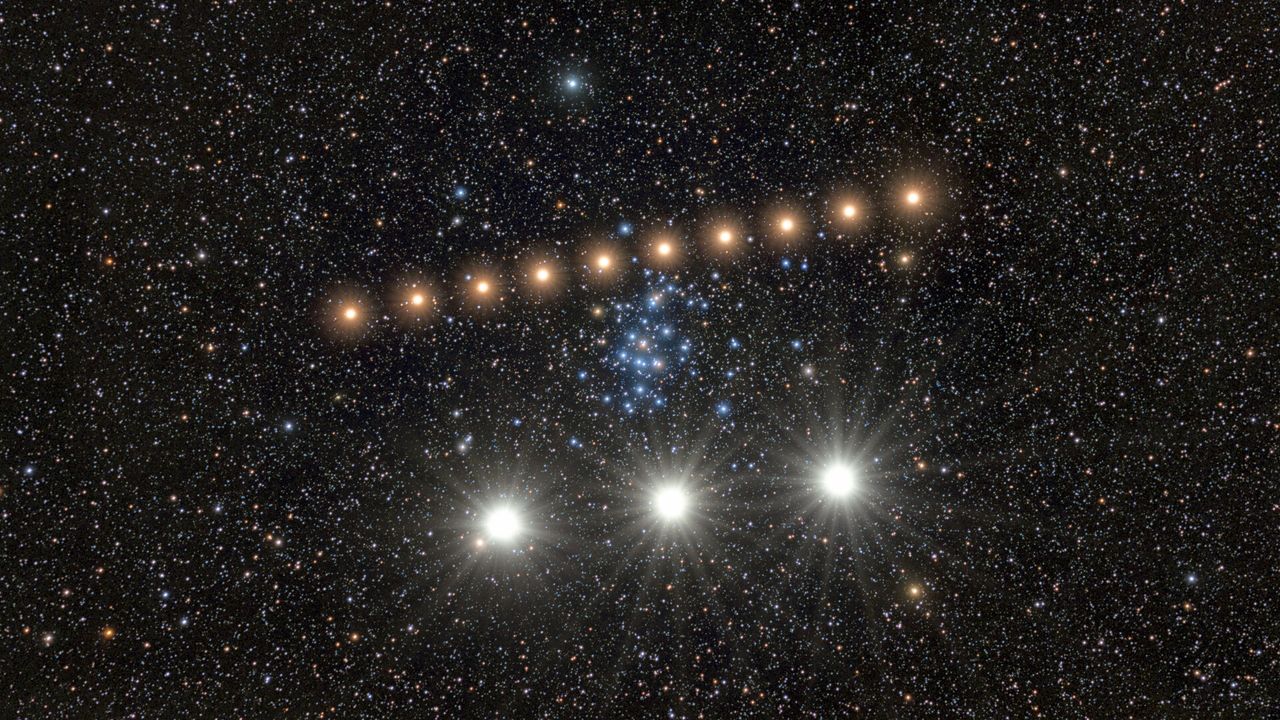
Skywatchers in the Southern Hemisphere experienced a remarkable astronomical event as Mars and Venus aligned in a recent conjunction, offering a stunning view of the night sky. The two planets appeared to “cross” the Beehive Cluster, also known as Messier 44, creating two bright trails against a backdrop of stars in a composite time-lapse photograph. This captivating image was crafted by astrophotographer Petr Horálek, an ambassador for NOIRLab, and showcases the planets’ movements during distinct apparitions in 2025.
Horálek’s composite image illustrates the planets’ positions over time, with Mars tracing its path through the Beehive Cluster from late April to early May, while Venus followed with a brief morning appearance from late August to early September. This creative endeavor took weeks to complete, as the planets’ crossings occurred months apart, culminating in a mesmerizing display of celestial mechanics.
The Beehive Cluster: A Celestial Gem
Located approximately 600 light-years away in the constellation Cancer, the Beehive Cluster is a favorite among astronomers and casual skywatchers alike. Comprising around 1,000 stars, it is one of the nearest and most densely packed open clusters visible from Earth. NASA describes its allure as a prime target for observational astronomy, particularly when bright planets like Mars and Venus pass through its vicinity.
The unique positioning of the Beehive Cluster relative to the ecliptic—the plane of the solar system projected onto the sky—allows for spectacular alignments. The conjunction of Mars and Venus serves as a vivid reminder that these planets share a common orbital neighborhood and that notable deep-sky landmarks, like the Beehive, are ideally situated for such striking events.
A Captivating View from Multiple Locations
The time-lapse images capturing this conjunction were photographed from various locations, including Chile, Bolivia, and the Czech Republic. These diverse vantage points enhanced the visual narrative of the planets’ movements, offering a broad perspective on their celestial dance.
The significance of witnessing both Mars and Venus crossing the Beehive Cluster in the same year transforms abstract astronomical concepts into tangible experiences. The term “planet,” derived from the Greek word for “wanderer,” reflects the dynamic nature of these celestial bodies as they move continuously through the night sky.
For those intrigued by the wonders of the universe, this conjunction serves as an invitation to explore more about skywatching and the beauty of star clusters. Understanding the paths of planets like Mars and Venus not only enriches our appreciation of the cosmos but also connects us to the rhythm of the solar system.