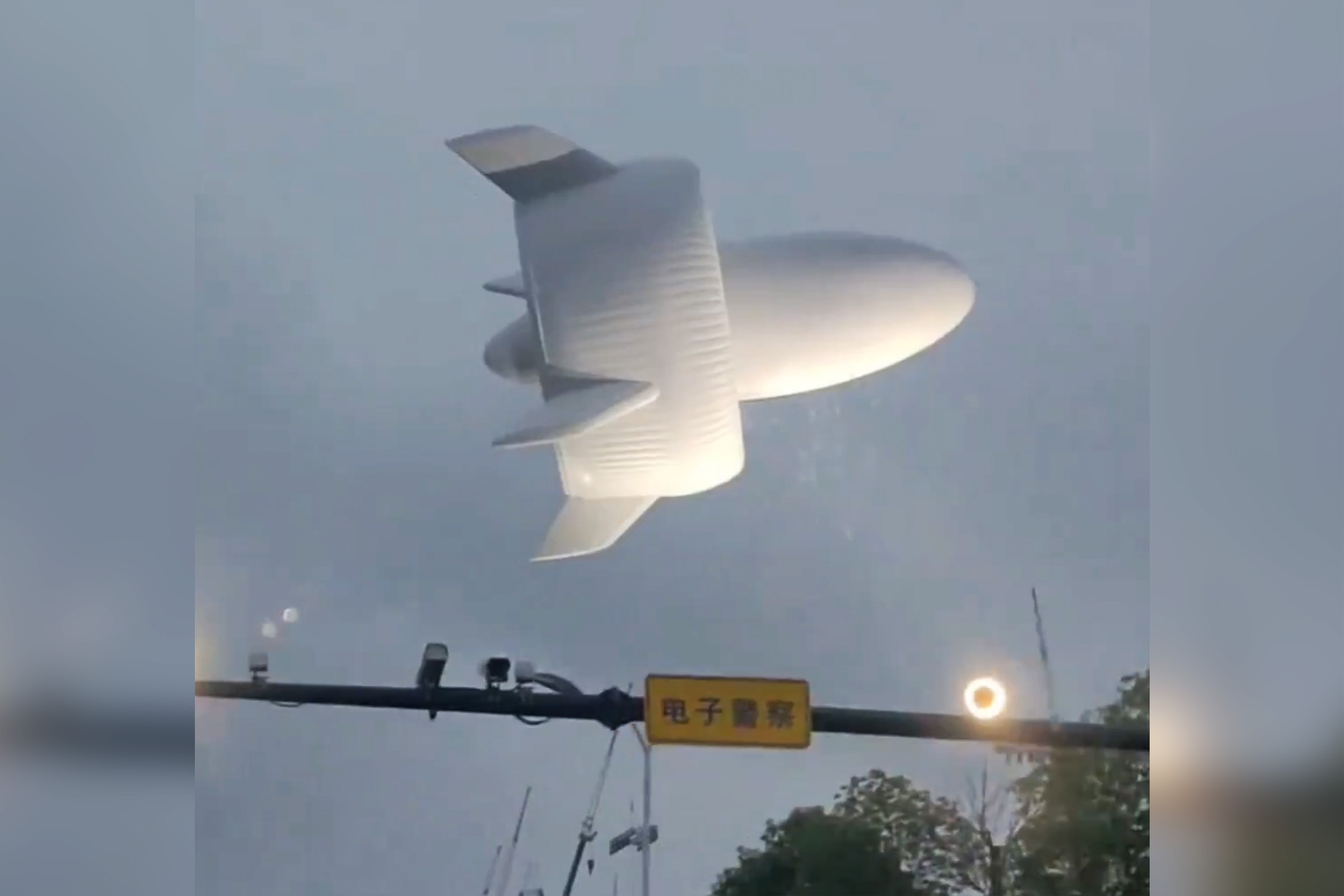
A new innovation in renewable energy has emerged in China with the unveiling of a massive airborne wind turbine (AWT) that promises to revolutionize how wind power is harnessed. The prototype, developed by the Chinese energy company Linyi Yunchuan, was showcased in a video shared by journalist Li Zexin on January 9, 2026, and is designed to float at high altitudes to capture stronger winds.
The airborne wind turbine, identified as the SAWES S2000, is part of the Stratospheric Floating Wind Power Systems initiative. This project is a collaboration between Linyi Yunchuan, Tsinghua University, and the Institute of Aeronautics and Astronautics of the Chinese Academy of Sciences. According to reports from the Global Times, the SAWES S2000 completed a successful test flight, demonstrating its capability to generate substantial amounts of electricity.
During its brief 30-minute flight, the SAWES S2000 reached an altitude of approximately 6,500 feet and produced around 385 kilowatt-hours of electricity. This marks a significant milestone as it connected to the local power grid, a first for airborne wind turbines. The system is touted as the world’s first megawatt-class high-altitude wind power system intended for urban deployment, with a maximum power output of about 3 megawatts.
The chief designer of the system, Dun Tianrui, emphasized the turbine’s efficiency, stating that one hour of operation can generate enough electricity to fully charge about 30 top-spec electric vehicles from zero to full. The SAWES S2000 can be easily transported and stored in shipping containers, taking only eight hours to reach full inflation. If helium supply chains are coordinated effectively, deployment time could be reduced to four or five hours.
In functionality, AWTs bear similarities to airships, but rather than transporting passengers, they remain relatively static while lifting lightweight turbine-generators into high-altitude wind streams. The electricity produced is transmitted down to the ground through a tether, where it is then fed into an electrical substation.
The latest tests follow a successful flight of an earlier model, the S1500, which has a generator capacity of 1.2 megawatts. This earlier unit was notable for being roughly the size of a basketball court and as tall as a 13-story building. It was the first turbine of its kind to generate a full megawatt of power during its inaugural flight.
These advancements come at an important time as China’s carbon dioxide emissions have reportedly declined for the first time year over year, largely due to a shift towards renewable energy sources such as wind and solar. As the world’s leading producer of solar power and offshore wind energy, China’s continued investment in innovative technologies like the SAWES S2000 reflects its commitment to sustainable energy development.
The introduction of these airborne wind turbines not only represents a striking visual in China’s skies but also solidifies the nation’s role in the ongoing global transition to greener energy solutions.