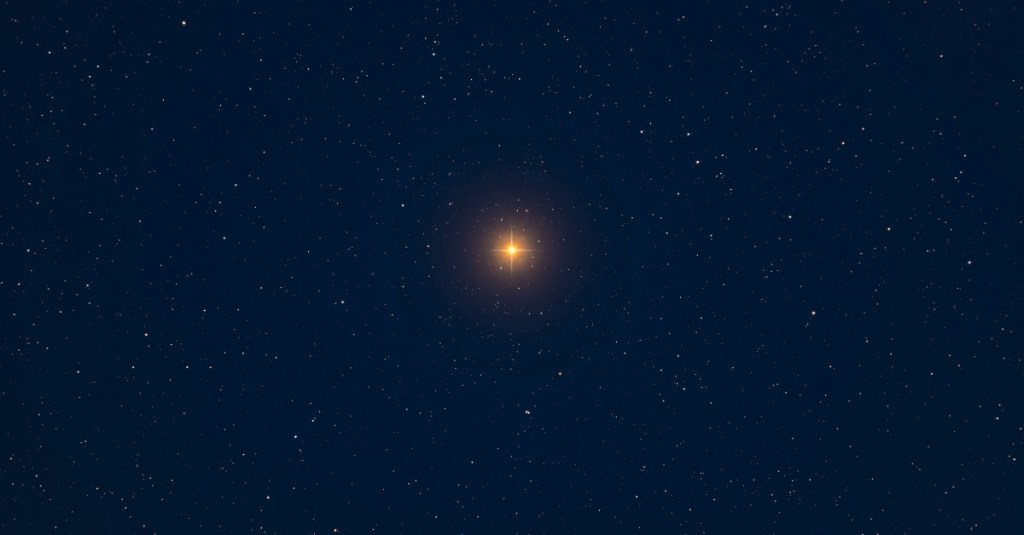
Astronomers have uncovered a significant discovery regarding Betelgeuse, a prominent red supergiant star known for its fluctuating brightness. After years of observation, researchers have confirmed the existence of a previously hidden companion star, officially named Siwarha, which plays a crucial role in the star’s behavior.
Betelgeuse, located approximately 700 light-years from Earth, has been the subject of extensive study due to its unique pulsation patterns. Scientists previously identified a cycle of brightness changes occurring roughly every 400 days, attributed to internal processes typical of aging stars. However, they were puzzled by a longer cycle of about 2,100 days, which did not fit existing models of stellar behavior.
Revealing the Companion Star
After nearly eight years of observations using the Hubble Space Telescope and ground-based observatories in Arizona and the Canary Islands, researchers have pinpointed the cause of this mysterious cycle. The dense trail of gas detected moving through Betelgeuse’s atmosphere has been linked to Siwarha, which appears to interact with the red giant’s outer layers.
As Siwarha orbits Betelgeuse, it alters the star’s ultraviolet emissions, particularly those from ionized iron. This interaction causes a noticeable spike in brightness when the companion star passes in front of Betelgeuse. Following this event, the gas trailing behind Siwarha absorbs some of the emitted radiation, resulting in a distinctive pattern that reflects the star’s 2,109-day cycle.
“The companion star creates a ripple effect in Betelgeuse’s atmosphere that we can actually see in the data,” said Andrea K. Dupree, lead author of the study.
Dupree likened the phenomenon to a boat moving through water, creating ripples. This new understanding confirms that Betelgeuse has a hidden companion that shapes its appearance and behavior in a significant way.
Looking Ahead
Currently, Siwarha has moved behind Betelgeuse and will not be observable again until August 2027. During this time, astronomers plan to continue their observations, analyzing the ripples in Betelgeuse’s atmosphere now that they understand their origin.
This discovery not only sheds light on the behavior of Betelgeuse but also enhances our understanding of stellar dynamics and the interactions between stars. The findings represent a significant advancement in the field of astronomy, confirming theories that have long been debated among scientists.
The research results have been officially released by NASA, marking a milestone in the study of one of the night sky’s most intriguing stars. As astronomers await Siwarha’s return, they are equipped with new insights that will guide future observations and studies of Betelgeuse and its cosmic companion.