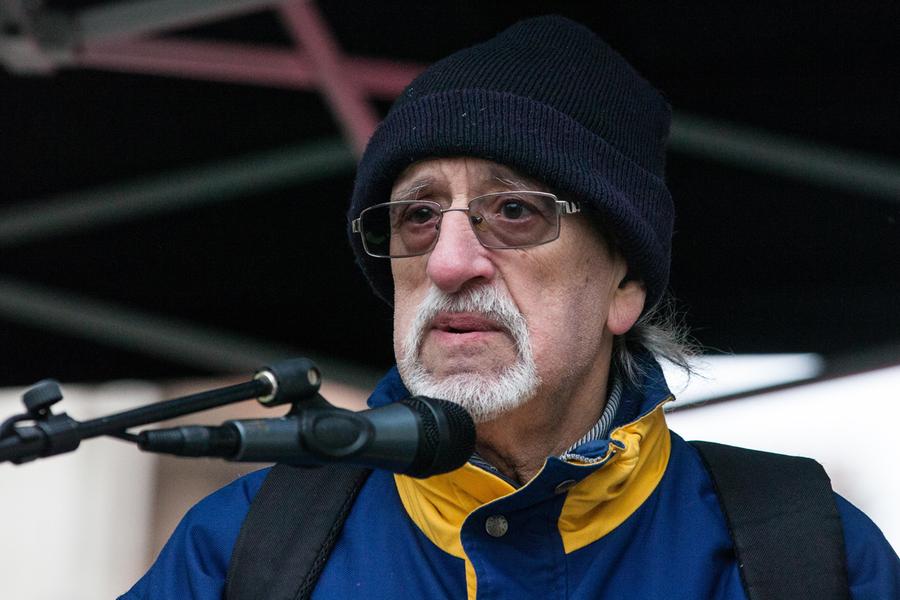
Gerry Gable, a prominent anti-fascist campaigner and journalist known for his unwavering commitment to fighting far-right extremism, has passed away at the age of 88. Gable’s life was marked by numerous challenges, including death threats and legal disputes, yet he remained a steadfast advocate for democracy and social justice throughout his career.
Born on January 27, 1937, in the East End of London, Gable was raised in a family with diverse religious backgrounds, including a Jewish mother and an Anglican father. His Jewish heritage played a significant role in his activism, serving as a catalyst for his lifelong dedication to combating antisemitism and fascism.
Searchlight, the anti-fascist magazine Gable edited for nearly fifty years, became a key platform for exposing the activities of far-right groups in the UK and beyond. Gable began his involvement with the publication in the 1960s, and he officially took the reins as editor in February 1975. Under his leadership, Searchlight evolved from a quarterly magazine into a monthly publication, gaining notoriety for its investigative journalism and community engagement.
Controversial Tactics and Notable Achievements
Gable’s methods were not without controversy. One of the most infamous incidents occurred in 1963 when he and two associates infiltrated the flat of Holocaust denier David Irving, posing as telephone engineers. This audacious act resulted in a conviction for burglary and a fine of £25, but it showcased Gable’s willingness to confront extremist views directly.
In the 1980s, Gable’s investigative work took him into the heart of the Conservative Party, where he alleged connections to right-wing extremism. His claims against Conservative MPs Neil Hamilton and Gerald Howarth during a BBC Panorama programme led to significant legal repercussions for the broadcaster, including a £20,000 settlement for the MPs. Despite these setbacks, Gable’s efforts contributed to raising public awareness of the extremist elements within British politics.
One of Gable’s significant achievements was his role in the BBC programme “Spy Story,” which investigated the British National Party (BNP) and resulted in the arrest of eight of its members. This collaboration illustrated Gable’s effectiveness in combining journalism with activism to challenge far-right ideologies.
Legacy and Tributes
Gable’s influence extended beyond his editorial work. He served as an independent adviser to the Metropolitan Police’s Hate Crime Independent Advisory Group and was involved with the organization Tell Mama, which addresses anti-Muslim hatred. His contributions to the fight against racism and fascism have been widely acknowledged, with various organizations paying tribute following his death.
Mark Gardner, chief executive of the Community Security Trust, praised Gable for his unique contributions to anti-fascist efforts. Following his passing on January 3, 2026, the CST described him as a towering figure in the struggle against racism and far-right extremism in Britain. Similarly, Searchlight characterized him as one of the most critical figures in post-war anti-fascism, both nationally and internationally.
Gable’s legacy will also be preserved through the extensive archive of Searchlight, which has become a vital resource for research on far-right movements. In recognition of his lifetime achievements, he was awarded an honorary doctorate by Northampton University in 2011.
Survived by his wife, Sonia, Gerry Gable’s life and work left an indelible mark on the fight against fascism and racism. His courage and determination will continue to inspire future generations of activists and journalists committed to defending democratic values.