Images of ancient pottery featuring floral designs, created up to 8,000 years ago, provide compelling evidence of early mathematical thought among humans. A recent study conducted by researchers from the Hebrew University of Jerusalem focused on pottery from the Halafian culture, which thrived in northern Mesopotamia between 6200 BC and 5500 BC. The findings were published in the Journal of World Prehistory last month.
The researchers analyzed pottery fragments from 29 Halafian sites excavated over a century, starting in 1899. They found that many bowls depicted flowers with a specific number of petals: four, eight, 16, 32, or 64. This consistent use of numbers forms a “geometric sequence,” suggesting an early form of mathematical reasoning connected to symmetry and repetition.
Study co-author Yosef Garfinkel, a professor of archaeology, emphasized that this strict adherence to numerical patterns across various sites indicates deliberate intent rather than coincidence. He stated, “The strict adherence to these numbers, which are repeated in examples from different sites over hundreds of kilometers, cannot be accidental.”
The researchers propose that the Halafians developed this mathematical reasoning to manage increasingly complex village communities in the Near East, which had existed for approximately 4,000 years. According to Garfinkel, “The ability to divide space evenly, reflected in these floral motifs, likely had practical roots in daily life, such as sharing harvests or allocating communal fields.”
The study points out that written records of mathematical systems only emerged in the third millennium BC. The Sumerians, residing in present-day Iraq, utilized a numerical system based on 60, which is still used in timekeeping today. It has been suggested that a pre-Sumerian system using the number 10 as a base existed. However, the Halafian numerical patterns do not align with either of these systems, indicating they might reflect an earlier, simpler level of mathematical thought in the Near East during the 6th and 5th millennia BC.
Co-author Sarah Krulwich noted, “These patterns show that mathematical thinking began long before writing. People visualized divisions, sequences, and balance through their art.” This research contributes to the field of ethnomathematics, which recognizes mathematical knowledge embedded in the cultural expressions of prehistoric or non-literate communities.
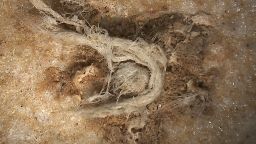
Other experts have previously suggested that artifacts, such as evidence of string-making by Neanderthals over 40,000 years ago, indicate early mathematical understanding, including concepts like pairs and sets. Garfinkel remarked that this discovery represents a foundational step in the evolution of human thought, suggesting that basic division was essential for the later development of more complex mathematics. He stated, “Like everything in human development, aspects of mathematics also developed in an evolutionary way from the simple to the more complex.”
The Halafian pottery stands out as an early example of humans applying an understanding of symmetry to art. The imagery does not depict edible crops, indicating that the intention behind these designs was likely aesthetic rather than agricultural or ritualistic. Garfinkel and Krulwich stated, “These vessels represent the first moment in history when people chose to portray the botanical world as a subject worthy of artistic expression. It reflects a cognitive shift tied to village life and a growing awareness of symmetry and aesthetics.”
Despite these findings, some experts remain skeptical. Jens Høyrup, Senior Associate Professor Emeritus at Roskilde University in Denmark and a specialist in Mesopotamian mathematics, questioned the archaeologists’ conclusions. He described the symmetry in the Halafian floral depictions as “an isolated incident of mathematical technique” rather than evidence of a broader mathematical system. Høyrup explained that dividing a circle to achieve symmetry is a basic technique that does not necessarily imply advanced mathematical reasoning.
In summary, the study reveals important insights into the cognitive abilities of early human societies, suggesting that the roots of mathematical thought may extend further back in history than previously recognized. The Halafian pottery serves as a testament to the intricate relationship between art and early mathematical understanding, marking a significant milestone in the evolution of human thought.