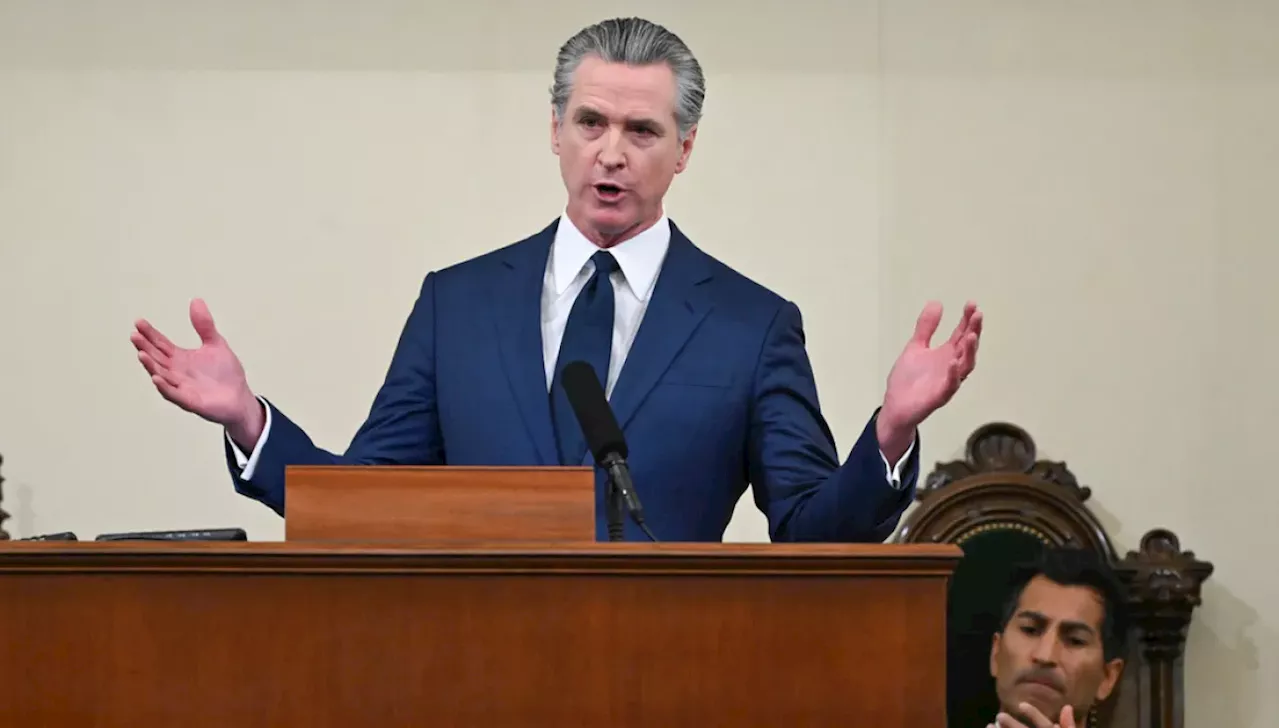
California Governor Gavin Newsom is under scrutiny for his contrasting public statements and campaign strategies as he sets his sights on a presidential run in 2028. While Newsom presents himself as a balanced and reasoned leader, his communications team has been accused of disseminating inflammatory content that undermines this image. Critics argue that this duality reflects a broader pattern of political opportunism that could have serious implications for his candidacy.
Newsom has recently made headlines for his remarks regarding Immigration and Customs Enforcement (ICE). He described certain actions taken by ICE as “state-sponsored terrorism,” a statement that has sparked outrage among law enforcement and supporters of immigration enforcement. This comment followed an incident where a protester allegedly interfered with ICE operations, leading to a confrontation that resulted in an ICE officer being injured. Critics assert that such rhetoric endangers the safety of ICE agents and stokes divisive sentiments within the political landscape.
In an attempt to appeal to a wide range of Democratic voters, Newsom has oscillated between progressive rhetoric and moderate positions. For instance, during a podcast episode with conservative activist Charlie Kirk, he addressed the contentious issue of transgender athletes in sports, suggesting that it may not be fair for transgender girls to compete against biological females. Despite this, his administration has actively promoted policies that support the inclusion of transgender athletes, showcasing a dissonance between his public statements and policy actions.
Furthermore, Newsom’s stance on parental rights concerning gender identity in schools has also drawn criticism. He has expressed that “parents know what’s best for their kids,” supporting families who move to California for gender transition. Yet, he simultaneously defends state laws that limit parental notification when children express a desire to change their gender identity at school, further complicating his narrative.
This pattern of behavior has led some to question the sincerity of Newsom’s political ambitions. His critics argue that he is willing to adopt conflicting positions to cater to different audience segments, a strategy that could alienate voters who value consistency and integrity in leadership. The governor has previously criticized former President Donald Trump for his divisive communication style, only to see his own staff replicate similar tactics on social media platforms.
As Newsom continues to navigate his potential presidential bid, the tension between his public personas raises concerns about the authenticity of his campaign. The duality of his image—one as a pragmatic leader and the other as a progressive provocateur—could pose challenges in unifying the Democratic base, particularly as the party grapples with internal divisions.
Political analysts are closely monitoring how these dynamics will unfold as the 2028 election approaches. As Newsom attempts to consolidate support from various factions within the Democratic Party, his ability to reconcile these contrasting views may ultimately determine his success on the national stage.
In the coming months, Newsom’s campaign strategies will likely be scrutinized not only by political opponents but also by voters who demand clarity and accountability from their leaders. The stakes are high as he seeks to establish himself as a viable candidate for the presidency while managing the expectations of an increasingly diverse electorate.
Only time will reveal whether Newsom’s approach will resonate with voters or lead to further criticism as he maneuvers through the complex landscape of American politics.