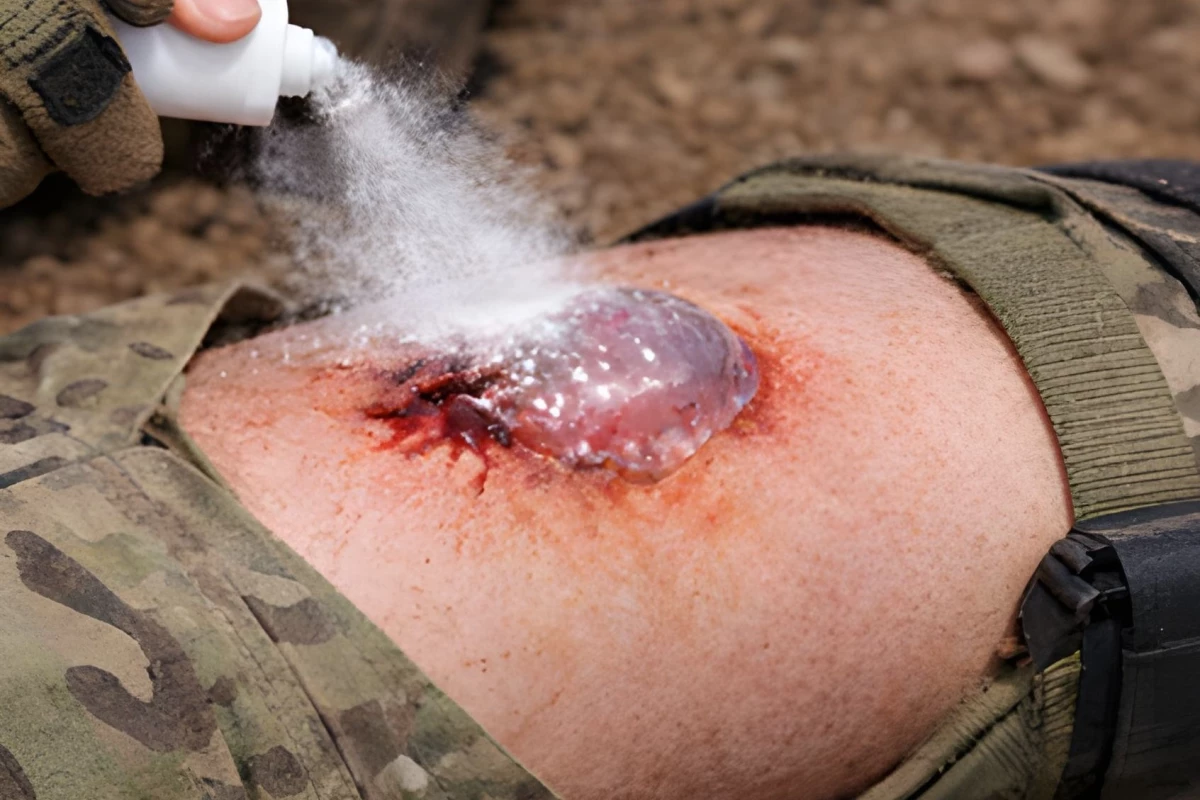
Researchers at the Korea Advanced Institute of Science and Technology (KAIST) have developed a groundbreaking spray-on powder that can stop bleeding within one second. This innovative product, named AGCL, transforms into a gel upon contact with blood, offering significant potential for enhancing wound care in combat and emergency medical situations.
Bleeding is the primary cause of death in the initial hours following injury, particularly in combat scenarios. According to military statistics, it is the leading factor behind potentially survivable deaths on the battlefield. Traditional methods of halting severe bleeding can be challenging, especially when wounds are deep or irregular. The new powder developed by the KAIST team, which includes Army Major Kyusoon Park, aims to address these critical challenges.
The AGCL powder reacts with positively charged particles, such as calcium present in blood, to quickly form a gel that effectively seals wounds. Composed of three natural ingredients—alginate, derived from brown seaweed; gellan gum, a fermented bacterial thickener; and chitosan, sourced from crustacean exoskeletons—the formulation exhibits remarkable capabilities. Upon contact with blood, alginate and gellan gum immediately transition from powder to gel. Chitosan, with its positive charge, attracts negatively charged red blood cells and platelets, promoting clot formation and halting bleeding.
Key Features and Benefits of AGCL
AGCL’s unique composition not only aids in blood clotting but also possesses antibacterial properties. In animal testing, it demonstrated a cell viability rate exceeding 99%, suggesting its potential for tissue regeneration. The gel can absorb more than seven times its weight in blood, making it effective even in extreme bleeding situations. Remarkably, AGCL can maintain its efficacy for up to two years at room temperature and is resilient in various environmental conditions, including high humidity.
In preclinical tests conducted on mice with liver injuries, AGCL outperformed existing anti-bleeding agents, restoring normal liver function within just two weeks after application. Although primarily designed for battlefield use, the researchers believe AGCL could also benefit standard emergency medicine and surgical practices.
Kyusoon Park, a Ph.D. candidate and researcher at KAIST, expressed a deep commitment to the project, stating, “The core of modern warfare is minimizing the loss of human life. I started the research with a sense of mission to save even one more soldier. I hope this technology will be used as a life-saving technology in both national defense and private medical fields.”
The research findings have been published in the peer-reviewed journal Advanced Functional Materials, shedding light on the potential of AGCL to revolutionize wound care in critical situations. As this technology advances, it may play a pivotal role in saving lives on and off the battlefield.