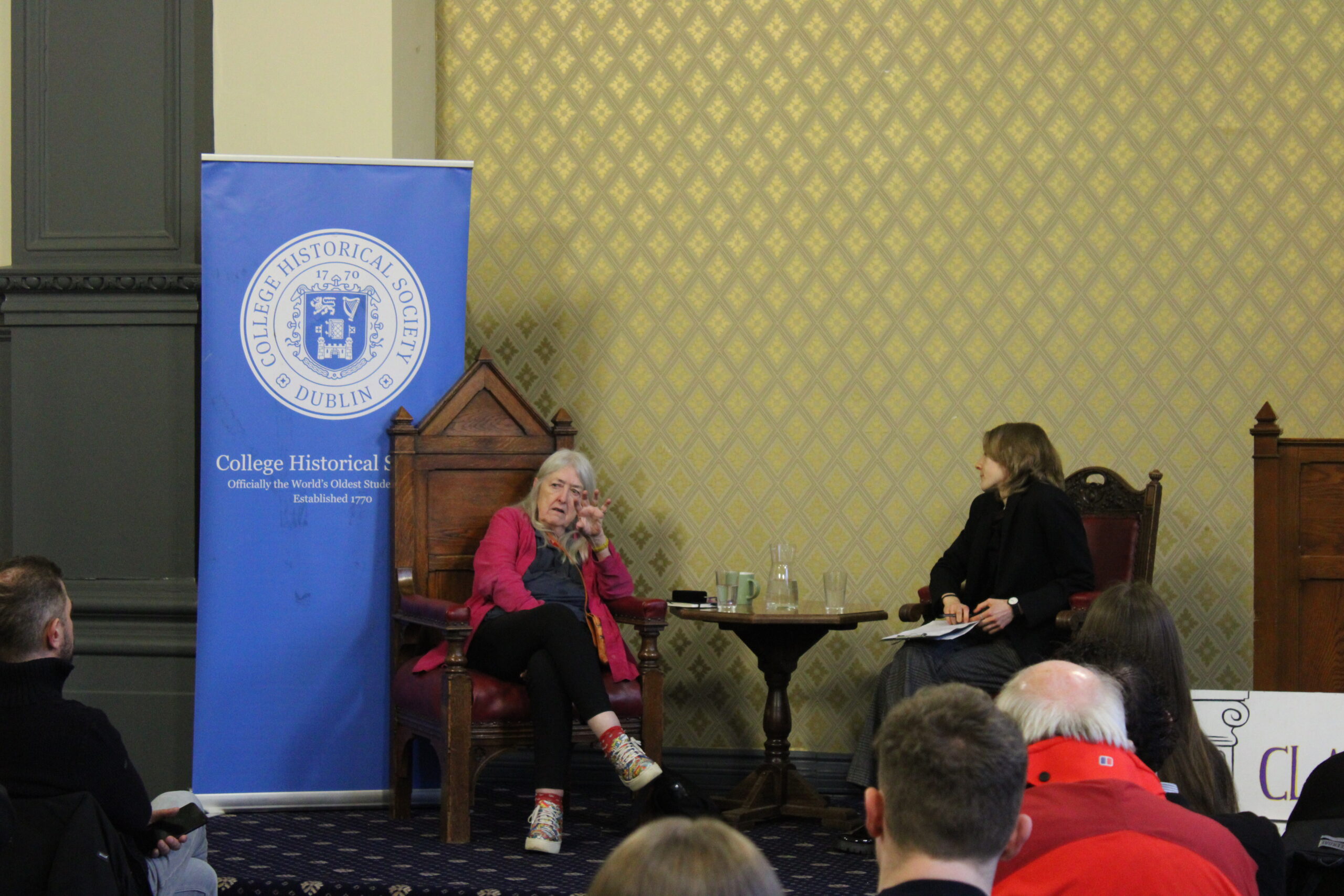
UPDATE: Renowned classicist and documentary presenter, Professor Mary Beard, received the Gold Medal for Outstanding Contributions to Public Discourse from the College Historical Society (Hist) at Trinity College Dublin on February 6, 2023. This prestigious award highlights her profound impact on academia and public life, making her insights more urgent than ever.
Beard captivated the audience with a personal story from her childhood, recalling a visit to see “Egyptian mummies” at the British Museum when she was just five years old. She vividly described the moment when a curator revealed a 4,000-year-old piece of bread from an exhibit, an experience that profoundly shaped her belief in the necessity of sharing knowledge. “I have never forgotten this little piece of bread,” Beard remarked, emphasizing that academics should aim to “open museum cases for other people.”
In her speech, Beard stressed the critical importance of humanities degrees in today’s society. She argued, “The world of public debate is dominated by those who have never thought about what it would be like to think differently.” This statement comes amid concerns that political leaders, including members of the Conservative Party, view humanities as a “luxury” rather than a necessity. “The humanities are absolutely essential,” Beard asserted, reinforcing her commitment to responsible citizenship through education.
During the event, Beard addressed the controversial subject of conservation in museums, stating that too often, conservation efforts “caps every other aim.” She passionately advocated for allowing people to touch artifacts, reflecting her belief that such interactions are vital for educational growth. “It’s a risk I’m prepared to take,” she declared, highlighting the transformative potential of direct engagement with history.
As the conversation shifted to modern adaptations of ancient texts, Beard shared her excitement about the upcoming film adaptation of the Odyssey by Christopher Nolan. “More people are going to read the Odyssey in 2026 than ever,” she predicted, despite acknowledging some historical inaccuracies in the film. This adaptability of classics to modern mediums showcases her belief that history is not just about facts but also about the narratives we create.
Beard also introduced the concept of being a “post-truth historian,” emphasizing her interest in what is not literally true. She explained that examining historical inaccuracies reveals what society values, stating, “When the untruths are cut out of historical narratives, we are left with boring information.” This insight highlights the relevance of storytelling in connecting past events to contemporary issues.
In a surprising twist, Beard revealed her recent experiment using AI to write an essay in her style, which helped her identify “clichés” in her writing. While she expressed skepticism about AI’s role in academia, she acknowledged its potential to spark new ideas and approaches.
The discussion took a provocative turn when Beard was asked to draw parallels between modern political figures and ancient leaders. She humorously identified Elagabalus, a short-lived Roman Emperor, as a point of comparison for Donald Trump, illustrating the complexities of political power throughout history. “There is no one Roman personality who can equally equate to another modern personality,” she clarified, challenging the audience to think critically about the lessons history offers.
As Beard concluded her address, she urged academics and the public alike to cultivate curiosity and engage in meaningful discourse. Her call to action resonates deeply in today’s climate of polarized opinions and underscores the pressing need for diverse perspectives in public dialogue.
This award and Beard’s compelling message reinforce the urgent need for humanities studies in understanding our world today. As she leaves a profound mark on Trinity College Dublin and the broader academic community, her insights continue to inspire curiosity and critical thinking in all of us.