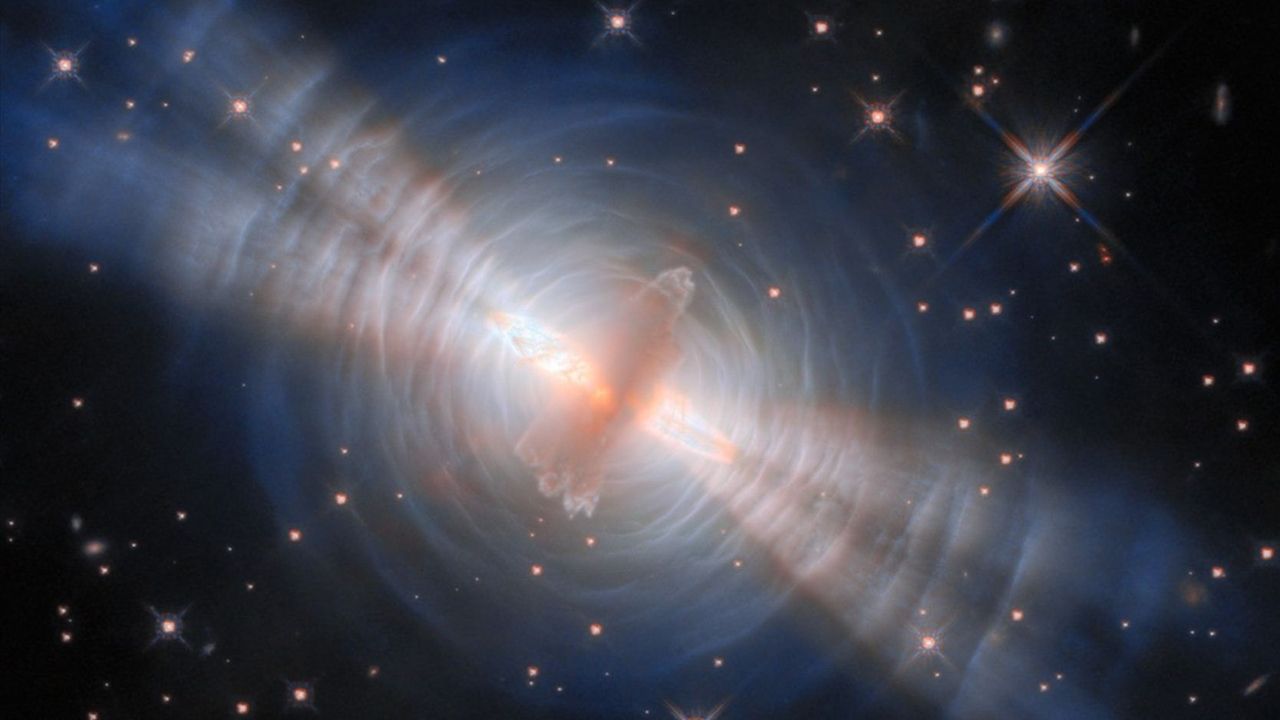
The Hubble Space Telescope has unveiled a breathtaking view of the final stages of a star’s life cycle, located in the constellation Cygnus, approximately 1,000 light-years from Earth. This celestial phenomenon, known as the Egg Nebula, showcases the dramatic and intricate processes occurring as the star approaches its demise, providing astronomers with valuable insights into stellar evolution.
The Egg Nebula, aptly named for its egg-like shape, features a central star surrounded by clouds of dust and gas resembling egg whites. In this image captured by Hubble, twin beams of light pierce through rippling arcs of material, illuminating a scene that is not only visually stunning but also scientifically significant. Unlike many nebulas that emit light due to the ionization of gas, the illumination in the Egg Nebula comes directly from the dying star itself, filtering through gaps in its dusty exterior.
Understanding Stellar Evolution
According to NASA, the Egg Nebula represents the first, youngest, and closest pre-planetary nebula ever discovered. While planetary nebulae have no direct connection to planets, they play a crucial role in providing the essential materials needed for future star systems, including those that may host planets like our own. The pre-planetary phase, which lasts only a few thousand years, allows scientists to observe the ejection process nearly in real-time.
Initial observations have focused on the nebula’s symmetrical patterns, which appear orderly enough to suggest they did not originate from a violent supernova explosion. Instead, NASA notes that these patterns likely arise from a series of poorly understood sputtering events within the carbon-rich core of the dying star, indicating a need for further research to unravel these mysteries.
By synthesizing both past and recent observations of the Egg Nebula, researchers have created the most detailed profile of its layered structure to date. This comprehensive portrait provides new clues about how dying stars shape the material that will eventually contribute to the formation of new stars and planetary systems.
The Importance of Continued Research
As the star’s core continues to heat up, it will eventually begin ionizing the surrounding gas, causing the nebula to emit its own light. This transition marks the next stage in the star’s evolutionary journey, further enriching the cosmos with the elements necessary for life as we know it.
The findings from the Hubble Space Telescope not only highlight the beauty of the universe but also emphasize the importance of ongoing research in astrophysics. Each observation contributes to our understanding of the complex processes that govern stellar life cycles and the formation of new celestial bodies. As scientists continue to study the Egg Nebula, they aim to unlock the secrets of these celestial phenomena, paving the way for a deeper comprehension of our universe.