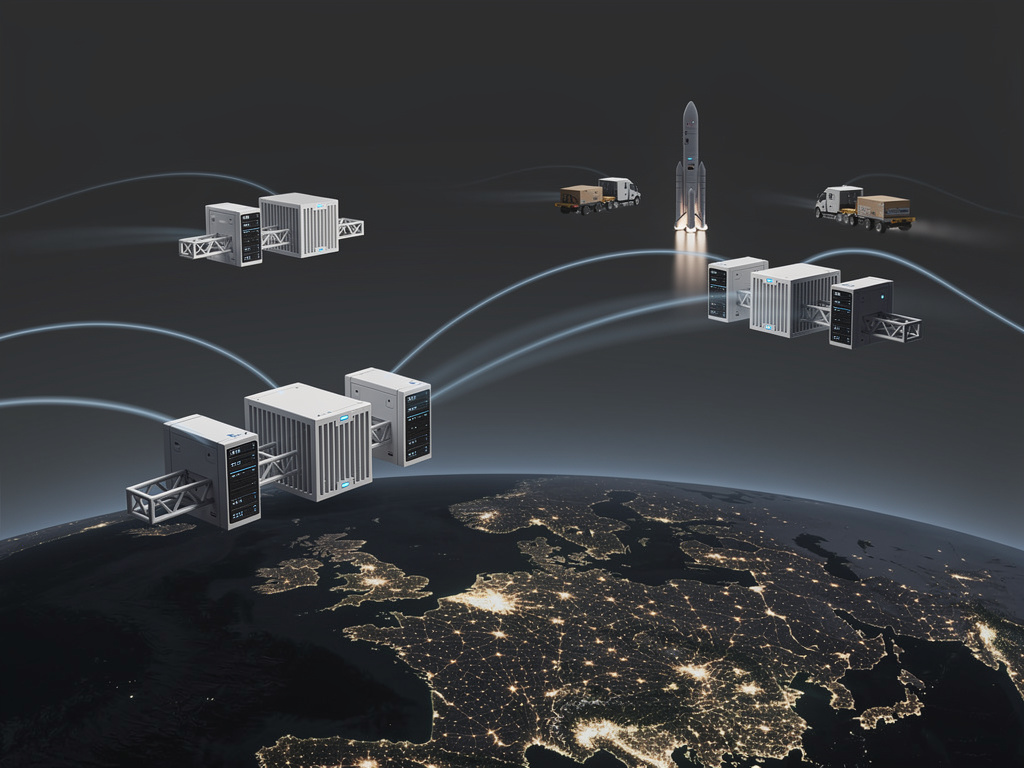
The demand for electricity in the artificial intelligence sector is escalating rapidly, prompting tech leaders such as Sam Altman and Elon Musk to explore innovative solutions beyond Earth. They propose that space-based data centers might hold the key to addressing AI’s growing energy requirements. This concept, once confined to science fiction, is now gaining traction among industry experts, with discussions centering on making it a reality in the near future.
According to Business Insider, Altman recently suggested that space data centers could become operational within just a few years, not decades. Musk echoed this sentiment, highlighting the decreasing costs associated with launching payloads into orbit thanks to SpaceX’s Starship rocket. This collaboration between the leaders of OpenAI and SpaceX signifies a shift from theoretical discussions to strategic planning.
AI’s Energy Demand Surges
The rapid increase in power consumption is underscored by estimates from Goldman Sachs, which projects that data center electricity use in the United States could more than double by 2030, primarily driven by AI workloads. The International Energy Agency forecasts that global data center power consumption could reach 1,000 terawatt-hours annually by 2026, approximately equivalent to Japan’s entire electricity usage. This surge has already resulted in power supply challenges in regions like Northern Virginia, Texas, Ireland, and the Netherlands, where utility providers are warning of impending shortages.
In response, major tech companies including Microsoft, Google, and Amazon have initiated long-term power purchase agreements and investments in alternative energy sources like nuclear and geothermal energy. Yet, these solutions require years to implement, and the demand for computational power continues to outpace the grid’s capacity.
Solar Power in Orbit: A Viable Solution
Altman’s vision for space-based data centers is grounded in a significant advantage: solar panels in orbit receive uninterrupted sunlight, free from atmospheric interference. Such solar arrays could produce five to ten times more energy per square meter than their terrestrial counterparts. This potential for abundant, low-cost, and carbon-free power presents a compelling case for the industry.
During his remarks, Altman indicated that the infrastructure for these data centers could start to materialize as early as 2026 or 2027. He emphasized the rapid decline in launch costs—where SpaceX’s Starship aims to reduce the cost to approximately $10 per kilogram—as a crucial factor in making space-based computing economically feasible.
Musk’s dual role as both a supplier of launch services through SpaceX and a significant consumer of computing power through his company xAI further solidifies his interest in this venture. His Colossus supercomputer in Memphis is one of the largest AI training facilities globally and already faces challenges due to local power constraints.
Musk has publicly acknowledged the possibilities of orbital computing, citing the success of SpaceX’s Starlink satellite constellation, which operates over 6,000 satellites equipped with advanced hardware. The transition from communication satellites to computing satellites, while technically challenging, leverages SpaceX’s extensive experience in satellite deployment.
Technical Challenges and Market Viability
Despite the promising outlook, significant technical hurdles remain. Cooling computer hardware in the vacuum of space differs markedly from Earth-based methods, as there is no air for heat dissipation. This necessitates reliance on radiative cooling, which is less efficient and requires larger surface areas. Additionally, electronic components in orbit face degradation from radiation, raising the need for robust designs or regular replacements.
The latency between orbital data centers and users on Earth could also complicate real-time applications. Maintenance poses another challenge; while servers can be replaced quickly on Earth, repairs in orbit would likely necessitate robotic servicing or the replacement of entire satellite units.
Startups are beginning to explore these frontiers. Companies like Lumen Orbit, backed by Y Combinator, are developing satellites specifically tailored for AI workloads. They assert that the combination of abundant solar energy and the natural cold of space can mitigate some cooling challenges. Another venture, Axiom Space, is working on commercial space station modules that could host computing infrastructure.
The Economic Equation
The fundamental question remains whether the costs associated with space-based computing can compete with traditional ground-based solutions. Currently, launching a single rack of high-performance AI servers entails significant expenses, far exceeding the cost of establishing similar infrastructure on land.
Yet, as SpaceX’s Starship approaches its intended economic goals, the potential for reduced launch costs could shift the balance. Additionally, rising energy prices for terrestrial data centers, driven by increasing demand and supply constraints, could make space-based solutions more appealing.
Regulatory and Geopolitical Challenges
The advent of space-based data centers also introduces complex regulatory questions. Issues surrounding jurisdiction, spectrum allocation for computing versus communication satellites, and liability for orbital debris require careful consideration. On a geopolitical level, control over substantial computing resources in space could serve as a strategic advantage, intensifying competition between nations, particularly between the United States and China, in the race for AI supremacy.
As discussions about timelines accelerate, Altman and Musk are not envisioning a future set far in advance. They are indicating that the late 2020s could very well be the timeframe for these innovations to materialize. The AI sector has consistently demonstrated its capability to achieve previously unattainable milestones. If solutions to the electricity crisis cannot be found on Earth quickly enough, the industry may indeed be compelled to look skyward.