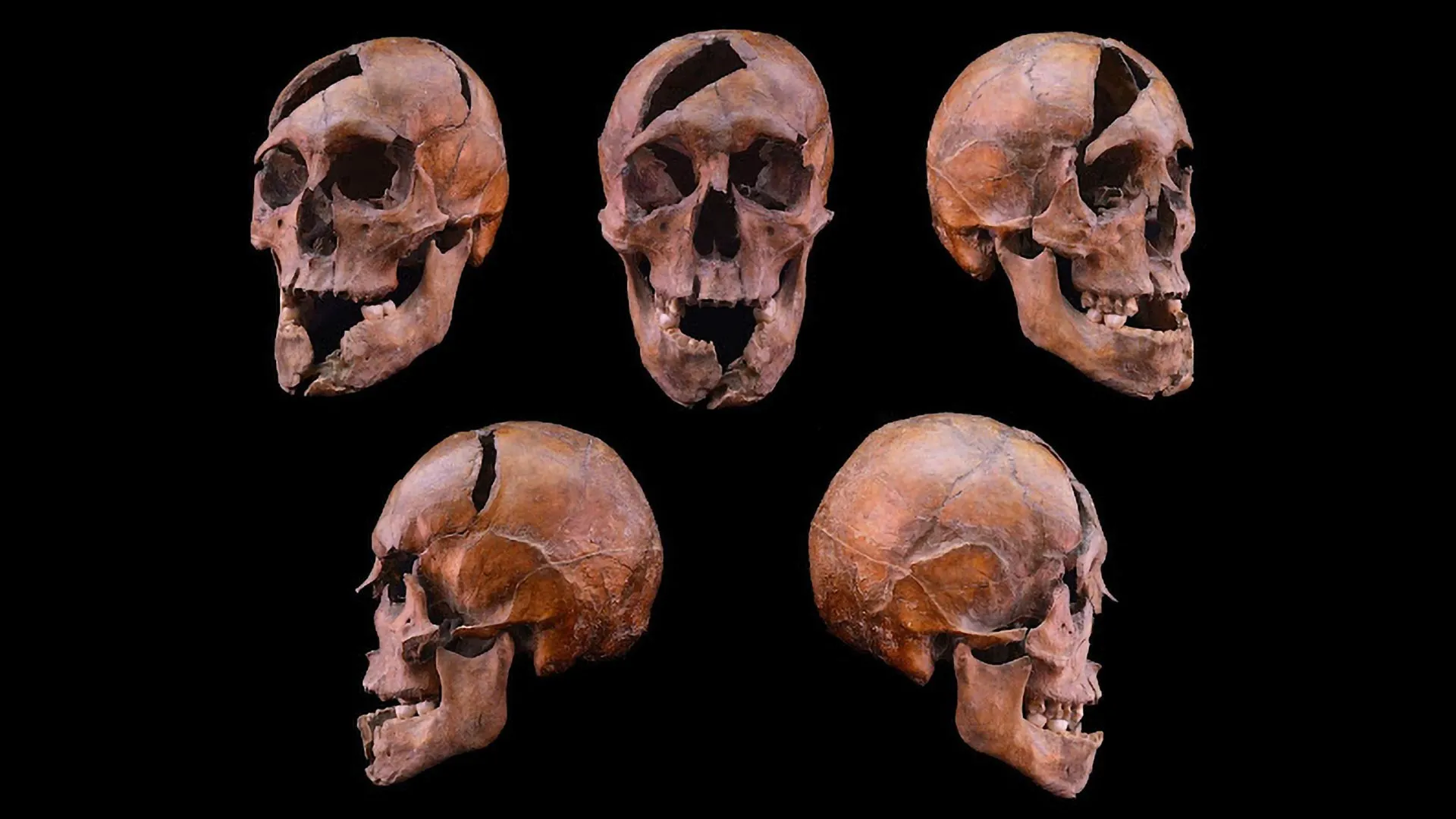
BREAKING: A groundbreaking study has confirmed the identity of Duke Béla of Maczó, revealing shocking details about his violent murder over 700 years ago. This urgent update from Eötvös Loránd University showcases how modern science has solved a historic mystery that has captivated historians and archaeologists alike.
In a sweeping investigation, an international team led by Hungarian scholars has conclusively identified skeletal remains discovered in Budapest as those of Duke Béla. This revelation not only uncovers his royal lineage, tracing back to both the Árpád and Rurik dynasties, but also provides a chilling account of his assassination in 1272, described as a coordinated and emotionally charged attack.
The findings, published in Forensic Science International: Genetics, are the result of a meticulous collaboration between anthropologists, geneticists, and archaeologists. They utilized genetic, isotopic, and forensic evidence to reconstruct the life and brutal death of Duke Béla, a nobleman of Scandinavian-Rurik roots. The study reveals that he was attacked with 23 sword cuts, indicating a violent struggle from multiple assailants.
The historical context dates back to November 1272 when Duke Béla was reportedly murdered by Ban Henrik “Kőszegi” and his allies. The gruesome details align with medieval records, as contemporary accounts described how his mutilated body was recovered by his sister Margit and niece Erzsébet, and laid to rest at a Dominican monastery.
The story of these remains began in 1915 when archaeologists unearthed the bones during an excavation on Margaret Island. Initial assessments hinted at their identity as Duke Béla’s, but the remains mysteriously vanished after World War II, leading many to believe they were lost forever. However, in 2018, the postcranial bones were rediscovered in a wooden box among thousands of specimens at the Hungarian Museum of Natural History, reigniting interest in this historical enigma.
The research consortium formed in 2018 aimed to verify the remains’ identity using cutting-edge forensic techniques. Their findings reveal that Béla of Maczó was in his early twenties at the time of death, and his diet included high amounts of animal protein, which significantly affected the radiocarbon dating of his remains.
Further genetic analysis confirmed a strong Scandinavian lineage, aligning him with the Rurik dynasty. The study highlights that Béla was the great-grandson of King Béla III, providing a rare glimpse into the royal heritage of medieval Europe.
The forensic investigation documented 26 perimortem injuries, indicating a violent attack involving multiple assailants. The nature of the wounds suggests that Béla recognized the assault and attempted to defend himself, but ultimately succumbed to a brutal and premeditated attack. The emotional intensity of the assault suggests deep-seated motives among his attackers, indicating that this wasn’t just a random act of violence.
This urgent discovery not only resolves a long-standing historical mystery but also emphasizes the power of interdisciplinary research in uncovering the truths of the past. The investigation showcases how collaboration between humanities and sciences can yield groundbreaking insights into historical narratives.
As researchers continue to analyze the implications of this study, the Duke’s story serves as a poignant reminder of the turbulent history of medieval Europe. The findings are set to spark further discussions about royal lineage, violence, and the historical context of power struggles in the region.
Stay tuned for more updates as this story unfolds and new insights emerge from this remarkable intersection of history and modern science.