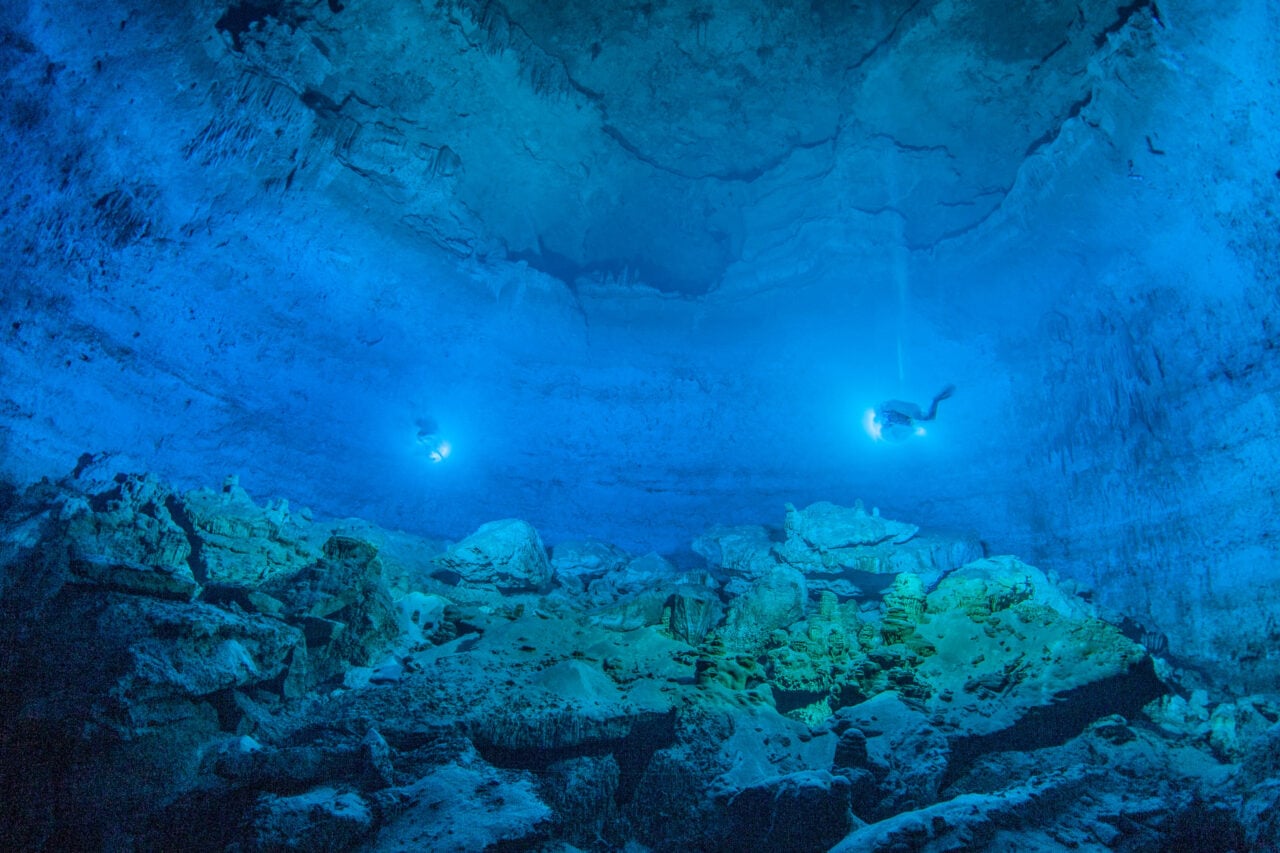
Deep beneath the lush forests of the Yucatán Peninsula lies Hoyo Negro, a submerged cave that serves as a portal to the Ice Age. This vast and intricate system of underwater caves, known as Sac Actun, is among the largest in the world, stretching for thousands of kilometers and accessible via sinkholes called cenotes. Fossils and evidence of ancient human activity found within these dark, flooded tunnels provide insight into a time when the area was dry and inhabited by both humans and animals.
The Hoyo Negro site gained significant attention in 2014 following the discovery of Naia, one of the oldest known human skeletons in the Americas, dated to approximately 12,970 to 12,770 years ago. This discovery was made by three divers—Alejandro Alvarez, Franco Attolini, and Alberto Nava Blank—who first identified the pit in 2007. In response to this significant find, the National Institute of Anthropology and History (INAH) established the Hoyo Negro Underwater Archaeological Project to further investigate the site.
Exploration and Mapping of Hoyo Negro
Since joining the project in 2011, diver and co-director Roberto Chávez Arce has documented the wonders of Sac Actun through stunning photography. His images have provided a glimpse into the submerged world, allowing scientists to study its contents without the need to dive themselves. However, exploring Hoyo Negro is perilous; the tunnels were largely unmapped when research began, and divers must carry extensive safety equipment, including breathing apparatuses, lights, and navigational tools.
Initially, divers entered Hoyo Negro from a cenote located approximately 3,000 feet (914 meters) away, a journey that could take nearly an hour. Today, access has improved significantly with the discovery of a nearer cenote, just 250 to 300 feet (76 to 91 meters) from the pit, and the use of motorized scooters to navigate the water efficiently. Early mapping efforts involved basic tools like compasses and tape measures, but the team has since adopted advanced techniques such as structure-from-motion (SfM) photogrammetry, which allows for the creation of detailed 3D models of the cave system.
Insights into the Pleistocene Ecosystem
Research has revealed that the water level in Hoyo Negro fluctuated significantly over time, with evidence showing it reached the bottom of the pit at least 9,850 years ago. The cave system eventually became fully submerged by approximately 6,000 years ago, marking a pivotal time for both human and animal access to the caves. The ancient ecosystem of Quintana Roo during the Pleistocene was markedly different from today’s environment, characterized by a savanna landscape that attracted both humans and wildlife seeking fresh water.
Fossils found at the bottom of Hoyo Negro include those of Naia, whose remains indicate a tragic end. Her incomplete adult teeth and skeletal analysis suggest she was approximately 15 to 17 years old at the time of her death, likely due to a fall into the pit. Dr. James Chatters, a co-director of the project, noted that Naia’s injuries indicate she suffered a broken pelvis upon landing.
The cave has yielded numerous other fossils, including extinct species such as the short-faced bear, Arctotherium wingei, and a new genus of ground sloth named Nohochichak xibalbahkah. These discoveries contribute significantly to our understanding of the Great American Biotic Interchange, a period of migration that reshaped the fauna of North and South America.
Researchers also found evidence of human activity within the caves, including mining for ochre, a mineral used for various purposes, including decoration and burial practices. Remnants of charcoal and fire-reddened stones suggest that ancient inhabitants utilized fire to navigate the dark passages.
The ongoing research at Hoyo Negro continues to uncover the complex relationship between early humans and the animals that roamed the region. As studies progress, the findings from this submerged cave system promise to enhance our understanding of prehistoric life in the Americas.
With each dive and discovery, Hoyo Negro unveils more of the ancient world, allowing scientists to piece together the mysteries of our past and the ecosystems that once thrived in what is now submerged beneath the Yucatán Peninsula.