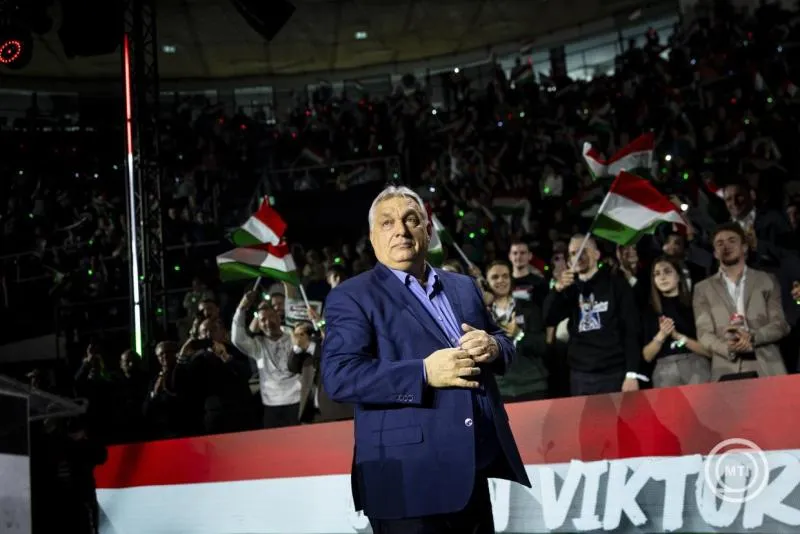
Prime Minister Viktor Orbán stated that the continuation of the war in Ukraine is essential for the country’s survival, suggesting that Kyiv relies on ongoing conflict for financial support. He made these remarks during a government forum held in Békéscsaba, where he also indicated that Hungary may take retaliatory actions in the energy sector should tensions escalate further.
Orbán opened his speech with optimistic local messages but quickly shifted to a more serious tone, referring to what he described as “clouds towering above our heads.” He emphasized the historical significance of Békéscsaba, a city with a legacy of conflict, as the venue for an “explicitly anti-war” gathering.
During the forum, attendees raised concerns about the resumption of oil deliveries through the Druzhba (Friendship) pipeline before the next election. Questions also arose about Hungary’s response if Croatia were to deny transit for Russian crude oil. While Orbán did not provide a timeline for when supplies might resume, he acknowledged the complex dynamics at play.
Orbán’s assertion that Ukraine benefits from the war stems from the financial aid it receives from international sources. He claimed that Ukrainian leaders are leveraging the ongoing conflict to achieve broader political and financial objectives, including increased funding from European nations.
The Prime Minister suggested that Hungary’s stance may not align with Ukraine’s interests, implying that Kyiv would prefer a change in government in Budapest. He further accused Ukraine of employing an “energy weapon” but did not address the fact that prior disruptions in pipeline deliveries were linked to military actions by Russia.
Potential Energy Countermeasures
Orbán stated that Hungary has already taken measures to defend itself against energy-related challenges and is ready to implement further “counterstrikes.” Among the actions he mentioned were halting diesel supplies and potentially vetoing a planned European Union loan package for Ukraine, despite Hungary’s non-participation in that initiative.
He warned that a significant portion of Ukraine’s electricity imports originates from Hungary, and ceasing these flows could have “serious consequences.” The possibility of halting energy exports was not ruled out, indicating that Hungary remains prepared to protect its interests in a volatile situation.
In a lighter moment, Orbán reflected on past visits to local festivals, contrasting this with a more assured tone regarding Hungary’s economic progress. He echoed comments made by János Lázár, the Minister of Construction and Transport, noting that the government has established some of the most modern factories globally “in the middle of the Great Plain.”
“We are capable of anything,” Orbán stated with confidence, asserting that once the government aligns with citizens on a program, it possesses the ability to deliver tangible results.
As the situation continues to evolve, Hungary’s response to the ongoing conflict in Ukraine remains a critical aspect of regional energy security and political dynamics.