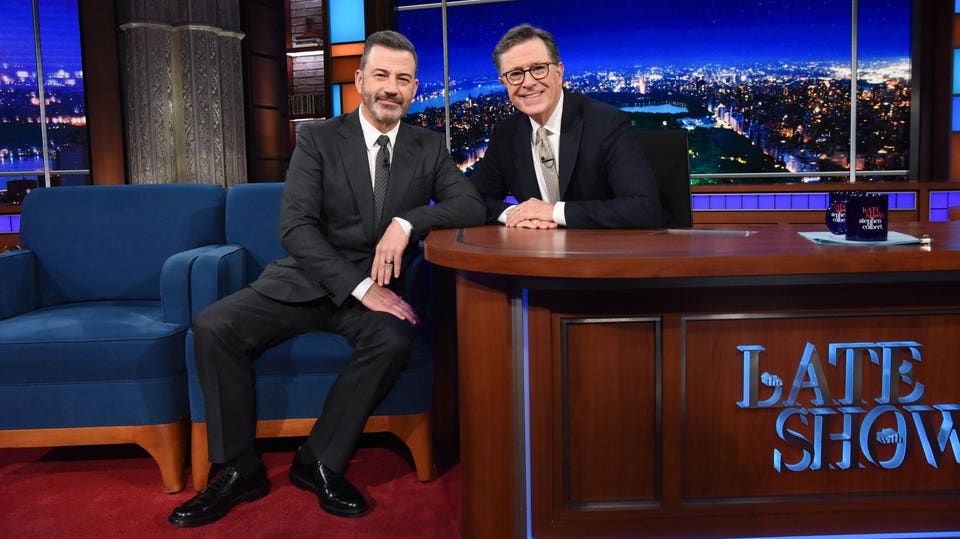
Late-night hosts Jimmy Kimmel and Stephen Colbert have voiced strong opposition to the Federal Communications Commission (FCC) for its recent enforcement of the “equal time” rule, which mandates networks to provide equal airtime to opposing political candidates. During their shows, both comedians described this move as an attempt to suppress their voices and labeled it a “crackdown” on late-night television.
On his show, Kimmel highlighted the FCC’s notice in his monologue, criticizing former President Donald Trump for continuing what he referred to as a “war on talk shows.” Kimmel explained that Trump had made comments on Truth Social about his supporters at the FCC planning to complicate interviews with politicians. He further stated that Brendan Carr, the chair of the FCC, was “reinterpreting long-agreed-upon rules to stifle us,” emphasizing the complexity of the situation.
Understanding the historical context, Kimmel noted that the “equal time” mandate was established when radio was the primary medium for news and later extended to television. He recalled that since 2006, late-night shows have operated under an exemption granted to news networks, an exemption that could now be removed. Kimmel asserted that Carr’s actions are designed to silence viewpoints that do not align with his own.
Kimmel also raised concerns about the relevance of such regulations in a changing media landscape. He pointed out that broadcast television has seen significant declines in viewership, stating, “Broadcast TV used to account for 100% of viewing…now it’s like 20%.” He remarked on the dominance of networks such as Fox News, Newsmax, and One America News Network, which focus heavily on pro-Trump content.
In a later segment, Colbert addressed the FCC’s decision, humorously expressing his apprehension about discussing Trump, saying, “Johnny Law is once again coming after yours truly here.” He referenced a New York Times headline that characterized the FCC’s move as a “new crackdown on late-night TV.” Colbert quipped that this development has significant implications for him, especially as CBS has decided not to renew his show for another season.
Colbert also shared that his lawyer advised him against discussing the new regulations, suggesting that they are a deliberate effort to silence him and his fellow late-night hosts. He humorously turned to the camera, addressing the FCC directly, saying, “Hey, I’m flattered you think that appearing on my show has the power to affect politics in any way.”
As both Kimmel and Colbert continue to challenge the FCC’s actions, they highlight a broader conversation about media freedom and the evolving landscape of political discourse in the United States. The enforcement of the “equal time” rule raises questions about the future of late-night television and the role these platforms play in shaping public opinion.
The FCC’s decision has sparked a significant reaction within the entertainment community, indicating that the implications of this mandate extend beyond regulatory compliance into the realm of creative expression and political commentary.