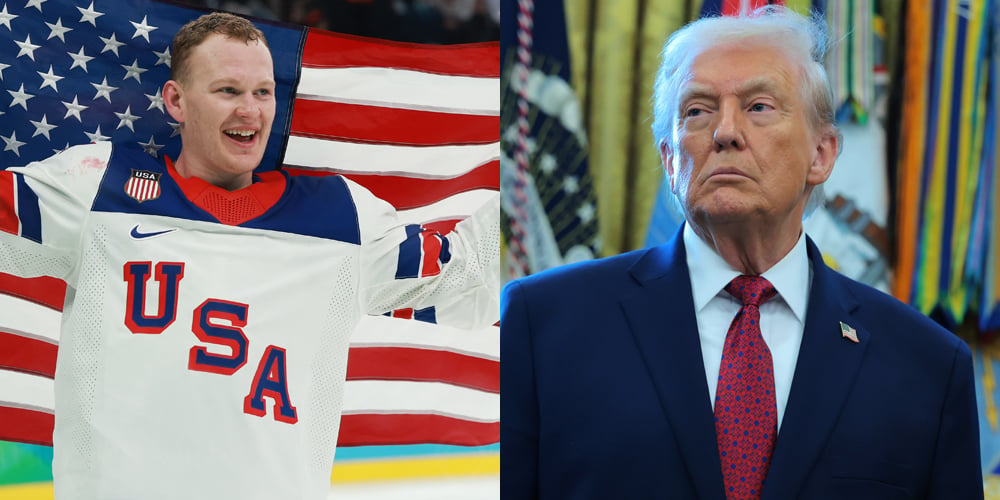
Donald Trump has sparked controversy by sharing an AI-generated video featuring NHL star Braeden Tkachuk that includes a fabricated insult directed at Canada. The video, released by the White House on TikTok shortly before Trump’s State of the Union address, has drawn criticism for its misleading content. Tkachuk, who was a member of the United States men’s hockey team at the 2026 Winter Olympics, has publicly disavowed the remarks attributed to him in the video.
The video, which celebrates Team USA’s victory over Canada, opens with Tkachuk appearing to make derogatory comments about Canada, claiming, “They booed our national anthem, so I had to come out and teach those maple syrup eating f—- a lesson.” These words, however, were never spoken by Tkachuk, who described the video as “clearly fake.” He stated, “It’s not my voice. It’s not what I was saying. I would never say that. That’s not who I am.”
On February 23, 2024, the White House shared the video in an effort to commemorate the hockey team’s success. Although the caption read, “Silver does NOT shine just as bright,” it quickly drew backlash from viewers who recognized the AI manipulation. Many commenters expressed disbelief that such a misleading video would be posted by an official government account.
Critics voiced their concerns on social media, highlighting the importance of authenticity in communication from the White House. One comment read, “Do none of you realize this is fake? It is AI dubbed. Tkachuk never said any of that. I can’t believe this was put out by the White House.” Another user questioned the judgment of the social media team, asking, “Is there not ONE single sane person on the White House social media team?”
Despite the video containing a disclaimer indicating it was AI-generated, the lack of context and the evident fabrication led to widespread disapproval. Tkachuk, who serves as captain for the Ottawa Senators, reiterated his stance on the matter, emphasizing that he does not endorse the statements made in the video. “I know that those words would never come out of my mouth,” he stated.
The White House has yet to respond to inquiries about the decision to post the controversial video. This incident raises questions about the implications of using AI in public communications, particularly regarding the integrity and trustworthiness of the messages being conveyed.
As the situation unfolds, it remains to be seen how this controversy will impact public perception of both Trump and the White House’s approach to digital media.