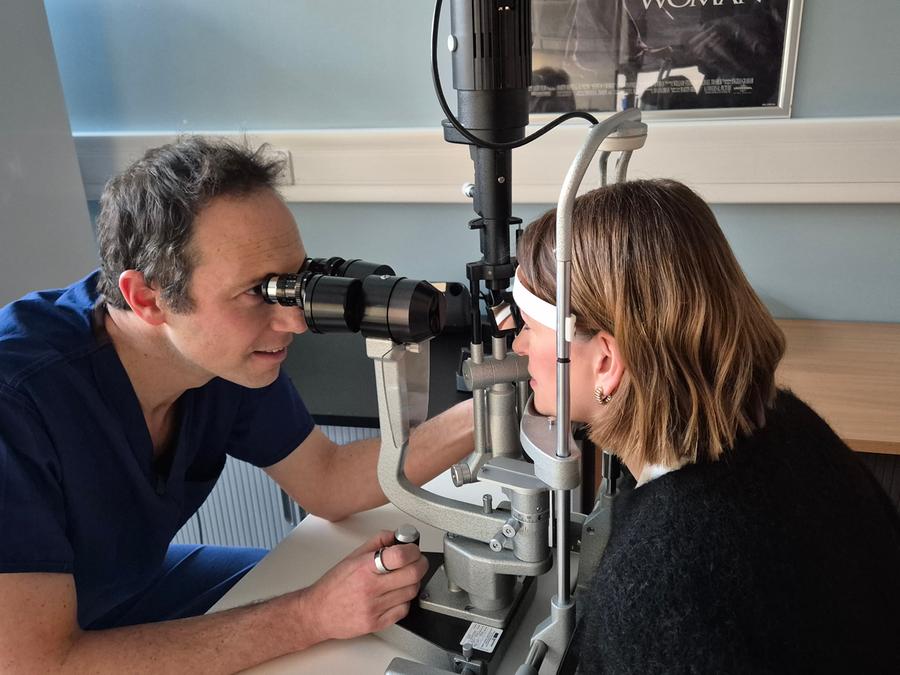
A pioneering treatment developed by ophthalmologist Harry Petrushkin at Moorfields Eye Hospital has successfully restored vision in a patient suffering from hypotony, a condition previously deemed incurable. Nicki Guy, a 47-year-old woman, regained her sight after an innovative approach involving the injection of hydroxypropyl methylcellulose (HPMC) gel into her eye.
Hypotony is characterized by abnormally low pressure within the eyeball, which can lead to severe vision impairment or blindness. This condition often goes unnoticed in children but can manifest in adults with devastating consequences. Until recently, medical professionals were resigned to the belief that once hypotony reached an advanced stage, recovery was impossible.
Dr. Petrushkin, who specializes in managing inflammatory eye conditions, expressed his astonishment at the results achieved with Guy. “I was amazed that she did so well,” he said, adding that it was “a fantastic result, more than I ever could have hoped for.”
Guy’s journey began in 2017 after the birth of her son, when she started experiencing vision problems. By 2019, she sought treatment from Petrushkin after other ophthalmologists had prescribed eye drops and performed cataract surgery, which resulted in sudden blindness in one eye. “Her eye just deflated,” noted Petrushkin, who then focused on preventing similar outcomes in her other eye.
After two years of unsuccessful treatment attempts using immunosuppressive drugs, Petrushkin faced a critical decision during a second cataract surgery. He could either use standard silicone oil or explore a new treatment approach. With a supportive team around him, he opted for an innovative solution: injecting HPMC gel every couple of weeks for approximately ten months.
Petrushkin explained the rationale behind this method: “The way that we chose to do it, and to repeatedly do it, with a target in mind, is the new thing about this research.” He likened the process to inflating a flat tire multiple times to ensure it functions properly. Previous attempts at treating hypotony lacked the frequency and precision necessary for effective outcomes, he noted.
Guy described the treatment as “life-changing,” stating, “It’s given me everything back. I can see my child grow up.” Her ability to progress from “counting fingers” to seeing clearly marks a significant improvement in her quality of life.
Dr. Petrushkin estimates that this treatment could benefit between 500 and 1,000 patients annually. He emphasized the importance of a shift in the conventional wisdom surrounding severe eye diseases, advocating for a more open-minded approach to treatment possibilities. “What I hope is that there’s a paradigm shift in the conventional wisdom of when an eye is beyond hope,” he said, encouraging his colleagues not to dismiss cases where recovery is still feasible.
As the medical community evaluates the implications of this breakthrough, Dr. Petrushkin’s achievement stands as a testament to innovative thinking in ophthalmology, potentially offering new hope to many patients who have long been considered beyond help.