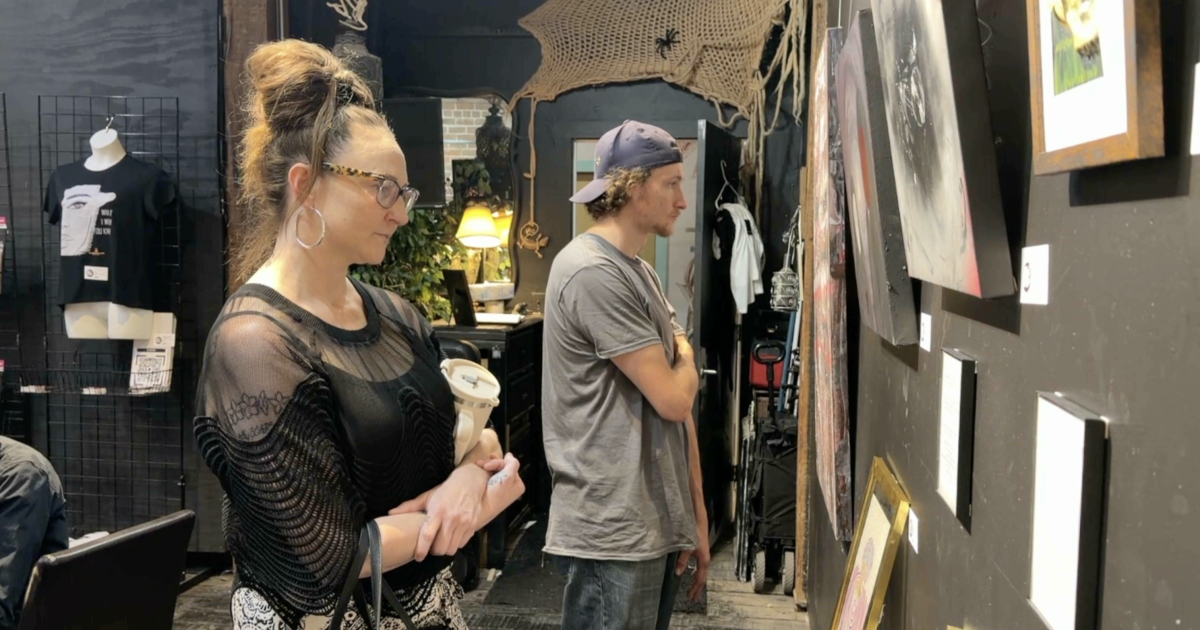
January marks National Human Trafficking Prevention Month, a time dedicated to raising awareness about this critical issue. In Tucson, Arizona, survivor Monica Perkins is using her powerful voice and creativity to shed light on her past experiences through poetry and art. Her story is part of an exhibit titled “Every Step has a Story – How We Got In, How We Got Out, Who We Are Now,” where she shares her journey and the struggles she faced during her eight years of human trafficking.
Perkins, who began her ordeal at the age of 17, recounts meeting her first predator in San Francisco while residing in a group home. “The day that I met him, he took me around and showed me some of his houses. He had a nice car, he told me he was a rap producer,” she explained. At that moment, the allure of a glamorous lifestyle clouded her judgment. As she reflects on the trauma she endured, Perkins emphasizes the lasting effects it has had on her mental health: “My brain was being rewired and reconditioned before I even knew myself.”
Her life took a dramatic turn after the birth of her son, Dondre Cannon. When he was just four months old, he was taken from her, and she was coerced into prostitution. “I was handed a purse by one of his women, full of rubber gloves, condoms, and lube, and told what I was going to be doing,” she recalled. This marked the beginning of a harrowing chapter filled with isolation, control, and abuse, where she was allowed to see her son only a handful of times.
Escaping this nightmare was not easy, but Perkins’s determination to reunite with her son propelled her forward. At the age of 25, she broke free from her captors and has since dedicated her life to helping others. Now, through her poetry, Perkins advocates for survivors, reading lines that resonate with strength and resilience: “As survivors, it’s up to us to unite and fight for what’s right. Stand tall and turn our pain into power.”
In sharing her story, Perkins hopes to inspire others who may be facing similar struggles. “I just know that like I did not, there’s no reason I had to have gone through all that if I can’t use it to help somebody else,” she stated. Her message is clear: silence is a barrier that needs to be broken. “There are so many people that could have stepped in and saved my life,” she said, calling for more awareness and action from the community.
The curator of the exhibit, Angela Marie, who is also a survivor, emphasizes the importance of providing a platform for victims to reclaim their voices after experiencing silence for so long. “Being able to walk with other survivors and see them begin to own their own lives again… to remind them they have a voice,” she said. The exhibit serves not only as a showcase of art but as a communal space for healing and support.
Perkins, along with her now 21-year-old son Dondre and 15-year-old daughter Arianna, collaborates with local nonprofits such as Southern Arizona Against Slavery (SAAS). Norma Darnell, SAAS President and fellow survivor, aims to empower those affected by sexual exploitation. “I know that you’ve learned how to build walls and not to trust… we are a safe place and that we will love you wherever you’re at in your journey,” Darnell expressed.
The art exhibit is hosted at the 7 Legged Spider Gallery in the Steinfeld Warehouse, located at 101 W. 6th St. in Downtown Tucson, open throughout January on Saturdays from 13:00 to 16:00 and by special appointment. For those interested in learning more, inquiries can be directed to Angela Marie on Instagram at @angela_marie_arts.
Additionally, a Human Trafficking Awareness Walk is scheduled for January 19, 2024, at 09:00, starting at the northwest corner of Reid Park. This event aims to mobilize the community in the fight against human trafficking and support survivors in their healing journey.
Monica Perkins’s story and her artistic expression serve as a reminder of the resilience of the human spirit and the importance of standing together to combat human trafficking.