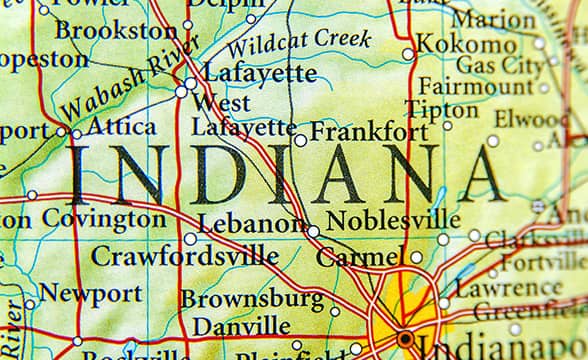
Legislation aimed at banning online sweepstakes casinos has been introduced in Indiana. The bill, designated as HB 1052, was filed by State Representative Ethan Manning as part of a broader effort to eliminate dual-currency gambling platforms. This proposed law focuses on regulating online sweepstakes operations and includes specific penalties for violations.
The legislation is a response to the growing trend of states prohibiting sweepstakes casinos. In recent months, both New York and California have enacted bans on dual-currency sweepstakes casinos, which allow players to convert virtual currencies into cash. Other states, including Connecticut, Idaho, Montana, New Jersey, and Washington, have also moved to restrict or outlaw these types of gambling operations.
In his prior legislative attempt, Manning proposed a bill that would have legalized iGaming in Indiana. This initiative would have granted the Indiana Gaming Commission regulatory authority over online casinos, requiring partnerships with licensed brick-and-mortar casinos. However, that proposal faced significant opposition and did not advance.
Details of HB 1052
The contents of HB 1052 outline two primary requirements for any online game, contest, or promotion to qualify as a sweepstakes. First, there must be a dual-currency system that players can exchange for real money, or there needs to be an equivalent chance to win cash prizes.
Should the bill pass, any individual or operator knowingly running a sweepstakes in Indiana may face a fine of $100 for each offense, multiplied by the number of violations. The bill does not specify additional penalties, keeping the focus on these initial fines.
Legislative efforts to curb sweepstakes gambling reflect a shifting regulatory landscape as more states re-evaluate their positions on online gaming. The recent changes to advertising policies by major platforms like Google have further complicated the situation for sweepstakes casinos, making it harder for them to reach potential customers.
Manning’s initiative, if successful, would align Indiana with a growing number of jurisdictions taking a stand against dual-currency gambling operations. As states grapple with the implications of online gaming, the outcome of this legislative effort could have significant ramifications for the future of gambling in Indiana and beyond.