Santa Clara County Superior Court Judge Hanley Chew on October 31, 2023, denied a request from the District Attorney’s Office to prohibit defense attorneys from using the term “genocide” during the felony vandalism trial involving five pro-Palestinian demonstrators from Stanford University. This ruling comes amidst a legal backdrop surrounding the defendants’ motivations and the context of their actions during a demonstration in June 2024.
In a related decision, Judge Chew also rejected a motion to limit discussions of political motivations within the trial. He emphasized, however, that such discussions would be “severely limited” according to evidentiary rules. “I will deny the prosecution’s motion,” Chew stated, adding that he would monitor the use of the term “genocide” closely due to its powerful and charged nature. He warned that if the term is exploited, he would sustain objections and restrict its usage further.
The five defendants—German Gonzalez, Maya Burke, Taylor McCann, Hunter Taylor Black, and Amy Zhai—are accused of damaging Stanford’s executive offices during a protest advocating for the university to divest from companies linked to Israel. If convicted, they face up to three years in prison. The remaining eight individuals arrested during the demonstration accepted plea agreements or entered diversion programs. Notably, District Attorney Jeff Rosen chose not to prosecute a student journalist who was also detained while covering the event.
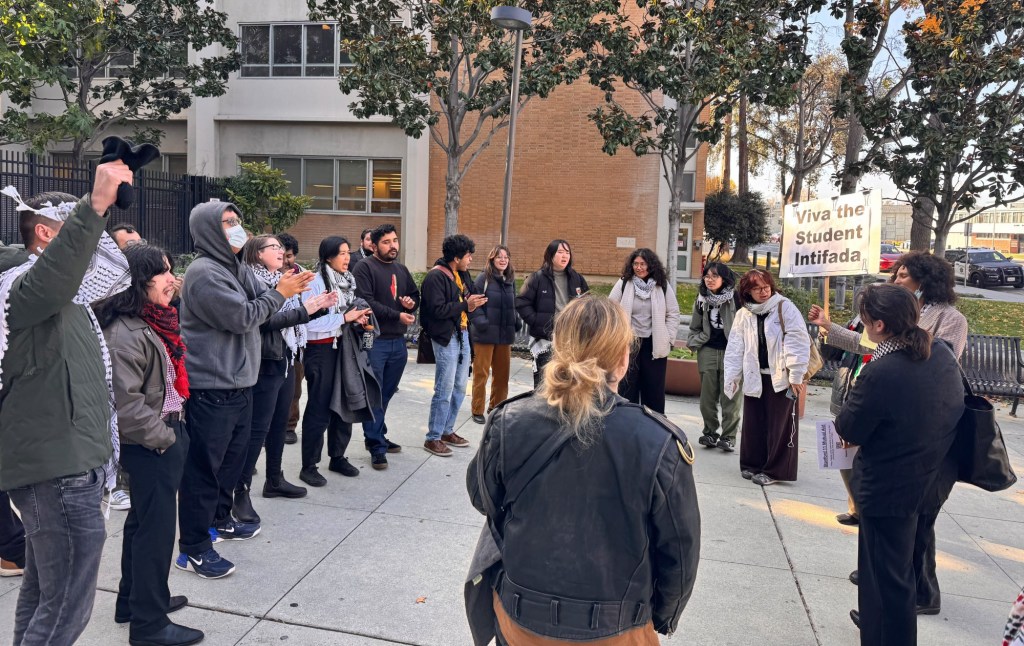
Supporters of the defendants filled the courtroom, many wearing kaffiyehs as a show of solidarity with the protesters and Palestinians in Gaza. Judge Chew admonished several audience members for disruptive behavior during proceedings but noted that there were no significant disruptions. Following the hearing, supporters gathered outside the courthouse, peacefully chanting in favor of Palestinian rights while commemorating three years since intensified military operations in Gaza resulted in significant casualties.
During the hearing, Deputy District Attorney Rob Baker argued against the inclusion of testimony regarding genocide and political motivations, suggesting that such discussions could lead to hearsay and speculation. “I’m asking the court to exclude testimony and argument that characterizes Israel’s actions as genocide,” Baker said. He asserted that without direct evidence of intent from the defendants, arguments related to genocide are irrelevant.
Defense attorney Leah Gillis countered, arguing that the use of the term reflects the defendants’ beliefs and is not prejudicial. “Israel isn’t a witness, a victim, or the district attorney in this case,” she explained. “Using the word ‘genocide’ describes what our clients believed and acted on.” Public defender Avanindar Singh, who represents Gonzalez, further emphasized that understanding the defendants’ motivations is crucial for determining their intent, a vital element of the vandalism charges.
Judge Chew acknowledged the importance of the defendants’ right to discuss their motivations but reiterated the necessity of limiting irrelevant and hearsay evidence. “I think defendants do have a right to speak about motivations and actions,” he stated, “but testimony must avoid non-relevant and hearsay evidence.”
Earlier in the day, Chew also dismissed a motion from the prosecution to exclude political context from the defense’s strategy. Baker expressed concern that allowing such discussions might open the door to unverified accounts and opinions. Singh responded by asserting that the defendants’ motivations are central to their case and should not be restricted.
During a recess, Taylor Black’s attorney, Tony Brass, remarked that the prosecution seems intent on keeping the focus solely on the alleged vandalism, disregarding the context behind the protesters’ actions. “What they want is a clean vandalism trial, as though these people simply decided to vandalize a building,” Brass said. He insisted that understanding the human story behind the protests is essential for a fair trial.
Several other motions regarding evidence and discovery were postponed for future hearings. Jury selection for the trial is expected to commence in January 2026.