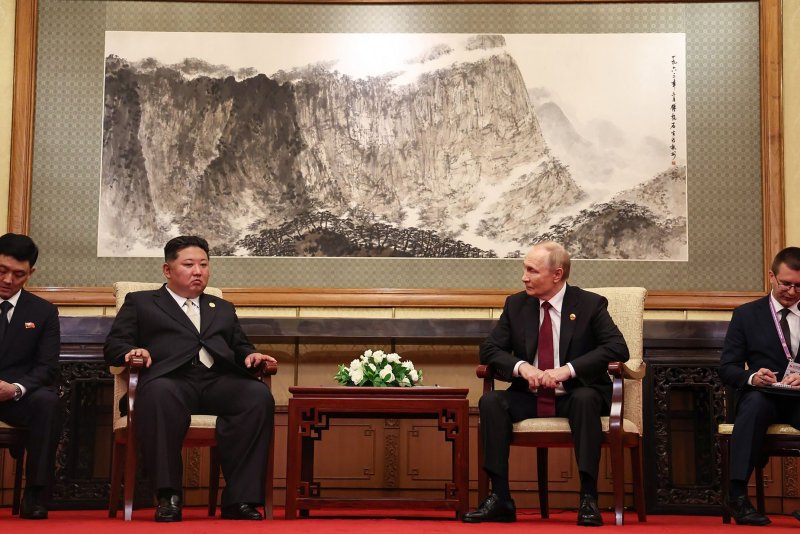
North Korean leader Kim Jong Un has expressed his support for the close relationship with Russia, referring to it as the “most sincere alliance” in a New Year message directed to Vladimir Putin. This communication, reported by the Korean Central News Agency on December 27, emphasizes the commitment of both nations to strengthen their ties as they move into 2025.
In his message, Kim addressed Putin as “my dear comrade,” highlighting the deep historical connections between the two countries. He stated that their relationship has evolved into a bond “forged by sharing blood in the trenches and experiencing life and death together.” The North Korean leader noted that with the passage of time, the strength of DPRK-Russia relations has become “vividly engraved on the pages of the era and history.”
Kim underscored that “no one can break the relationship between the peoples of our two countries, nor the solidarity of our peoples.” He described 2025 as “a truly meaningful year” during which both sides would advance their alliance through “mutual and complete support and selfless solidarity.” He emphasized the importance of this relationship as “a precious shared asset” that must endure for future generations.
The remarks have been interpreted as a reference to North Korea’s deployment of troops to support Russia in its ongoing conflict in Ukraine. Pyongyang has portrayed this military support as a significant factor in strengthening bilateral relations, even as international discussions continue regarding a potential resolution to the conflict.
Kim’s message was a response to an earlier New Year greeting from Putin, who expressed gratitude for North Korea’s troop deployment to Russia’s Kursk region. Putin expressed confidence that both nations would continue their constructive cooperation on regional and international issues.
North Korea and Russia have enhanced their cooperation in various fields since signing a comprehensive strategic partnership agreement in June 2024. The alliance has been particularly underscored through North Korea’s support of Moscow’s military efforts in Ukraine, including its attempts to regain control over the Kursk region.
Kim’s New Year message was prominently published on the front page of Rodong Sinmun, the official newspaper of the ruling Workers’ Party. In contrast, last year, a similar New Year card from Chinese President Xi Jinping was only briefly mentioned alongside greetings from other leaders, indicating a shift in North Korea’s diplomatic focus.
As 2025 approaches, the messages exchanged between Kim and Putin reflect a significant strengthening of ties, with both leaders committed to deepening their collaboration in the face of complex international dynamics.