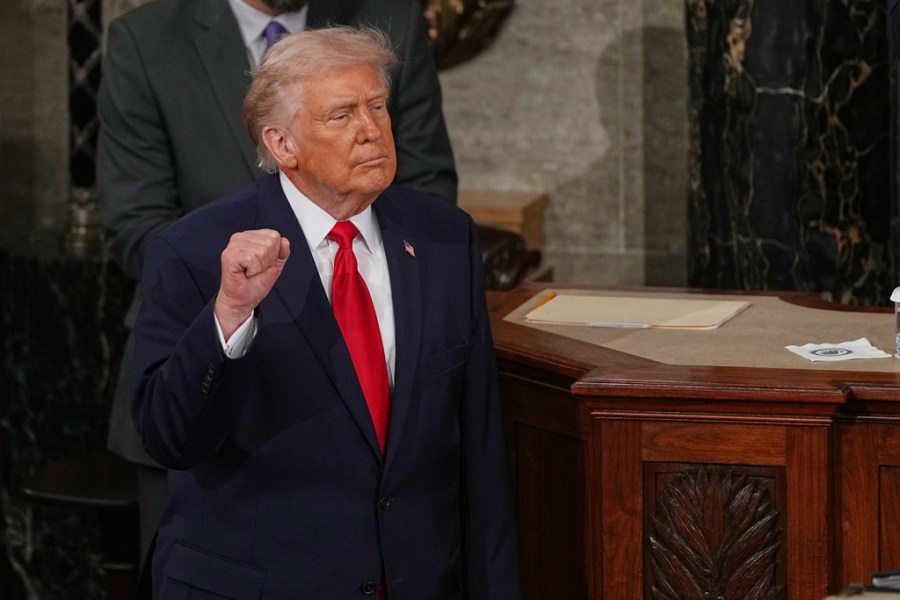
In his State of the Union address delivered on February 4, 2020, President Donald Trump utilized the platform to launch a series of accusations against political opponents, particularly targeting Democrats. The address, held in Washington, D.C., was marked by a tone that some observers described as divisive, as Trump focused on projecting his failures onto others rather than addressing his own administration’s challenges.
Throughout the speech, Trump claimed that his adversaries were engaged in what he labeled as misconduct, making sweeping allegations without substantial evidence to support his assertions. This approach has drawn criticism from various political analysts who argue that such tactics serve to deflect attention from his administration’s shortcomings, particularly in areas where it has faced scrutiny.
In particular, Trump criticized Democrats for their handling of the impeachment process, portraying them as obstructive and corrupt. This characterization was met with skepticism by many, given the backdrop of the impeachment inquiry, which centered on allegations that Trump had solicited foreign interference in the upcoming presidential election. The inquiry ultimately led to his impeachment by the House of Representatives in December 2019, although he was acquitted by the Senate in February 2020.
Responses from Political Analysts
Political analysts have noted the implications of Trump’s rhetoric for both the political landscape and public discourse. According to a report from the Brookings Institution, Trump’s method of employing projection—attributing his own failings to opponents—may resonate with his base but risks alienating moderate voters who seek accountability from their leaders. The report suggests that this strategy could be detrimental in the upcoming elections.
Furthermore, experts argue that such behavior undermines the decorum traditionally associated with the State of the Union address, which is typically an opportunity for presidents to unite the nation and outline their visions for the future. Instead, Trump’s approach reflects a broader trend of polarization in American politics, where party lines increasingly dictate rhetoric and policy discussions.
In response to Trump’s assertions, several Democratic leaders took to social media and news outlets to rebut the claims made during the address. They emphasized the need for transparency and accountability, particularly regarding issues such as healthcare, economic inequality, and foreign policy. The American public’s reaction to the address was mixed, with some expressing support for Trump’s confrontational style, while others expressed disappointment over the lack of substantive policy discussion.
Impact on Public Perception
The State of the Union address is an important event in American political life, shaping public perception and influencing voter sentiment. According to a poll conducted by Pew Research Center, the division in responses to Trump’s speech reflected a broader trend of partisan polarization, with 79% of Republicans approving of the address compared to only 16% of Democrats.
As the 2020 presidential election approached, the implications of Trump’s rhetoric became increasingly significant. Voter sentiment, as revealed in subsequent polls, indicated a growing concern among the electorate regarding issues such as economic stability and government transparency. Analysts suggest that the effectiveness of Trump’s projection strategy may diminish as voters seek leaders who acknowledge their challenges and work collaboratively toward solutions.
In conclusion, President Trump’s State of the Union address served as a platform for accusations against political opponents while failing to address his own administration’s challenges. The speech has sparked ongoing debate regarding accountability in political discourse and its potential impact on the upcoming elections. As the nation moves forward, the effectiveness of such tactics remains to be seen in shaping public opinion and electoral outcomes.