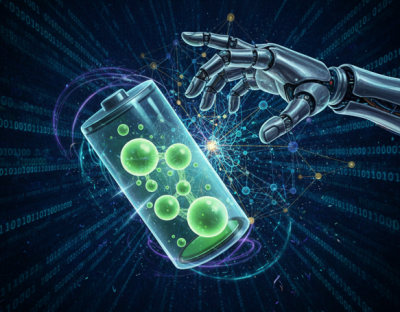
A research team at the Korea Institute of Science and Technology (KIST) has made significant strides in the development of all-solid-state batteries. Led by Dr. Byungju Lee, the team utilized artificial intelligence (AI) to uncover critical factors affecting the movement of lithium ions in amorphous solid electrolytes. Their findings could pave the way for advancements in battery technology, enhancing performance and efficiency.
The research focused on analyzing lithium-ion movement, breaking it down into two main components: the ‘ease of movement between sites’ and the ‘connectivity of movement paths.’ This dual analysis allowed the team to pinpoint that the overall performance of solid-state batteries is primarily influenced by the difficulty ions face when transitioning from one site to another, rather than the connectivity of the movement paths themselves.
Insights from AI Simulations
Using advanced AI-based atomic simulations, the team was able to simulate and evaluate the behaviors of lithium ions in various conditions. This approach provided a detailed understanding of how different factors interact to affect ion mobility. The results indicate that optimizing the ease of movement between sites could lead to more effective and powerful solid-state batteries.
The implications of this research are profound, particularly as the demand for more efficient energy storage solutions continues to rise. Solid-state batteries are being actively pursued as a safer and more efficient alternative to traditional lithium-ion batteries. Their potential to deliver higher energy densities and improved safety profiles makes them a focal point for future energy storage technologies.
KIST President Sang-Rok Oh emphasized the importance of this research in the context of global energy challenges. “Understanding the fundamental mechanisms of ion movement in solid electrolytes is essential for the next generation of batteries,” he stated. “This research not only enhances our knowledge but also lays the groundwork for practical applications in energy storage systems.”
The team’s findings contribute to a growing body of knowledge within the field of battery technology and demonstrate the transformative potential of AI in scientific research. As industries seek to implement greener technologies, advancements in solid-state battery development could play a crucial role in shaping the future of energy storage.
The study has been published in a peer-reviewed journal, showcasing the rigorous methodology and the innovative approach adopted by the researchers. As this field continues to evolve, the insights gained from such studies will undoubtedly influence both academic research and industrial applications.
As the world moves towards a more sustainable future, breakthroughs like this one at KIST highlight the critical intersection of technology and energy solutions. The research not only reflects the capabilities of AI in driving scientific discovery but also illustrates a significant step forward in the quest for efficient and safe energy storage solutions.