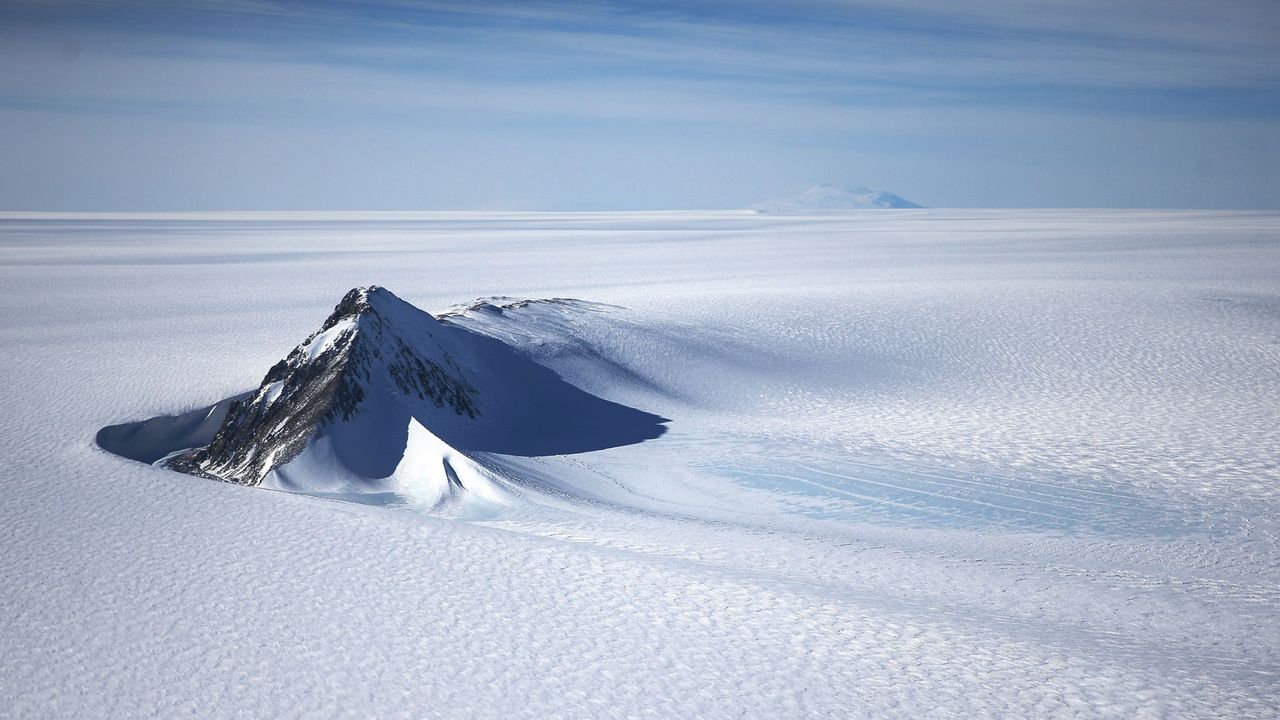
A significant study led by researchers at the University of Florida has revealed that the “gravity hole” beneath Antarctica, known as the Antarctic Geoid Low, provides crucial insights into the evolution of Earth’s deep interior. This anomaly, which represents a gentle dip in Earth’s gravity field, reflects the distribution of mass deep within the planet and has been evolving for approximately 70 million years.
The Antarctic Geoid Low is not merely a transient feature but a persistent signature of the dynamic processes occurring thousands of miles beneath the ice. The findings, published in the journal Scientific Reports on March 15, 2024, indicate that this gravitational anomaly is shaped by slow-moving currents of rock that continually reshape our understanding of the planet’s interior dynamics.
Alessandro Forte, Ph.D., a geophysicist and co-author of the study, emphasized the importance of this research, describing it as “a window into deep Earth movements over tens of millions of years.” He explained that while the term “gravity hole” may suggest a hazardous void, its actual impact on human weight is negligible; a person weighing 198 pounds (90 kilograms) would be only about 5 to 6 grams lighter in this region.
Gravity varies across the globe due to non-uniformities in Earth’s interior. Hot mantle rock rises while colder, denser slabs sink, leading to the redistribution of mass within the planet. In areas like Antarctica, where gravitational pull is slightly weaker, the ocean’s gravity-defined “level surface,” or geoid, is closer to Earth’s center. The Antarctic Geoid Low represents one of the deepest long-wavelength valleys on the planet, indicating substantial geological processes at work.
To reconstruct the evolution of this anomaly, researchers utilized seismic images of Earth’s mantle derived from earthquake waves. They employed advanced physics-based models to simulate the flow of rocks over millions of years, allowing for a better understanding of how this gravity feature has persisted and evolved. Forte noted, “What surprised me most is how coherent the long-term story appears to be. The gravity low is not a random, short-lived feature.”
Interestingly, the study suggests that the Antarctic gravity low intensified around 34 million years ago, coinciding with the transition of Antarctica into a permanently ice-covered continent. This timing raises the possibility that changes in the gravity field could influence regional sea levels, although the study does not establish a direct link to ice growth. Multiple factors, such as decreasing carbon dioxide levels and shifting ocean currents, also played a role in Antarctic glaciation.
“Our study shows how deep Earth dynamics can reshape the gravity field over geological time,” Forte stated. He acknowledged that further research is needed to explore the relationship between these internal processes and their potential impact on climate and ice dynamics.
The Antarctic Geoid Low stands out due to its unique characteristics, including its large, long-wavelength amplitude and persistence over millions of years. While other gravity anomalies exist, none match its mantle-driven signature. The study’s implications extend beyond Earth, providing insights into the internal dynamics of other planetary bodies. Variations in gravity on planets like Mars and Venus offer clues to their geological history and processes.
Overall, this research enhances our understanding of Earth’s deep interior and emphasizes the importance of continued exploration in geophysical science. The collaborative effort, led by Forte and first author Petar Glišović, builds on nearly a decade of study and highlights the potential for future discoveries related to the planet’s complex geological evolution.