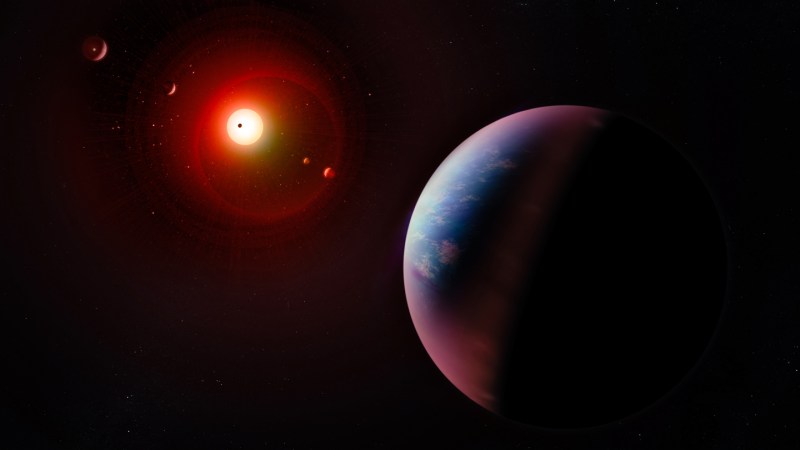
Recent research has unveiled a crucial factor in the search for extraterrestrial life: a “chemical Goldilocks zone.” This concept, identified by a team of astronomers, suggests that only specific planetary conditions can ensure the availability of essential nutrients like phosphorus and nitrogen. These nutrients play vital roles in biological processes, including cell structure and genetic coding.
In a study published on February 9, 2023, in the journal Nature Astronomy, planetary scientist Craig Walton from the University of Cambridge and his colleagues simulated tens of thousands of exoplanets. Their findings revealed that fewer than 10% of these planets possess Earth-like abundances of both phosphorus and nitrogen, casting doubt on the likelihood of finding life beyond our planet.
Essential Nutrients for Life
While water is often regarded as the primary requirement for habitability, Walton emphasizes that nutrients are equally important. Phosphorus and nitrogen are critical for forming cell walls, encoding genetic information, and synthesizing proteins. Imagining a life form without these elements poses a significant challenge, according to Walton. He stated, “It’s really hard to come up with what an alternative biology would look like.”
Even planets with ample water and initial supplies of phosphorus and nitrogen may not be viable for life. As planets form, these elements can sink into the core, becoming inaccessible to any potential surface-dwelling organisms. Astrophysicist Sebastiaan Krijt from the University of Exeter noted, “It’s completely inaccessible to life.”
The fate of these nutrients largely depends on the availability of reactable oxygen in a planet’s mantle. Laura Rogers, an astronomer at NOIRLab in Tucson, Arizona, explained that the abundance of oxygen influences how phosphorus and nitrogen interact with iron—another element that tends to sink into a planet’s core.
The Quest for the Right Conditions
When oxygen levels are high, phosphorus remains in the mantle, while nitrogen binds to iron and sinks deeper. Conversely, low oxygen levels lead to less phosphorus in the mantle and more nitrogen. Walton described this as a “push-pull situation,” where increasing one nutrient results in the loss of the other.
To explore this further, Walton and his team proposed the existence of a “chemical Goldilocks zone,” a range of oxygen abundance that allows for Earth-like quantities of both phosphorus and nitrogen in a planet’s mantle. Their simulations, based on the chemistry of thousands of nearby stars, revealed that only a small fraction of exoplanets meet these criteria.
The research suggests that many planets could be “starved” of either nitrogen or phosphorus, limiting their potential for hosting life. The study underscores the importance of reactable oxygen at levels similar to or slightly above that of Earth, which promotes the retention of essential nutrients.
As the search for exoplanets continues—over 6,000 have been confirmed to date—the alignment of various planetary parameters remains critical. Liquid water is essential, but the correct availability of oxygen is equally vital for the emergence of life. Krijt remarked, “This forces us to reconsider how prevalent Earth-like planets are in the cosmos.”
The implications of this research resonate with the longstanding question posed by physicist Enrico Fermi: where is all the extraterrestrial life? Understanding the chemical conditions necessary for life may offer insights into the so-called Fermi Paradox—the contradiction between the vastness of the universe and the absence of evidence for extraterrestrial life.