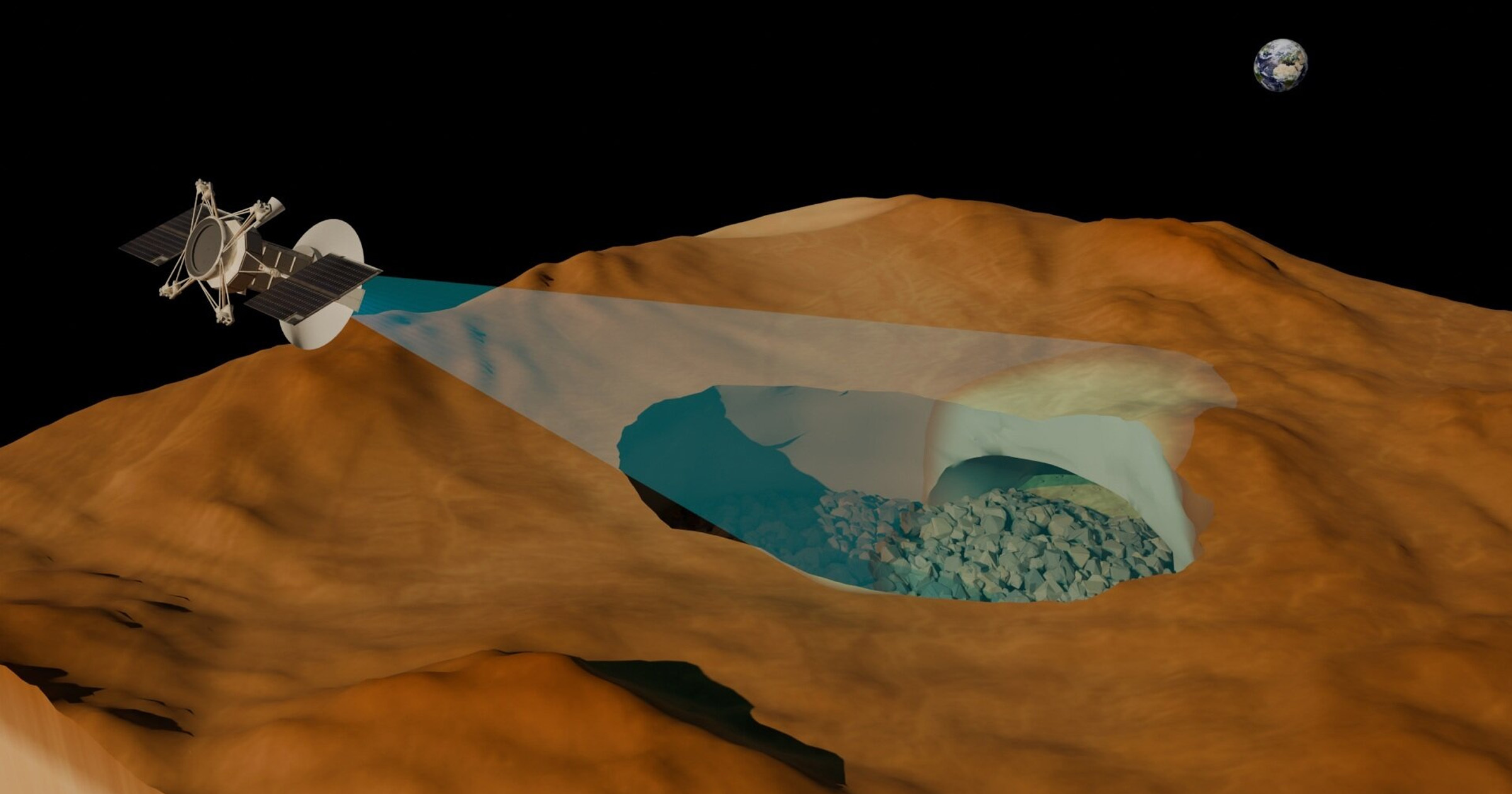
Astronomers have made a significant discovery on Venus, revealing a vast cave beneath its surface. This finding offers compelling evidence that the planet is interlaced with lava tubes, a theory long speculated by scientists. The research, published in Nature Communications, aligns with previous observations of volcanic activity on Venus, suggesting a dynamic geological history characterized by volcanism.
Significance of the Discovery
According to Lorenzo Bruzzone from the University of Trento, this identification marks a pivotal moment in our understanding of Venus. “Our knowledge of Venus is still limited, and until now we have never had the opportunity to directly observe processes occurring beneath the surface of Earth’s twin planet,” he stated. The detection of this volcanic cavity is crucial, as it validates theories that have remained unproven for many years.
Venus is home to an estimated tens of thousands of volcanoes, which have shaped its surface into plains and channels. Despite numerous studies indicating signs of recent volcanic activity, concrete evidence of lava tubes—also known as pyroducts—has been elusive. Factors such as Venus’ unique atmospheric conditions and weaker gravity have made it difficult to understand how these formations develop.
Methodology and Findings
Researchers faced significant challenges in observing underground structures on Venus, primarily due to its dense atmosphere, which is composed of thick clouds of sulfur and carbon dioxide. These clouds trap heat, resulting in surface temperatures exceeding 870 degrees Fahrenheit. Traditional optical observations are nearly impossible, prompting the team to utilize radar technology.
By analyzing data collected by NASA’s Magellan spacecraft from 1990 to 1992, the scientists employed Synthetic Aperture Radar (SAR) to penetrate the planet’s thick cloud cover. “SAR works by transmitting radio waves towards the surface and measuring the time it takes for the waves to bounce back after interacting with the terrain,” the researchers explained in their study. This method enabled them to create a detailed backscattering map of Venus’ surface.
The analysis focused on areas exhibiting signs of localized surface collapses, employing a specialized imaging technique to identify underground conduits. Their findings pinpointed a large subsurface conduit near Nyx Mons, a shield volcano measuring approximately 225 miles in diameter. This conduit is believed to be a lava tube with an estimated diameter of around one kilometer, surpassing similar formations found on Earth and Mars.
While the current data only confirm a portion of the cavity near the identified skylight, further analysis suggests that these conduits may extend for at least 45 kilometers. Bruzzone noted, “To test this hypothesis and identify additional lava tubes, new higher-resolution images and data will be required.”
This discovery not only enhances our understanding of Venus’ geology but also opens the door for future exploration and study of its volcanic history. As scientists continue to uncover the mysteries of this inhospitable planet, they hope to gather more evidence that could shed light on the processes that have shaped it over millions of years.