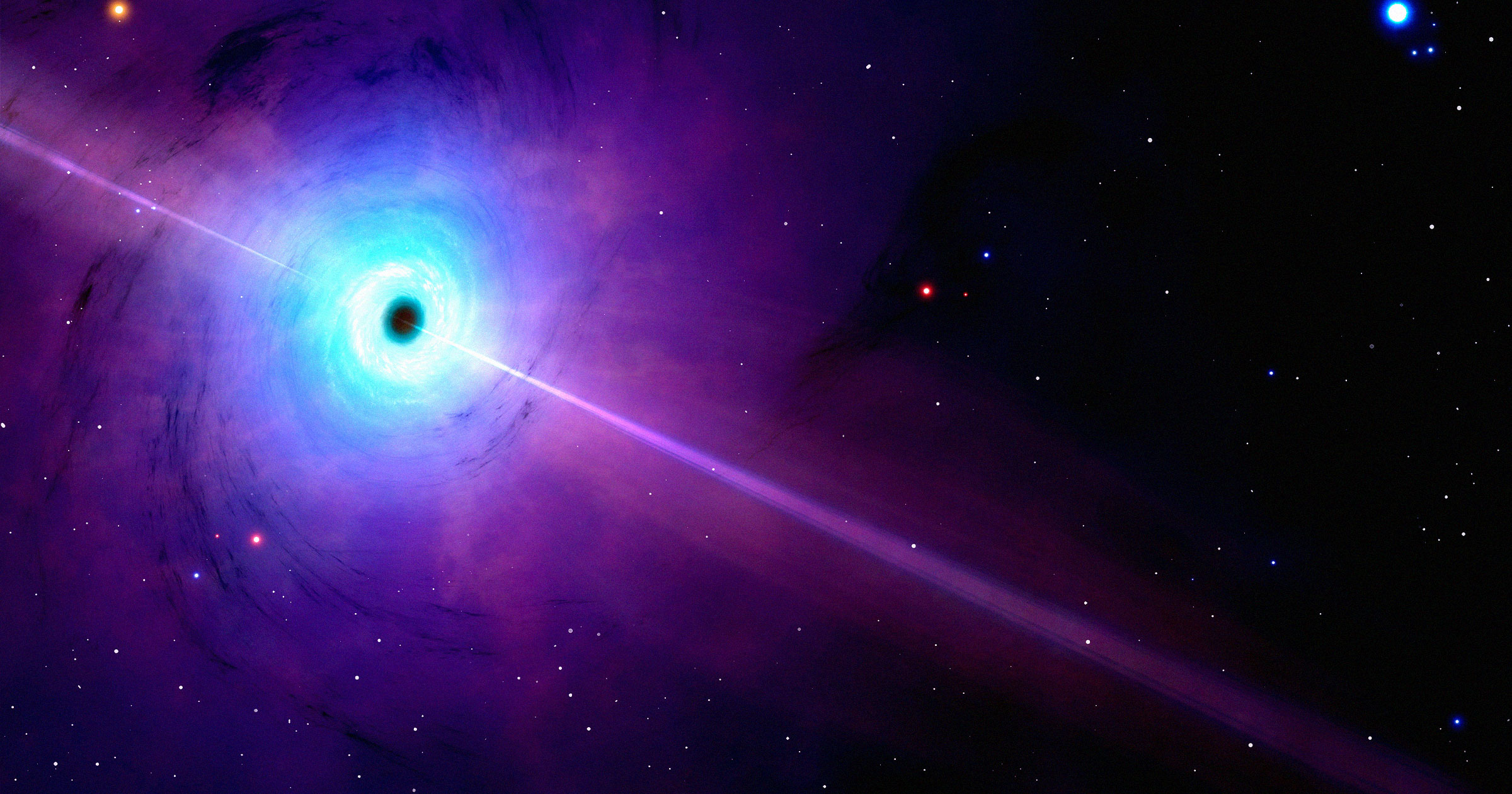
An international team of astronomers has reported a groundbreaking discovery involving a runaway supermassive black hole. Using data from NASA’s James Webb Space Telescope, the scientists have identified this black hole as it speeds away from its home galaxy at an astonishing velocity of 2.2 million miles per hour. This finding, if confirmed, represents not only the first instance of such a phenomenon but also potentially one of the fastest-moving celestial bodies ever recorded.
Located in the “Cosmic Owl,” a pair of interacting galaxies approximately eight billion light-years away, this supermassive black hole possesses a mass estimated at 10 million times that of the Sun. As it travels, it generates a massive “bow-shock” of material ahead of it and creates a long tail of gas extending 200,000 light-years behind, facilitating star formation in its wake.
Astronomer Pieter van Dokkum from Yale University and lead author of the forthcoming research, expressed astonishment at the implications of this discovery. He stated, “The forces that are needed to dislodge such a massive black hole from its home are enormous. And yet, it was predicted that such escapes should occur!” He emphasized that this is the only black hole confirmed to be far from its original location, making it a prime candidate for study.
The object was initially detected in March 2023 using the Hubble Space Telescope. Its event horizon, which absorbs light, made it challenging to observe as it moved through space. However, the enhanced capabilities of the James Webb Space Telescope enabled astronomers to analyze the significant amounts of gas the black hole was displacing, revealing its rapid motion.
Van Dokkum noted, “It is moving at approximately 620 miles per second, faster than just about any other object in the universe.” This high speed facilitated the black hole’s escape from the gravitational pull of its former galaxy. The researchers hypothesize that this supermassive black hole may have been ejected following a collision with another black hole or through interactions within a binary black hole system.
They believe that merging events are common in galactic evolution, with galaxies of similar size and mass to the Milky Way experiencing multiple mergers throughout their lifetimes. Van Dokkum commented, “So black hole binaries should form pretty regularly.” He further explained that the dynamics of these mergers can result in ejections, but the frequency and conditions under which a black hole is expelled remain uncertain.
As the team advances their research, they hope to identify additional cases of runaway supermassive black holes, which could provide deeper insights into their formation and behavior. Van Dokkum expressed optimism, stating, “Now that we know how to look for them, we can find other examples — and then we can answer the question directly from data, by counting the number of escapes.”
This discovery marks a significant milestone in the field of astrophysics, opening new avenues for understanding the enigmatic nature of supermassive black holes and their role in the universe.