Astronomers have made a groundbreaking discovery by observing the exoplanet WASP-121b losing its atmosphere in real time. Using the James Webb Space Telescope (JWST), researchers tracked the gas giant for an entire orbit, revealing two massive helium tails rather than a single stream of escaping gas. This unprecedented observation marks a significant advancement in our understanding of atmospheric escape in distant worlds.
Continuous Observation Unveils New Details
The research team, which includes scientists from Université de Genève, the National Centre of Competence in Research PlanetS, and the Trottier Institute for Research on Exoplanets at the University of Montreal (UdeM), conducted nearly 37 hours of continuous observation of WASP-121b. This monitoring covered more than one complete orbit around its star, providing the most extensive detection of helium around a planet to date. The findings, published in Nature Communications, showcase not just the escape of atmospheric gases but also the dynamic processes involved.
Previously, astronomers could only study atmospheric escape during brief planetary transits, limiting their insights to snapshots lasting only hours. These short-term observations did not allow for a comprehensive understanding of how escaping gases evolved over time. The JWST’s capabilities enabled scientists to monitor the atmospheric loss with unmatched precision, revealing complex interactions between the planet and its stellar environment.
Discovering Two Distinct Helium Tails
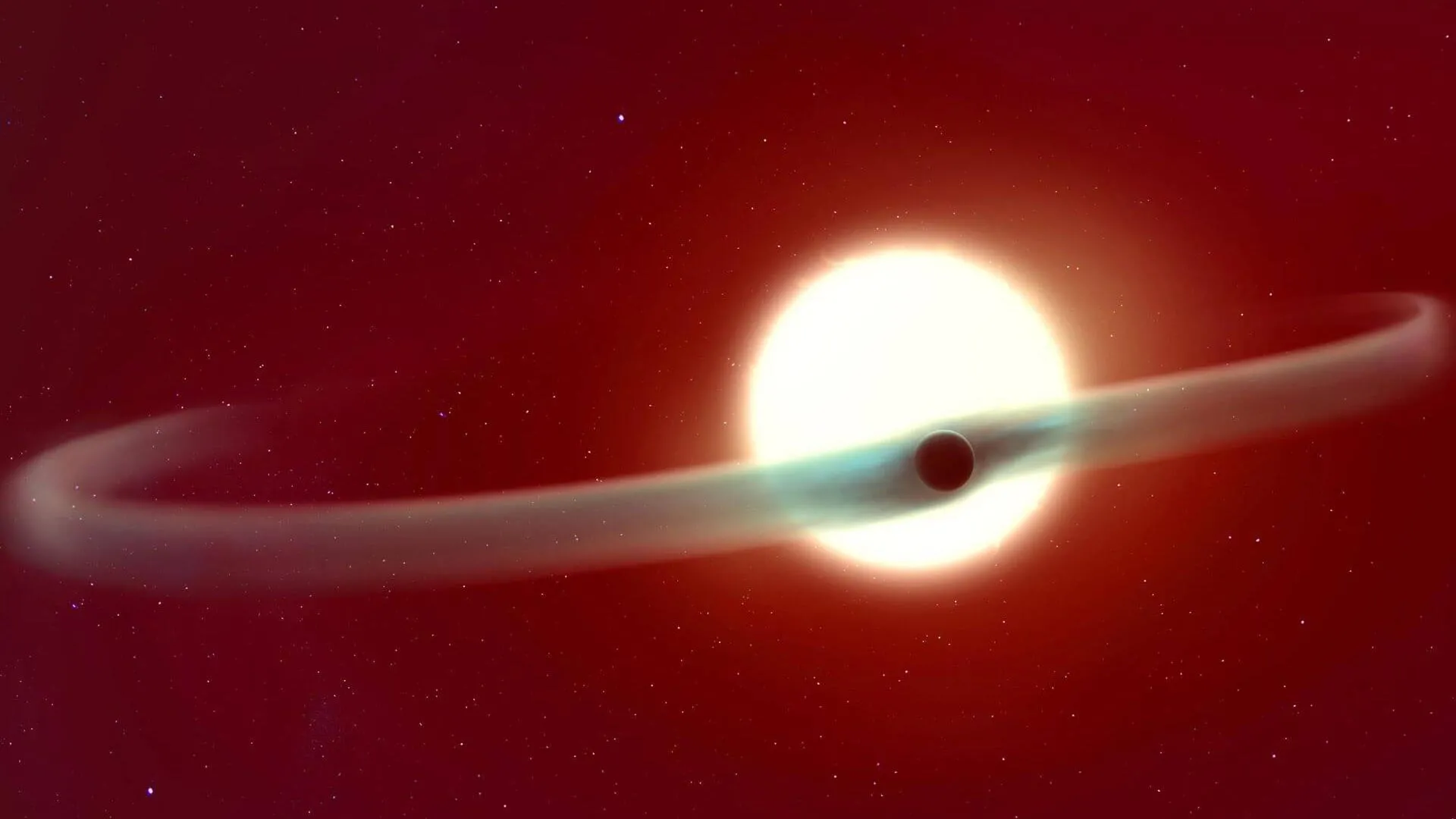
The observations identified that WASP-121b is enveloped by two significant helium streams. One tail trails behind the planet, driven away by the intense radiation and stellar winds from its host star. The second tail curves ahead, likely influenced by the star’s gravitational pull. Together, these streams extend over a distance greater than 100 times the planet’s diameter, or more than three times the distance between WASP-121b and its star.
Romain Allart, a postdoctoral researcher at the University of Montreal and lead author of the study, expressed surprise at the duration of helium escape. “This discovery reveals the complexity of the physical processes that sculpt exoplanetary atmospheres and their interaction with their stellar environment,” he stated. This insight opens up new avenues for understanding how gas giants evolve over time.
The research team utilized the Near-Infrared Spectrograph (NIRISS) aboard the JWST to measure how helium absorbs infrared light, revealing that the gas disperses significantly beyond the planet itself. The duration and structure of the escaping gases challenge existing models of atmospheric escape, suggesting that gravity and stellar winds play crucial roles in shaping these flows.
The Future of Exoplanet Studies
The implications of these findings are vast. Helium has emerged as a vital tool for tracking atmospheric loss, and the sensitivity of the JWST allows for unprecedented detection of this element over extensive distances and timeframes. Future observations will aim to determine whether the twin-tail structure observed around WASP-121b is common among other hot exoplanets.
Researchers also recognize the need to refine theoretical models to better understand the interplay between gravity, radiation, and stellar winds in shaping escaping atmospheres. “New observations often reveal the limitations of our numerical models, pushing us to explore new physical mechanisms,” said Vincent Bourrier, a researcher in the Department of Astronomy at the University of Geneva and co-author of the study.
As scientists continue to investigate exoplanets like WASP-121b, their discoveries will deepen our understanding of planetary atmospheres and the factors influencing their evolution. The ongoing advancements in telescope technology and observational techniques promise to unveil even more about these distant worlds in the years to come.