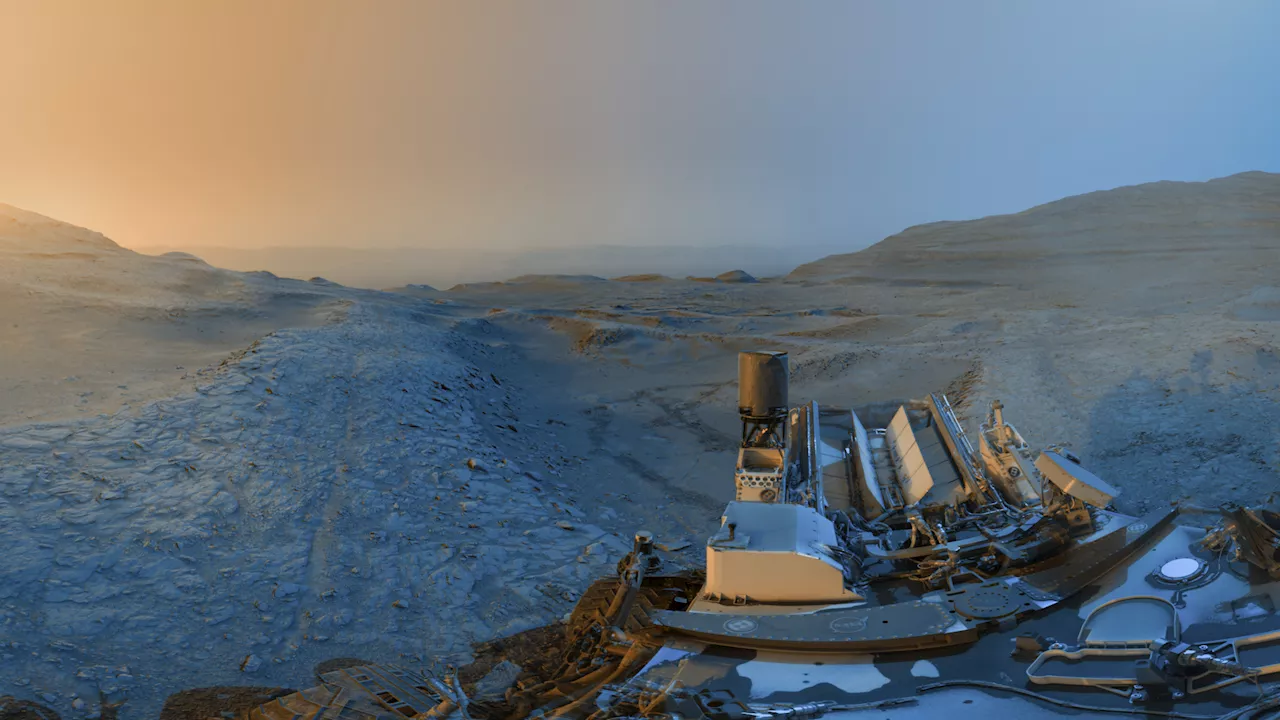
NASA’s Curiosity rover has unveiled a breathtaking panoramic view from the slopes of Mount Sharp within Gale Crater, showcasing the intricate Martian landscape shaped by ancient water flow. The images, captured over two days in November 2025, provide insights into the planet’s geological history and the environmental changes it has undergone over millennia.
This latest ‘postcard’ from Mars combines images taken on Sol 4,722 and Sol 4,723, representing Martian days. The black-and-white photographs were recorded at 16:15 and 08:20 local Mars time, respectively. NASA enhanced the merged images with cool blue and warm yellow hues to illustrate how lighting varies throughout the Martian day. According to NASA officials, “Adding color to these kinds of merged images helps different details stand out in the landscape.”
Insights from the Boxwork Terrain
The captured panorama highlights a region characterized by complex boxwork formations, which are intricate networks of mineral-rich ridges. These formations were formed by groundwater flowing through cracks in the rock billions of years ago. Over time, erosion has exposed these hardened mineral veins, preserving evidence of ancient water activity. Scientists are particularly interested in these features, as they offer clues to Mars’ past as a potentially habitable environment.
Curiosity’s mission has involved detailed scientific analysis at this location. Recently, the rover used its drill to collect samples from the top of a ridge known as “Nevado Sajama.” The panoramic view not only captures the boxwork formations but also looks down the slopes of Mount Sharp toward the crater’s floor. In the distance, the rim of Gale Crater is visible, approximately 40 kilometers away. Wheel tracks mark a shallow hollow behind the rover, indicating where it previously drilled a sample at a site called “Valle de la Luna.”
By studying the boxwork terrain and other sedimentary layers, Curiosity continues to unravel the story of Mars’ transition from a wetter, potentially habitable world to the cold, arid landscape seen today. The rover’s analyses of rock chemistry, textures, and mineral veins contribute significantly to our understanding of the Martian environment.
Advancements in Rover Operations
As Curiosity approaches its 14th year on Mars, enhancements in its operational capabilities have allowed it to maintain efficient scientific output. The rover can conduct observations while simultaneously communicating with orbiters overhead, which maximizes its productivity despite the limitations of its aging nuclear power source.
More than a decade into its mission, Curiosity remains a vital asset to planetary science. Its ability to deliver stunning visuals and valuable data exemplifies that the Red Planet still has many stories to tell. As Curiosity continues to explore its surroundings, scientists remain hopeful that further discoveries will deepen our understanding of Mars and its potential for past life.
For those interested in space exploration, Curiosity’s ongoing mission serves as a reminder of the significance of robotic exploration in uncovering the mysteries of our solar system.