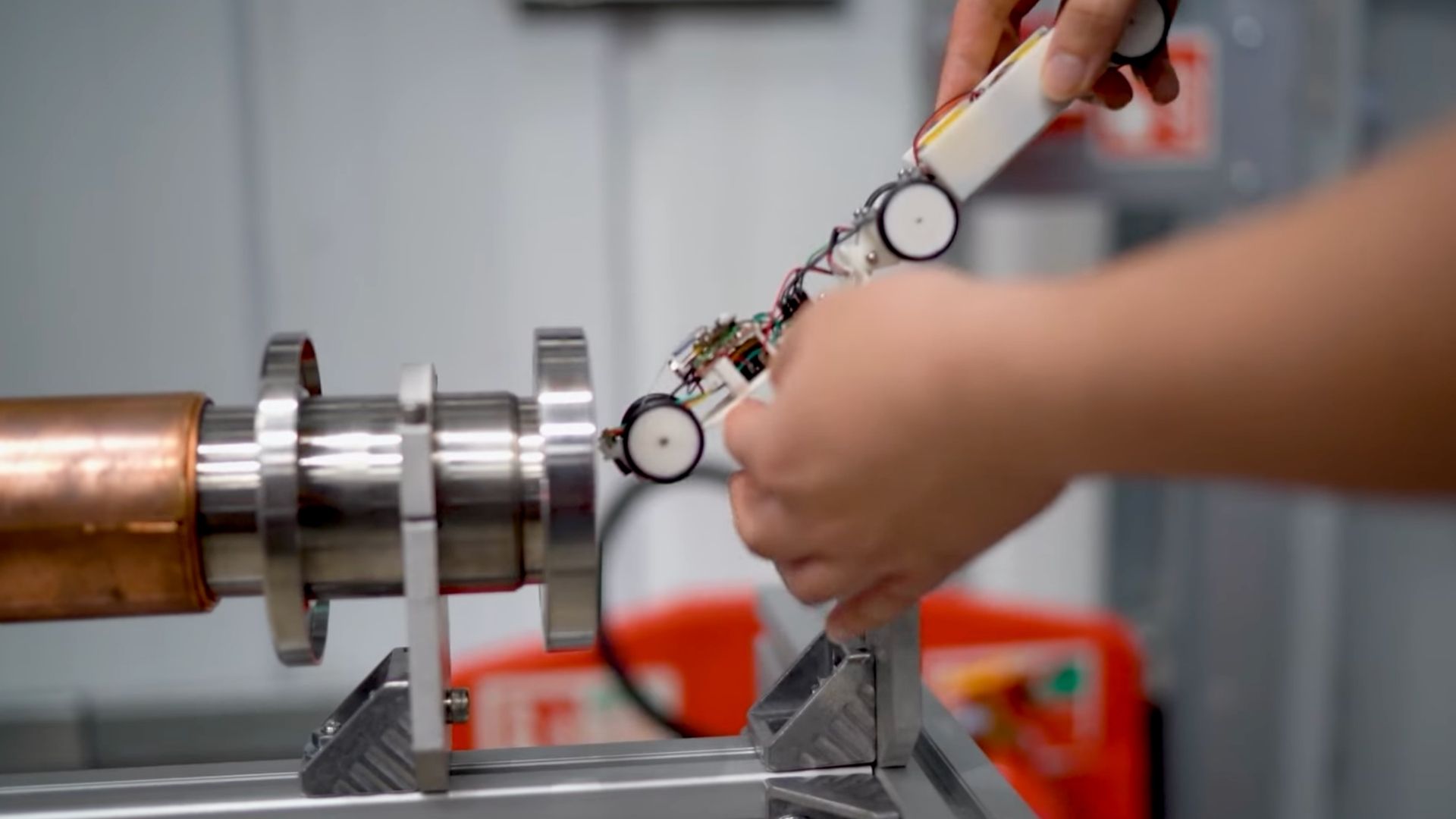
Engineers at the UK Atomic Energy Authority (UKAEA) have introduced a groundbreaking inspection robot designed specifically for the intricate infrastructure of the Large Hadron Collider (LHC) at CERN. Known as PipelNEER, this compact, mouse-shaped device is poised to revolutionize the way engineers monitor the collider’s beamline pipes, which span an impressive 27 kilometers (17 miles).
The innovative PipelNEER robot utilizes advanced artificial intelligence and sophisticated sensors to identify faults within the beamline pipes, which operate under extreme conditions, including temperatures approaching -455.8 °F (-271°C) and ultra-high vacuum environments. Regular inspection of these pipes is crucial, as maintaining their integrity typically requires dismantling extensive equipment, a process that is both time-consuming and costly.
Addressing Inspection Challenges
As the PipelNEER navigates the long, narrow beamline, it encounters challenging conditions that can cause the pipes to expand and contract. The LHC comprises approximately 2,000 plug-in modules (PIMs), and over time, components within these modules can be affected by thermal cycling, leading to deformation that may compromise system reliability. Consequently, regular inspections are vital for maintaining the collider’s safe operation.
Measuring around 20 centimeters in length, PipelNEER is designed to autonomously traverse beamline spaces as narrow as 3.7 centimeters. Unlike traditional pipe-inspection tools, this robot can cover distances of up to 6 kilometers on a single battery charge. As it moves, PipelNEER captures high-resolution images of each plug-in module and employs AI trained on actual imagery from the LHC to detect any abnormalities.
Equipped with energy-efficient components and multiple safety systems, PipelNEER monitors its performance during extended autonomous missions. Should it identify a fault, the robot will return to its starting point and provide engineers with the precise location of the issue, allowing for targeted inspections and minimizing the need for manual dismantling of long stretches of pipe.
Recognition and Future Plans
The collaborative effort between the UKAEA and CERN has earned them a ‘Highly Commended’ recognition at The Engineer’s Collaborate to Innovate (C2I) Awards for the development of PipelNEER. Ricky Sykes, Director of RACE at UKAEA, expressed pride in applying their robotics expertise to support CERN’s pioneering experiments. He stated, “By combining our remote handling experience with CERN’s scientific excellence, we’re helping ensure the Large Hadron Collider operates safely and efficiently for years to come.”
Dr. Giuseppe Bregliozzi, a Beam Vacuum Operation Section Leader at CERN, highlighted the transformative impact of PipelNEER, noting, “It marks a major step forward in keeping our experiments running smoothly.”
Performance trials for PipelNEER are scheduled to take place over a distance of 60 kilometers in 2026, with the final production units expected to be manufactured by late 2026. Training for CERN operators is anticipated to commence in early 2027, preparing them for the robot’s deployment in the field. This innovative technology promises to enhance the reliability and efficiency of inspections within one of the world’s foremost scientific facilities.