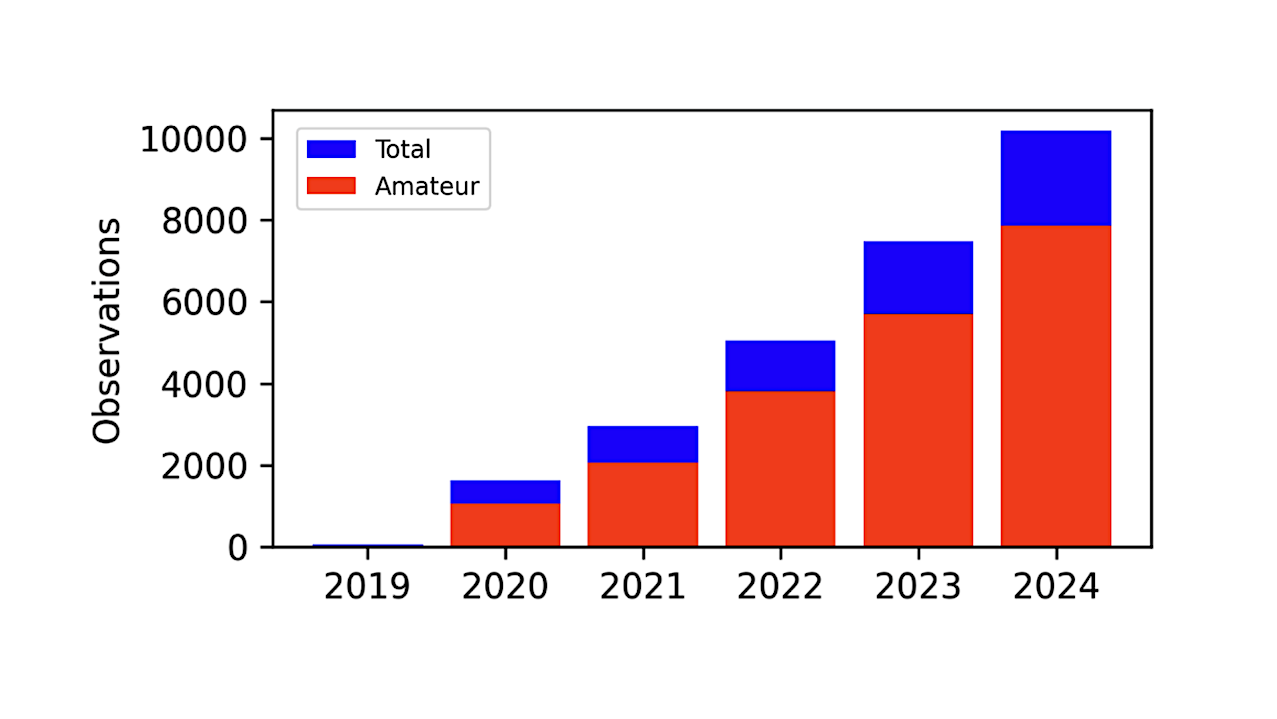
The ExoClock project has unveiled an updated catalogue that features ephemerides for 620 exoplanets, bringing together data from various astronomical observations. This initiative integrates approximately 30,000 measurements sourced from both ground-based telescopes and space observatories, including Kepler, K2, and TESS. The catalogue aims to enhance the monitoring of exoplanets, offering crucial insights for future astronomical studies.
Among the updated entries, the catalogue includes 277 planets identified through TESS that necessitate specific observational strategies due to factors such as shallow transits or bright host stars. The findings suggest that advancements in telescope technology and methodologies, particularly the use of synchronous observations with smaller telescopes, can successfully track these unique planetary cases.
Notably, the study highlights that 45% of the planets required updates to their ephemerides, showcasing a significant improvement in prediction uncertainty that is now an order of magnitude better than previous assessments. Additionally, the analysis led to the identification of new planets exhibiting transit timing variations (TTVs), underscoring the necessity for extensive observational coverage in exoplanet research.
Collaborative Efforts and Open Science
Developed in conjunction with the European Space Agency (ESA)’s Ariel mission, the ExoClock project not only aims to provide reliable ephemerides to optimize mission efficiency but has expanded its scope beyond the original remit of Ariel. The platform promotes open science principles, ensuring that all tools and data are readily accessible to researchers and the broader community. This accessibility is crucial for facilitating efficient scheduling of future observations, particularly from larger telescopes where time allocation is at a premium, such as JWST, VLT, ELT, and Subaru.
Through inclusive collaboration, the ExoClock project fosters a democratic approach to scientific inquiry, enhancing the quality and reliability of its results. This open framework encourages participation from diverse audiences, ultimately enriching the scientific community’s understanding of exoplanets and their unique characteristics.
The full catalogue, along with machine-readable versions of relevant tables, is available through the ExoClock project’s data release, which can be accessed online. The publication of this catalogue signifies a pivotal step forward in exoplanet research, driven by a commitment to transparency and collaboration in the scientific process.
The implications of these findings extend beyond the scope of the ExoClock project, promising to inform and improve future explorations in the field of astrobiology and planetary sciences. With ongoing advancements in observational techniques, the path forward appears bright for uncovering the mysteries of exoplanets and their potential for hosting life.