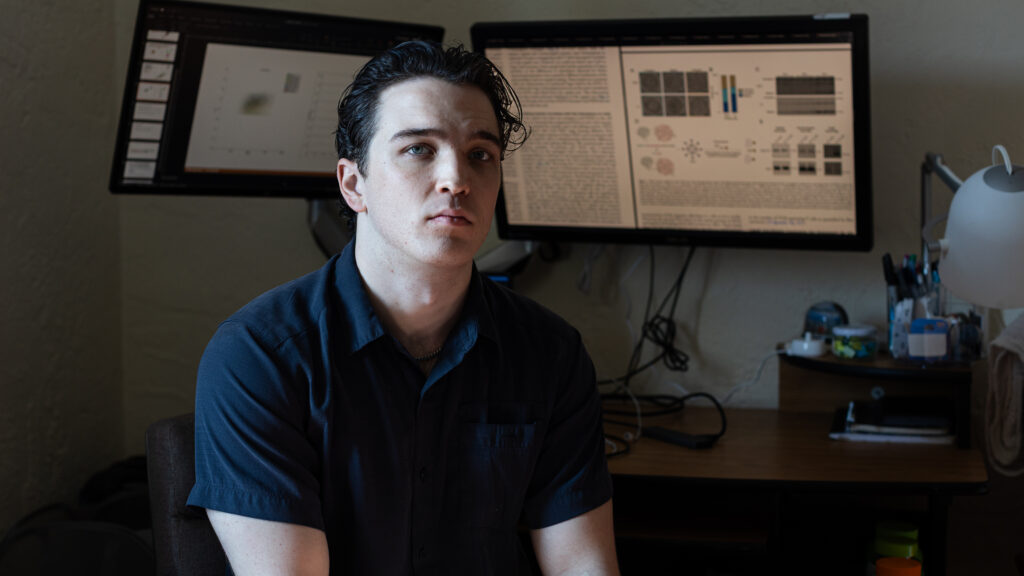
First-year Ph.D. students in biomedical disciplines face significant challenges as funding for research becomes increasingly uncertain. Many aspiring scientists, like Alex Sathler, who recently received the prestigious National Science Foundation (NSF) Graduate Research Fellowship, are discovering that securing funding does not guarantee a place in the right laboratory.
Sathler, who received an annual stipend of $37,000 for three years, initially felt optimistic about his prospects. However, upon enrolling in a joint program at the University of California, Berkeley and UC San Francisco, he encountered barriers when lab heads informed him they could not accommodate additional students. This situation reflects a broader trend affecting first-year biomedical graduate students across the United States.
Funding Cuts and Increased Competition
The National Institutes of Health (NIH) has reduced funding for research projects, resulting in heightened competition for the limited slots available in well-funded labs. Sathler noted that other students in his program share similar frustrations, stating, “The real sense that I get is that there aren’t enough labs with funding to give everyone their best fit.” The tightening funding climate has led to a disheartening reality where some students find themselves working on projects that do not align with their interests or career goals.
Chevelle Newsome, president of the Council of Graduate Schools, emphasized the gravity of these challenges, saying, “The strain that you’re hearing is real. It’s not an isolated case. It’s actually across the board.” Many Ph.D. programs anticipated these difficulties and proactively reduced incoming class sizes by a third or more in response to the potential funding cuts from the previous administration. Yet, overall enrollment in biomedical graduate programs, both master’s and doctoral, rose slightly last fall, indicating a complex landscape for aspiring researchers.
Students typically spend their first year engaging in lab rotations—an essential component of their training that enables them to find the right research environment. However, this process has become increasingly complicated due to funding concerns. Hannah Barsouk, a biochemistry student at Stanford University, reported that several labs have expressed uncertainty about their ability to accept new students. After reaching out to 30 to 40 labs, she noted a “cloud of general anxiety” surrounding her search for a suitable advisor.
Changing Admission Processes and Student Uncertainty
In light of funding issues, some institutions, such as Georgia Tech and Emory University, have shifted to a direct-admission system for their joint bioengineering program. This new approach requires applicants to secure a lab commitment before being offered admission, a significant departure from traditional methods where students could rotate through labs before making a decision.
While Stanford has not adopted a similar system, it has reduced the guaranteed funding for its bioscience graduate students from four years to just one year for incoming students. Joe Wu, director of the Stanford Cardiovascular Institute, highlighted that this change makes faculty more selective about whom they choose to mentor, stating, “Unless the student’s outstanding, then you’re not going to commit.”
Such shifts have left some students feeling betrayed. One biology student, speaking anonymously, recounted how a professor initially guaranteed her a spot in the lab. However, during a recent rotation, the professor indicated that she needed to secure her own funding to join the team. This experience left her feeling misled, saying, “I was kind of catfished.”
Sathler has faced similar challenges, with lab heads expressing concerns that the NSF fellowship would not fully cover their financial needs. As he navigates the complexities of graduate school, he notes that even introductory seminars meant to showcase labs are struggling to attract participants, further illustrating the difficult landscape facing first-year students.
While there is still time for students to find suitable labs before the start of their second year, the uncertainty surrounding funding is causing many to question their long-term career prospects in academic research. Although recent congressional discussions have suggested a slight increase in the NIH budget, the overall climate remains daunting.
As students like the anonymous biology graduate reflect on their futures, they grapple with whether their aspirations of leading their own research labs are realistic in the current environment. “I still very much want to be a professor, and I just don’t know if that’s ever going to be possible because of the way NIH and the NSF are being dismantled,” she explained.
The challenges faced by first-year biomedical Ph.D. students underscore a critical need for sustainable funding and support systems within academic research, as the future of many aspiring scientists hangs in the balance.