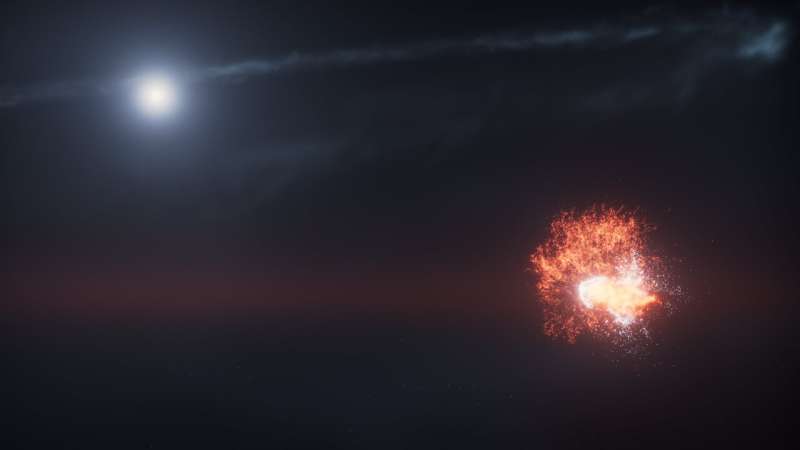
NASA’s Hubble Space Telescope has made a groundbreaking discovery by capturing the aftermath of two rare collisions between space rocks in the Fomalhaut planetary system, located just 25 light-years from Earth. Initially believed to be an exoplanet reflecting starlight, the bright objects observed turned out to be luminous clouds of debris resulting from violent collisions between planetesimals, the building blocks of planets.
The international team of astrophysicists, including Jason Wang from Northwestern University, identified these collisions as a significant event in understanding planet formation. In their study, published in the journal Science, they detailed how these collisions mark the first time such events have been observed outside our solar system.
Unexpected Discoveries in a Familiar System
Astronomers had been monitoring a bright object known as Fomalhaut b since its discovery in 2008. Initially thought to be a planet, it was located within a complex system of dust belts surrounding the star Fomalhaut. This system, in the constellation Piscis Austrinus, is notable for its extensive dusty rings, which made it a prime target for study over two decades.
Wang noted, “Spotting a new light source in the dust belt around a star was surprising. We did not expect that at all.” The team had aimed to observe Fomalhaut b, assuming it was a planet. However, upon analyzing new images, they found the original light source had disappeared, replaced by a new bright object, leading them to reevaluate their findings.
Insights into Planet Formation and Future Observations
The disappearance of Fomalhaut b, now designated as Fomalhaut cs1, suggests it was a dissipating dust cloud resulting from a collision. The subsequent emergence of Fomalhaut cs2 supports the theory that these bright points of light are not planets but rather remnants of collisions. The brightness and location of Fomalhaut cs2 closely resemble earlier observations of cs1, underscoring the extraordinary nature of these events.
Lead author Paul Kalas, an astronomer at the University of California, Berkeley, remarked, “It’s absent in all of our previous Hubble images, which means that we just witnessed a violent collision between two massive objects.” The research indicates that such planetesimal collisions, once thought to occur every 100,000 years or more, have happened twice in just two decades in this system.
The findings emphasize the importance of studying these cosmic events to enhance our understanding of planetary structures and formation processes. Wang explained, “Studying planetesimal collisions is important for understanding how planets form. It can also tell us about the structure of asteroids, which is crucial for planetary defense programs.”
As the research team continues to monitor the Fomalhaut system, they plan to use the James Webb Space Telescope to gather further insights. This next-generation telescope will provide color information that Hubble’s instruments could not, allowing scientists to analyze the size and composition of the dust clouds. Wang indicated that they have an approved program to investigate the nature of the two colliding planetesimals that created these unique observations.
The discovery serves as both a scientific breakthrough and a reminder of the complexities involved in distinguishing transient collision clouds from genuine exoplanets, particularly as next-generation telescopes aim to identify habitable-zone planets around nearby stars.
As the study progresses, researchers remain committed to uncovering more about the dynamics of these collisions and their implications for understanding the formation of planetary systems across the universe.