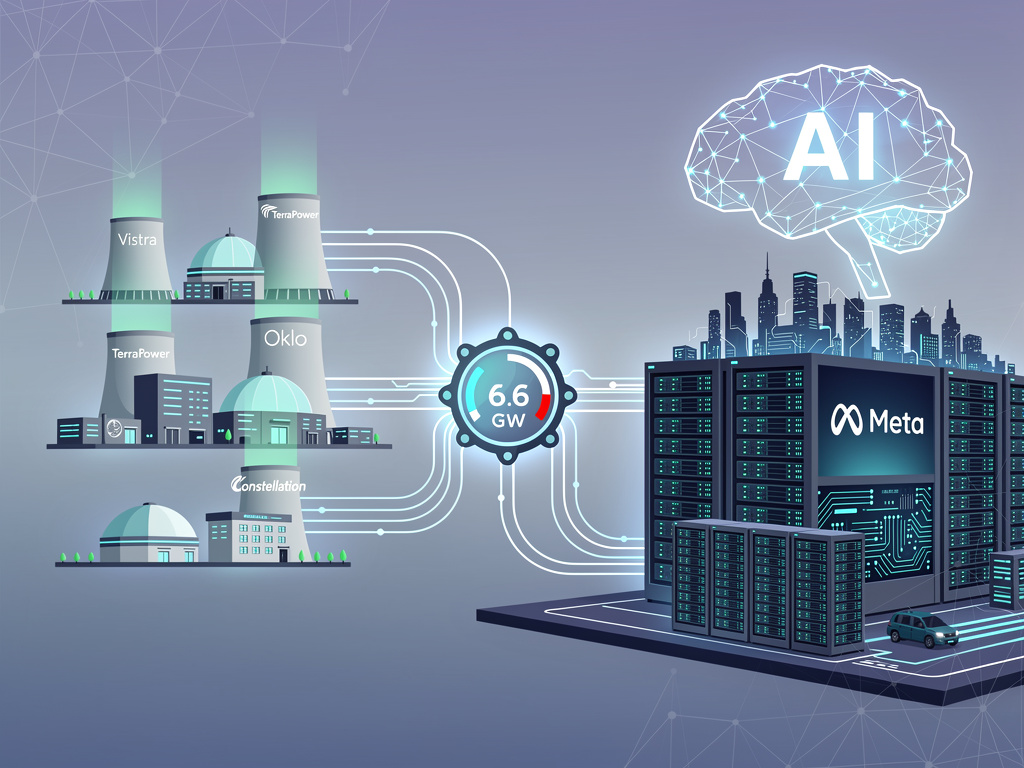
Meta Platforms Inc. has announced a significant energy procurement strategy that could deliver up to 6.6 gigawatts of nuclear power to support its expanding artificial intelligence infrastructure. This ambitious initiative, unveiled on January 9, 2026, includes agreements with Vistra Corp., TerraPower LLC, Oklo Inc., and Constellation Energy Corp. Positioned as a key player in rejuvenating U.S. nuclear capacity, Meta aims to address the escalating power demands driven by AI technologies.
The agreements encompass long-term power purchases from three existing Vistra nuclear plants located in the Midwest, alongside development assistance for advanced small modular reactors from TerraPower and Oklo. Meta described these pacts as “landmark agreements” in a blog post, emphasizing their potential to enhance plant operations, advance nuclear technology, and create jobs in local communities.
Addressing the Energy Demands of AI
The surge in AI training and inference workloads has driven a notable increase in electricity requirements for major data center operators. Meta’s upcoming Prometheus AI supercluster, designed to push the boundaries in model scale, necessitates a reliable and carbon-free baseload power source, which intermittent renewable energy sources cannot fully provide. Industry analysts project that U.S. data centers could account for 8% of the national electricity consumption by 2030, highlighting the urgent need for sustainable energy solutions.
Meta’s strategy builds on its prior commitments to renewable energy but emphasizes a shift towards nuclear power, which offers the density and dispatchability required for its operations. According to The Wall Street Journal, the agreements have the potential to provide enough power for a city with five million homes, leading to a significant surge in Vistra’s stock price, which rose by as much as 16% following the announcement.
Details of the Agreements
The agreements with Vistra involve 20-year power purchase contracts for output from plants in Illinois, Pennsylvania, and Texas, effectively extending their operational lifespans. Constellation Energy, the largest nuclear operator in the U.S., is also engaged in capacity expansions linked to these agreements. Meta’s executive, Joel Kaplan, highlighted the company’s position as one of the most substantial corporate purchasers of nuclear energy in American history.
Both TerraPower, which is backed by Bill Gates, and Oklo, supported by Sam Altman, focus on next-generation reactor designs that promise faster deployment and reduced costs. Meta’s commitments include funding for site development and licensing, which will expedite projects set for the late 2020s. The involvement of Meta is expected to mitigate risks associated with these technologies, which have encountered regulatory and financing challenges in the past.
The impact of these agreements extends beyond energy procurement. Joel Kaplan noted on social media that the collaborations will not only power Meta’s AI future but also bolster the nation’s energy infrastructure. This initiative aligns with national priorities, reflecting a broader shift in the tech sector away from dependence on natural gas, as nuclear power can provide a consistent output that is not affected by weather conditions. Following the announcement, Vistra’s market capitalization increased by $10 billion, underscoring investor optimism regarding the nuclear energy revival.
Technological Innovations and Market Implications
The small modular reactors developed by TerraPower and Oklo represent a significant advancement in nuclear technology. TerraPower’s Natrium reactor utilizes liquid sodium coolant to enhance safety and efficiency, targeting 345 megawatts per unit, with the potential for integrated energy storage. Meanwhile, Oklo’s Aurora microreactors, ranging from 15 to 75 megawatts, aim for factory fabrication and quick installation near data centers. With Meta’s backing, these technologies could overcome past obstacles related to regulation and financing.
As demand for uranium fuel tightens, with prices doubling since 2023 due to increased interest in AI, Meta’s substantial commitments could stabilize the market and encourage the revival of mining operations in regions such as Wyoming and Utah.
Regulatory and policy factors are also conducive to this nuclear initiative. The pro-nuclear stance of the Trump administration has facilitated streamlined approvals from the Nuclear Regulatory Commission (NRC). Meta’s announcement underscored its commitment to “American AI leadership and energy dominance,” reflecting a growing bipartisan consensus around nuclear power’s role in achieving net-zero emissions goals.
Community and Economic Benefits
The nuclear projects are expected to generate thousands of high-wage jobs in construction, operations, and supply chains. Existing Vistra plants already employ hundreds of workers, and expansions could significantly increase these numbers. Meta’s blog post emphasized the potential for job growth in American communities, which is critical as local opposition to nuclear energy has decreased following the adoption of advanced reactor designs.
The economic advantages extend beyond job creation, with anticipated increases in tax revenues and infrastructure improvements that could further bolster local support for these initiatives. By 2035, Meta’s nuclear investments could potentially offset 20 million tons of CO2 emissions annually compared to natural gas alternatives, helping to elevate the proportion of clean power generated by U.S. nuclear facilities.
The strategic focus on regions with constrained grids, such as Texas and the Midwest, minimizes transmission losses while aligning with Meta’s commitment to a 100% renewable energy matching policy. The collaborative efforts among Meta, its partners, and emerging competitors in the tech industry signal a transformative shift in corporate energy strategies on a global scale.
As Meta forges ahead with its nuclear power initiatives, it stands poised not only to meet its own energy needs but also to redefine the landscape of energy procurement in the technology sector.