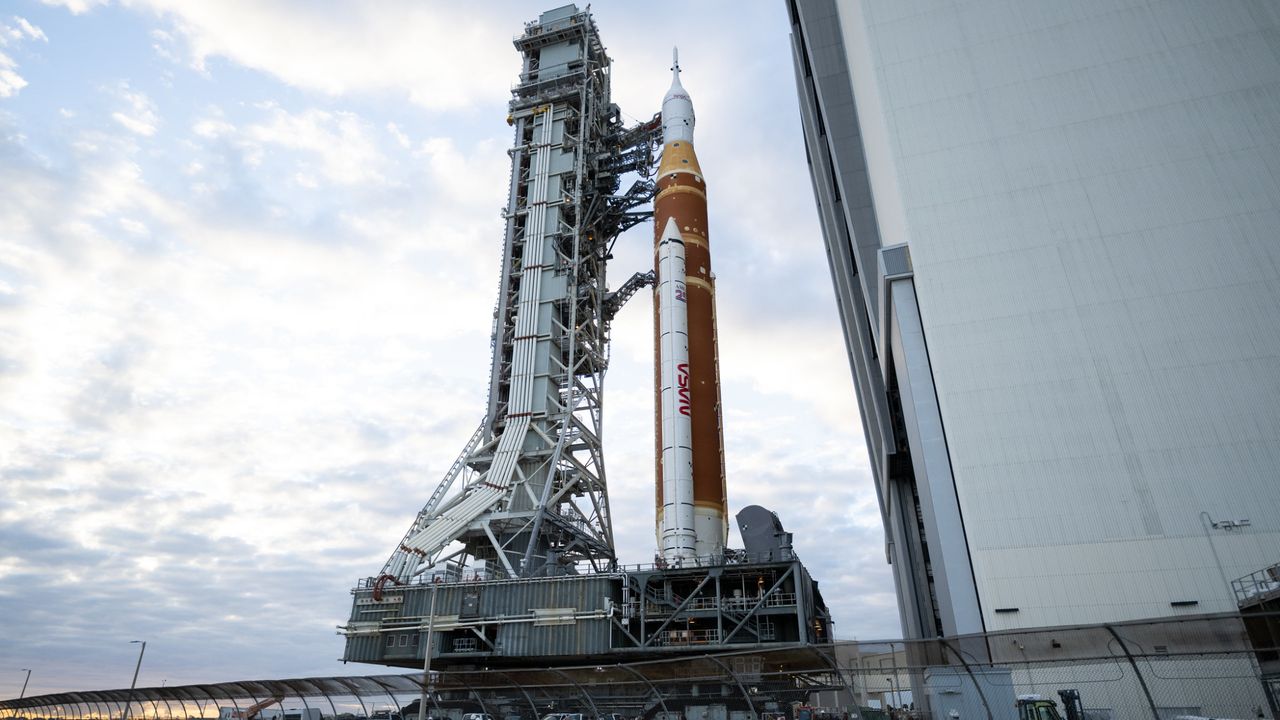
NASA has commenced preparations for its next lunar mission by rolling the Artemis 2 rocket to the launch pad at Cape Canaveral, Florida. This significant step marks the agency’s efforts to return humans to the moon, with a targeted launch window opening in early February 2024.
The rocket, known as the Space Launch System (SLS), departed the Vehicle Assembly Building (VAB) at Kennedy Space Center (KSC) on the morning of January 17, 2024. This journey, spanning approximately 4 miles (6.4 kilometers) to Launch Complex-39B (LC-39B), began at 07:04 EST (1204 GMT). Engineers have dedicated the past 18 months to constructing the Artemis 2 SLS, which is now fully assembled and ready for its mission.
Standing at an impressive height of 322 feet (98 meters) and weighing around 2,870 tons (2,600 metric tons) when fully fueled, the SLS is powered by two solid rocket boosters and four RS-25 engines. Together, these components generate a staggering 8.8 million pounds of thrust at liftoff, propelling the upper stages and the Orion crew capsule into space.
The massive vehicle is currently moving at a slow pace of less than 1 mph (1.6 kph), and the journey to the launch pad is expected to take between eight to ten hours. Once situated at LC-39B, NASA will conduct system integrations and vehicle checkouts over the next few weeks. This will culminate in a wet dress rehearsal, scheduled for February 2, which simulates a launch countdown with a fully fueled rocket.
NASA aims to launch Artemis 2 as early as February 6, 2024. This mission will carry four astronauts, including NASA crew members Reid Wiseman, Victor Glover, Christina Koch, and Jeremy Hansen from the Canadian Space Agency. They will embark on a ten-day mission that will take them around the moon.
The specific launch date will depend on the outcomes of system checks upon reaching the launch pad. Backup opportunities are available through February 11, with additional windows identified for March and April.
Artemis 2 represents the second phase of NASA’s Artemis program and will be the first mission to carry a crew aboard the Orion spacecraft. The previous mission, Artemis 1, launched successfully in November 2022 after an extended testing campaign. NASA officials expressed confidence that Artemis 2 will proceed without the extensive delays experienced during the previous mission.
Upon launch, the SLS will place Orion into Earth orbit, where the crew will perform necessary systems checks before executing a translunar injection burn. This maneuver will set the spacecraft on a course for the moon, utilizing SLS’s interim cryogenic propulsion stage.
The mission will follow a “free-return trajectory,” allowing the Orion capsule to loop around the moon and return to Earth without entering lunar orbit. This flight path ensures the crew’s safety, mitigating the risk of being stranded due to any potential anomalies.
Artemis 2 is a critical step toward NASA’s long-term goal of establishing a presence on the lunar surface, particularly in the moon’s south polar region. The subsequent Artemis 3 mission is designed for a lunar landing but will move forward only if Artemis 2 is successful.
In preparation for their mission, the Artemis 2 crew has been training at KSC, conducting launch-day rehearsals over recent months. They were present to witness the rocket’s rollout for the first time, marking an exciting moment in their journey to the moon.